Speed Bumps at Housing Authorities: Placement & Plow Clearance - Poughkeepsie
Key Takeaways
- Before picking a device, confirm who controls the roadway and which city approvals apply to public streets, sidewalks, or rights-of-way near the property
- Short speed bumps generally suit very low-speed parking areas, while longer speed humps may fit internal residential drives instead
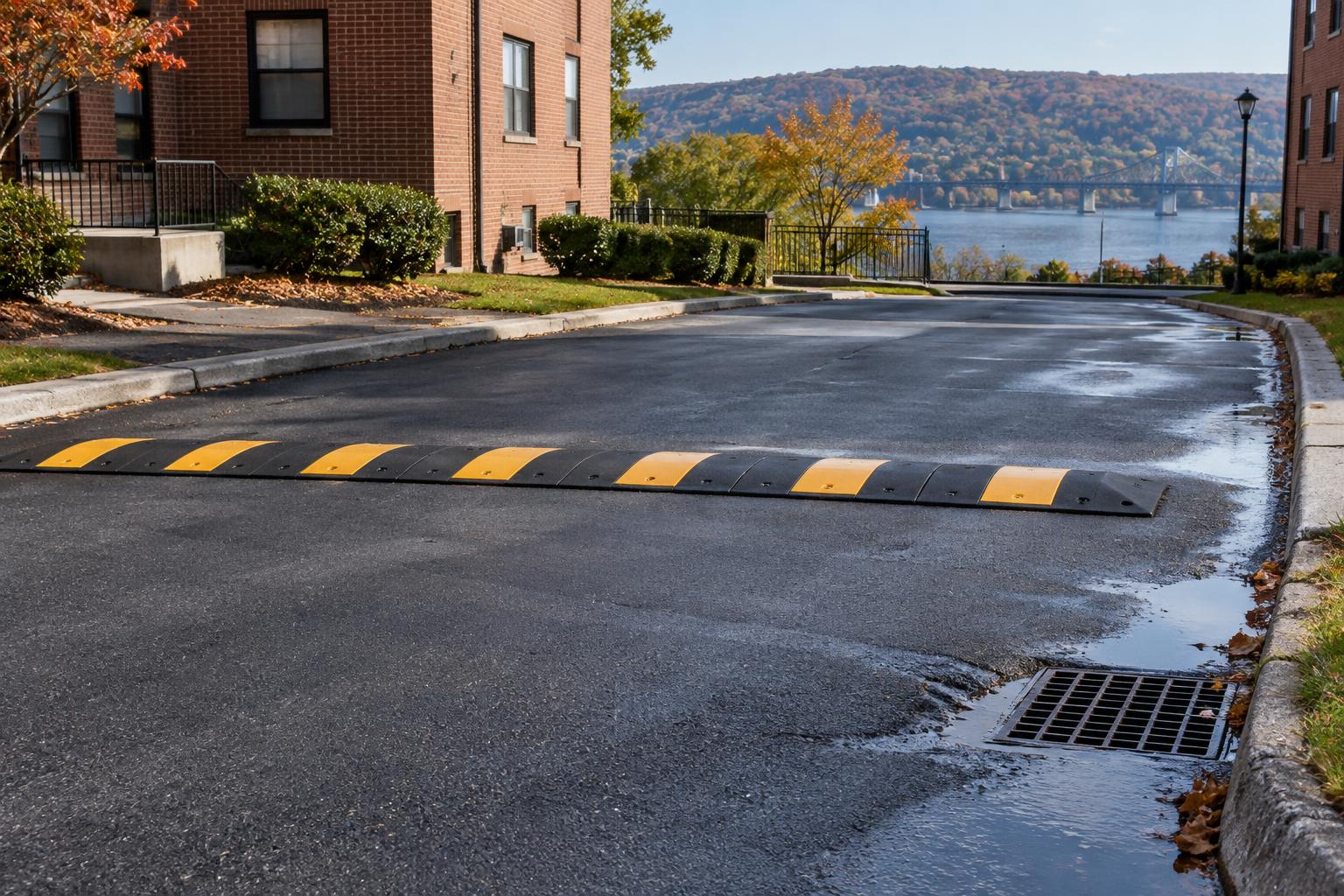
- A raised device can redirect water toward walkways, entrances, or parking spaces, so drainage needs checking at every proposed location
- Fire, ambulance, sanitation, snow-removal, and delivery operators should review proposed locations before construction, especially where a drive is the only access route
- A written scope covering device type, placement, drainage, signage, and phasing keeps a housing authority's traffic-calming project on track from approval through winter inspection
Traffic-calming requests at a Poughkeepsie housing property usually start the same way: residents report cars moving too fast through a drive or parking area, and someone asks for speed bumps. That request deserves a careful look before any pavement gets touched, because the wrong device in the wrong spot can create new problems with drainage, snow removal, or emergency access.
Why One-Device-Fits-All Fails Housing Sites
A single parking aisle, an internal residential drive, and a fire-apparatus access lane all behave differently under traffic, and each calls for its own review. Ordering a standard speed bump for every spot ignores how vehicle speed, pedestrian routes, drainage, and winter plowing interact at that specific site. A property with one shared entrance has different constraints than a sprawling campus with multiple building clusters, so the plan has to start with the site itself rather than a product list.
Residents describing speeding may actually be describing a blind corner, a confusing parking layout, or a driver cutting through where there's no clear path. A guide to speed bumps and traffic calming for public housing authorities in the City of Poughkeepsie walks through how placement, drainage, signage, and winter operations fit together, worth reviewing before any device gets ordered. Getting the diagnosis right before choosing a raised device saves both money and rework.
Confirm Who Controls the Roadway First
Ownership of the pavement does not automatically settle every approval question. A housing authority may control most of its internal drives, but where those drives meet a public street, or where a sidewalk or right-of-way is involved, additional city review can apply.
Separate Housing Property From Public Streets and Sidewalks
Before selecting a device, map which segments are fully under housing-authority control and which touch a public street, sidewalk, or right-of-way. The City of Poughkeepsie building or engineering department can clarify which reviews apply and whether another department needs to sign off. Assuming a device can simply extend onto a public approach, without checking first, risks having to redo the work later.
Watch Traffic Before Picking a Device
Speeding complaints and visibility problems can look similar from a distance, so it helps to actually watch the location during the times residents mention: school pickup, evening arrivals, deliveries, or trash collection. Measured observations separate a true speed issue from a blind turn near a building entrance or a parking area where drivers cut through unpredictably. That distinction changes what kind of fix makes sense, whether it's a raised device, a striping change, or better sight lines.
Match the Device to the Drive
The terms speed bump and speed hump get used interchangeably in casual conversation, but the engineering differences matter for how a vehicle crosses them and where they belong.
Bumps, Humps, Tables, and Cushions Compared
Each device profile serves a different kind of traffic and location:
- Short speed bumps create an abrupt vertical movement and generally fit very low-speed parking aisles where vehicles already crawl along.
- Speed humps use a longer, rounded profile that spreads the rise and fall over more distance, making them a better fit for internal residential drives after review of grades and drainage.
- Speed tables use ramps and a flatter top, and may work well for broader traffic-calming locations, though a table meant to double as a pedestrian crossing needs its own accessibility and visibility review.
- Speed cushions leave gaps between raised sections so some wider-track vehicles can pass through more smoothly, though suitability depends on actual vehicle dimensions at the property.
- Removable manufactured devices can support a trial installation in a parking lot, but anchoring, winter removal, and storage all need planning ahead of purchase.
Striping and circulation changes do not physically slow a car on their own, but clearer travel paths and parking setbacks can reinforce a raised treatment and make driver behavior more predictable.
Speed and Spacing Limits That Apply
Speed humps are generally considered appropriate only where the posted speed limit sits at 30 mph or below, and some jurisdictions set an even lower ceiling. Placement matters just as much as the device itself: a hump is typically placed midblock rather than close to an intersection, with cited examples of 150 feet from an unsignalized intersection and 250 feet from a signalized one, though local criteria can differ. For spacing between devices, NACTO recommends keeping vertical speed controls no more than 500 feet apart to maintain an 85th-percentile speed in the 25 to 35 mph range, with closer spacing producing a bigger speed reduction. None of these figures substitute for a site-specific engineering review, but they give a housing authority a sense of what a reasonable layout looks like.
Check Pavement and Drainage at Each Spot
A raised device is only as reliable as the pavement underneath it. Walking each proposed location, along with the approaches on both sides, can reveal loose aggregate, open cracks, potholes, or settled patch areas that need repair before anything gets installed on top. Widespread interconnected cracking or repeated depressions can point to weaker material below the surface, worth confirming with test openings rather than guessing from the surface alone.
Drainage deserves equal attention, and ideally gets checked during or right after rain. Water lines, sediment trails, and puddling show how runoff actually moves across a drive, and on a sloped property, a raised device can act like a small dam that pushes water toward a doorway, sidewalk, or parking space it never used to reach. Guidance on traffic-calming measures notes that speed humps can alter roadway drainage and recommends reviewing drainage characteristics, including catch basins, channels, gutters, and trench drains, before finalizing a design. Skipping this step risks solving one problem while creating another.
Protect Pedestrian Routes and Emergency Access
Residents walk routes that formal sidewalks don't always capture, from mailbox clusters to laundry rooms to bus stops, and those paths need protecting just as much as the roadway does.
Keep Raised Devices Off Accessible Paths
Painting stripes across a speed hump does not make it a safe crosswalk. Raised vehicle devices should stay off accessible pedestrian routes unless the whole treatment, including ramp transitions, slopes, drainage, and any required detectable warnings, is specifically engineered as a crossing. Mapping where residents using wheelchairs, walkers, or strollers actually travel helps avoid forcing a longer detour that nobody planned for.
Review Placement With Fire, Sanitation, and Plow Crews
Speed humps are generally suited to residential local streets but are generally not recommended on primary emergency-vehicle routes, since fire apparatus and ambulances must cross them at reduced speed. One fact sheet on speed humps reports delays of one to nine seconds per standard hump depending on the vehicle and desired travel speed, which sounds small until a drive is the only access route to a building. Reviewing proposed locations with fire, sanitation, snow-removal, and accessible-transportation operators before construction can catch conflicts that aren't obvious from a site plan alone, and their feedback may change the device type, spacing, or exact placement.
Plan for Hudson Valley Winters
Dutchess County's freeze-thaw cycles can let water enter pavement openings, freeze, and widen any existing damage, so spring often reveals problems that weren't visible in October. A post-winter inspection, rather than an assumption that everything survived intact, is the more reliable approach.
Alerting Plow Operators to Device Locations
Snow-removal crews need to know a device's finished profile and exact location well before the first storm. Design guidance calls for advance warning to snowplow operators along with signage or other methods to alert them to raised speed reducers, and mitigations for equipment damage can include rubber-tipped plows, gently sloped devices, or slightly raising the plow blade at the device location. Well-designed speed humps are meant to let plows pass over them without major impedance, and a sign posted next to each hump can help maintain that warning through repeated snow events.
Post-Winter Inspection of Surfaces and Markings
Plowing and winter grit wear down pavement markings, while salt and moisture can affect exposed hardware on manufactured devices and any already-damaged asphalt. Scheduling a walk-through once the snow clears, checking markings, anchors, and surface condition, keeps small issues from turning into bigger repairs by the following winter.
Build a Scope That Covers Every Detail
A written scope is what lets every bidder price the same finished result, and for traffic calming that means a location plan tied to an approved device detail. The scope should spell out device type, material, dimensions, and profile at each location; pavement repair limits and anchoring requirements; drainage provisions and protection of utility covers; required signs and pavement markings; removal of conflicting old markings; construction phases and resident access arrangements; and inspection responsibilities through to final acceptance. Leaving any of these out invites mismatched bids and disputes once work is underway, so it pays to spell out responsibility for design, permits, and agency coordination up front rather than leaving it to be sorted out mid-project.
Phase Work Without Disrupting Residents
Before scheduling begins, gathering a current site plan, delivery schedules, resident accommodation needs, and service-provider contacts makes the phasing plan far easier to manage. Notifying residents through the authority's usual communication channels, showing affected parking spaces, walking routes, and work periods, keeps surprises to a minimum. Working by building cluster or circulation segment, rather than closing two routes residents rely on as alternatives to each other, reduces the disruption of any single phase. A protected, usable pedestrian route through construction matters just as much as the finished product, since directing people through an active equipment path creates its own hazard.
Measure Results Before Adding More Devices
Once the devices are in and the markings are down, the real test is whether conditions actually changed. Comparing vehicle behavior, resident feedback, bypassing patterns, drainage performance, and pavement condition before and after installation gives a housing authority something concrete to evaluate rather than a general impression. If a problem shifts to another aisle or driveway after installation, revisiting the overall circulation plan makes more sense than reflexively adding another device in the new location.
Coordinated Planning Protects Residents Year-Round
Getting traffic calming right at a public housing property means treating placement, drainage, pedestrian routes, emergency access, and winter operations as one connected plan rather than a series of separate decisions. A device chosen in isolation, without checking who maintains the roadway, how water moves across it, or whether a plow can clear it safely, tends to create new maintenance demands even when it slows traffic. For a Poughkeepsie housing authority weighing options this season, working through a traffic-calming plan built around the property's actual drainage, pedestrian routes, and plow operations creates a more durable path to calmer, safer drives year-round.
Company: Avello Asphalt & Construction Corp City: Poughkeepsie Address: 141 Daley Road Website: https://www.avelloasphalt.com
Mentioned in this blog post: City of Poughkeepsie service area, Poughkeepsie service area, Purchase service area
Have a property like this?
Tell us what you're seeing. We'll walk the site, explain the options plainly, and give you a clear scope.
Related Avello guidance
More blog posts
- Does Restriping Fix ADA Bank Parking? - East Fishkill Paving Contractor Explains
- 10-Year Asphalt Pavement Plan for Office Parks - Poughkeepsie Paving Contractor
- Can a Medical Office Stay Open During Paving? Fishkill Contractor Explains
- What to Check Before Approving a Pre-Winter Crack Filling Bid in Dutchess County