For a Hopewell Junction retail plaza, mill and overlay fits pavement with dependable underlying support and mostly surface-level wear. Full reconstruction fits areas where the foundation is weak, movement is widespread, or elevations need substantial correction. Many properties need a combination rather than one treatment across the entire lot. The best decision comes from mapping distress, checking pavement layers, and matching the work to customer traffic and delivery routes. This guide explains the investigation, realistic options, tenant-friendly sequencing, seasonal considerations, and written scope needed to make that choice with confidence.
Mill and overlay or full reconstruction: what fits retail plazas in Hopewell Junction?
Choose mill and overlay when the existing pavement still has sound support and the main problems are in its upper asphalt layers. Choose full reconstruction where damaged asphalt, weak underlying material, or substantial grading problems prevent a surface treatment from doing its job. For many Hopewell Junction retail plazas, the practical answer is a mapped combination: reconstruct the weak areas and mill and overlay the sound ones.
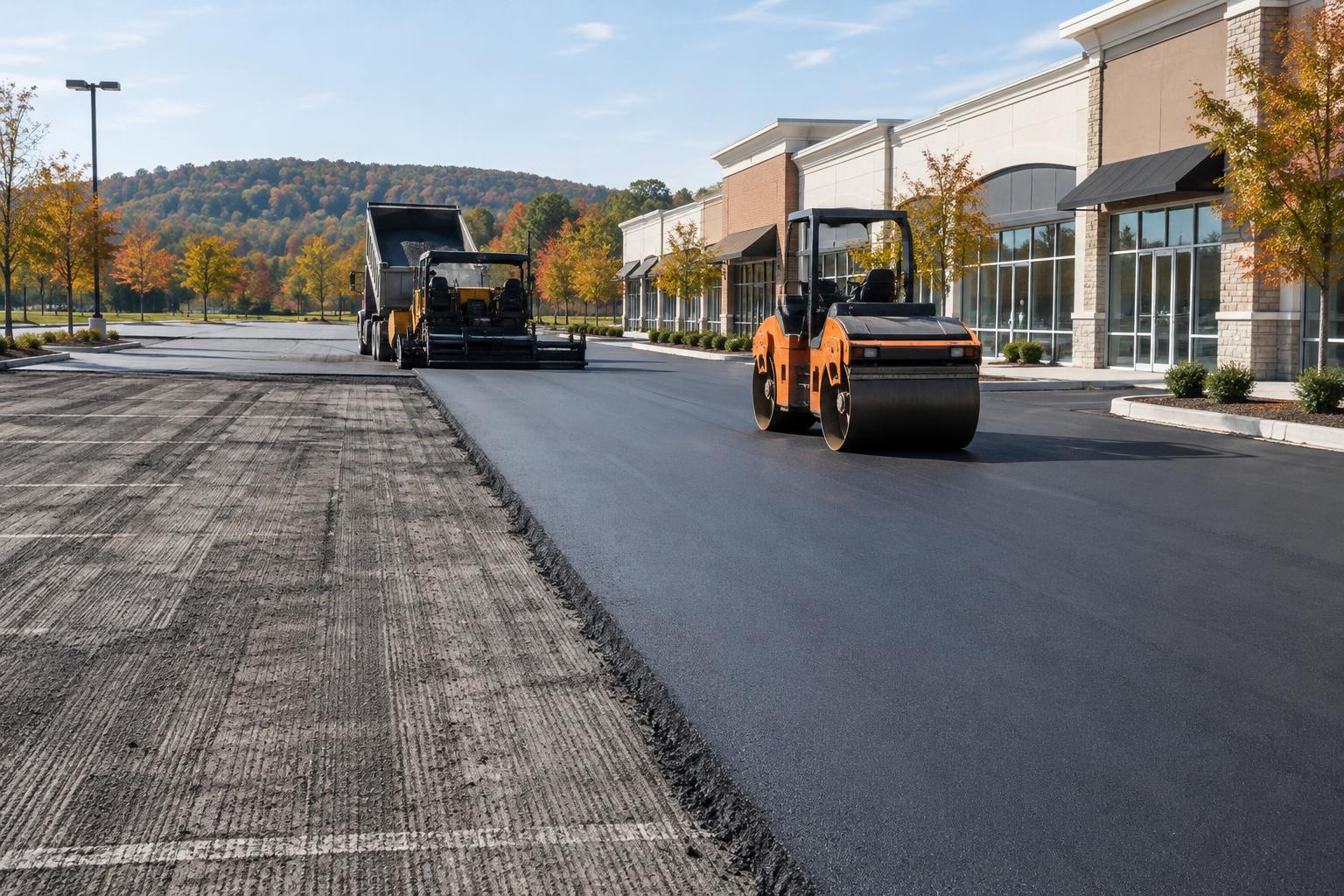
Milling removes a controlled depth of existing asphalt before new asphalt is placed. It helps preserve workable elevations at curbs, storefront approaches, and drainage structures rather than continually raising the lot. Reconstruction removes the pavement through the affected layers and repairs or replaces the supporting material as needed before building the pavement back.
The deciding question is not simply whether the lot looks old. It is whether the material beneath the proposed new surface can carry the traffic using that particular area. Customer stalls, delivery turns, dumpster approaches, and the main entrance may have very different answers.
A plaza also needs a business decision, not just a paving decision. Owners should weigh construction access, recurring repair locations, future tenant changes, and any planned utility work alongside pavement condition. Replacing sound pavement without a reason can be unnecessary; covering unstable pavement leaves the underlying cause in place.
At Avello, we approach this as a commercial paving assessment, with recommendations tied to defined areas and observed conditions. That keeps the discussion focused on what the property needs instead of treating every square foot as identical.
Read the whole plaza, then verify what is beneath the surface
Start with a walk-through that follows how the plaza operates. Trace the customer entrance, accessible parking routes, storefront crossings, delivery paths, and service areas. Mark distress on a simple site plan so a contractor can connect each proposed repair with an actual location.
- Surface wear: loose aggregate, rough texture, or shallow deterioration may be limited to the upper asphalt.
- Connected cracking: closely spaced cracks forming small shapes can indicate repeated movement under traffic.
- Ruts and depressions: determine whether the asphalt itself has deformed or the support beneath it has settled.
- Recurring patches: repeated repairs in the same place deserve investigation below the surface.
- Edge movement: broken pavement beside an unconfined shoulder may need support and edge correction.
- Elevation conflicts: check raised patches, drain rims, curb ramps, and transitions at storefront approaches.
These clues guide the investigation; they do not prove a diagnosis by themselves. A rut can come from an unstable asphalt layer, weak aggregate beneath it, or both. Likewise, a dry-looking lot may still have wet material below the pavement.
Where the treatment choice is uncertain, pavement cores can show asphalt thickness, layer separation, and the depth of cracking. Test pits can expose the aggregate base—the stone foundation beneath the asphalt—and the soil below it. An engineer may recommend additional testing where the extent of movement or future loading warrants it.
Bring repair records and observations from wet weather or spring thaw to this review. Note where water lingers, where pavement softens, and which repairs have held up. Testing should target both visibly distressed zones and representative sound areas, rather than assuming the entire plaza shares one condition.
Match each retail area to a realistic treatment
The useful comparison includes more than two choices. Depending on the findings, a plaza may need localized repairs, selective reconstruction followed by milling and paving, or reconstruction across a larger area. The proposal should explain why each treatment fits its assigned zone.
- Localized asphalt repairs fit isolated defects when surrounding pavement and support remain serviceable. They do not renew the entire driving surface.
- Mill and overlay fits broadly sound pavement with surface deterioration, suitable remaining asphalt, and elevations that can be maintained or modestly corrected.
- Selective full-depth repair plus mill and overlay fits a generally sound lot with identifiable weak pockets. Repair those pockets before placing the common new surface.
- Area-wide reconstruction fits widespread support problems, substantial settlement, or a layout and grading change that cannot reasonably be achieved within the existing pavement layers.
- An overlay without milling may fit some sound areas, but only when added height will not compromise drains, curbs, doors, or accessible routes.
A delivery lane does not automatically require reconstruction because trucks use it. Its condition, existing structure, and expected traffic determine the work. Conversely, a lightly used parking bay may need deeper repair if buried utility work has settled beneath it.
For a mixed approach, define the repair boundaries and how rebuilt sections will join retained pavement. Small scattered repairs can become impractical if investigation shows that weak material extends between them. The scope needs a way to adjust those limits with owner approval.
Compare proposals using the same treatment map, assumptions, and expected use. A lower initial price means little if one proposal excludes base repair or leaves critical elevation conflicts unresolved. No treatment supports a credible service-life promise without considering construction quality, drainage, loading, and future upkeep.
Build Hudson Valley weather and sloped-site conditions into the choice
Freeze-thaw cycles matter because water in and beneath the pavement can freeze, expand, and then leave weakened support as it thaws. A smooth new surface cannot compensate for persistently wet, unstable material below it. Where that condition is present, the repair needs to address its source and affected layers.
Spring thaw can make marginal support easier to identify, but it can also make excavation and compaction more difficult. Compaction means pressing the material into a stable, dense layer. A contractor should evaluate actual ground conditions before covering an area that is still soft or saturated.
April through November is a useful planning window for Hudson Valley paving, not a promise that every day within it is suitable. Rain, ground conditions, air and surface temperatures, asphalt availability, and the proposed layer thickness all influence placement. Late-season work needs particular attention to how quickly asphalt cools before rolling is complete.
On sloped Hopewell Junction properties, review where runoff travels across entrances, parking rows, and pedestrian crossings. Milling may improve a limited transition, but it cannot create a workable drainage route when the existing elevations leave nowhere for water to go. Larger grade corrections may require reconstruction in selected areas and a designed drainage solution.
Plowing and winter salt use also belong in the review. Raised patches and uneven transitions can catch plow blades, while meltwater and salty slush can enter existing openings. Identify snow-storage areas so meltwater is not routinely directed across accessible routes or toward already vulnerable pavement.
Confirm review and permit requirements with the applicable town building or engineering department. For properties within the Town of East Fishkill, that means checking with the town; frontage or entrance work affecting a county or state road may also involve the road owner.
Phase construction around storefront access, deliveries, and safe circulation
Keeping a plaza operating means planning complete customer routes, not merely leaving some parking spaces open. Every active phase needs a clear way to enter, park, walk to open businesses, and exit. Accessible access, emergency access, and delivery movements must be considered together.
- Confirm the phase plan with property management and tenants. Identify delivery windows, opening hours, pedestrian routes, and any work requiring a temporary entrance closure.
- Establish barriers, signs, and designated crossings before equipment arrives. Move parked vehicles and keep construction movements separate from customers.
- Complete utility, drainage, and deep pavement repairs in the affected phase. Verify exposed support before rebuilding covered layers.
- Mill the designated pavement and inspect what is revealed. Adjust repair limits only through the agreed approval process.
- Clean the prepared surface, apply the specified bonding coat, and place and compact the new asphalt. The bonding coat helps the asphalt layers adhere.
- Check transitions, complete required markings and access provisions, and reopen the phase only when the contractor confirms it is suitable for traffic.
Avoid leaving customers to cross active milling areas or step over abrupt pavement edges. If an intermediate surface must remain in service, its condition, temporary transitions, signs, and permitted traffic should be addressed explicitly. Some narrow entrances cannot safely support simultaneous public access and construction.
Phase size is a tradeoff. Smaller sections preserve more operating space but create additional equipment moves and construction joints, where separate paving placements meet. Larger sections can simplify paving but may require more tenant coordination and temporary parking changes.
Off-hours work can help some plazas, but it is not automatically the best choice. Lighting, noise rules, asphalt supply, crew access, and safe overnight reopening all need confirmation. A weather contingency should explain which areas remain available if a planned paving day moves.
Seeing this on your property?
Avello walks the lot, scores the pavement, and gives you written findings — free, no obligation.
Require a written scope that separates known work from hidden conditions
A clear scope makes the recommendation measurable. It should identify the limits of milling, overlay, and reconstruction on a plan instead of relying on phrases such as “repair as needed.” Each bidder should be pricing the same intended result.
- A treatment map with quantities, phase boundaries, and areas excluded from the work.
- Specified milling depths and the elevations to be maintained at pavement tie-ins, curbs, drains, and pedestrian approaches.
- The asphalt mixture and compacted thickness for each layer, plus the aggregate base requirements where reconstruction is planned.
- Criteria for removing unsuitable material, rebuilding support, and checking compaction or other acceptance requirements.
- Drainage adjustments, utility structure work, pavement edge support, and connections between new and retained pavement.
- Accessible parking, access aisles, routes, signs, and striping responsibilities, including any required design or compliance review.
- Traffic control, temporary access, tenant coordination, cleanup, and responsibilities for permit applications.
- A documented process for concealed conditions, including pricing terms and who may authorize additional work.
Depth deserves particular attention. The thickness of loose asphalt before rolling is not the same as its finished, compacted thickness. Likewise, a note calling for base replacement should explain the intended material and depth, while acknowledging that actual excavation may change if unsuitable conditions extend farther.
The scope should also describe how completion will be reviewed. That may include a joint walk-through, examination of transitions and drainage, confirmation of markings, and records of approved changes. Where engineering or testing is required, identify who provides it and when inspections must occur.
Commercial asphalt services are easier to compare when the contractor explains the intended construction outcome, not just the equipment arriving onsite. Equipment supports the work; it does not replace a treatment rationale or a clear acceptance standard.
Prepare tenant information and avoid decisions based only on appearance
Before requesting final proposals, assemble a site plan, repair history, available utility information, and tenant operating requirements. Identify known private utilities, irrigation, lighting feeds, and planned underground work. Required utility locating should occur before excavation, with private-system locating addressed separately where needed.
Ask tenants about deliveries, customer pickup areas, busiest trading periods, and any access needs that are not obvious during a daytime visit. Give the contractor one management contact who can make decisions and a separate contact if that person is unavailable. Unclear authority can leave exposed repair areas waiting for instructions.
Also review foreseeable property changes. A new tenant may alter delivery frequency, waste collection, or traffic circulation. If underground services will be installed soon, coordinate that work before placing the finished pavement rather than cutting through it afterward.
- Choosing reconstruction solely because the surface looks rough, without checking whether the underlying structure is sound.
- Choosing an overlay solely because it causes less disruption, despite documented support problems.
- Comparing lump-sum proposals that use different repair limits, layer thicknesses, or access assumptions.
- Treating striping as a cosmetic afterthought when the layout affects accessible routes and circulation.
- Scheduling every phase tightly without room for weather, concealed conditions, or tenant delivery changes.
Do not assume that new asphalt alone will correct an inaccessible route or an awkward storefront crossing. Those issues may involve slopes, geometry, curb ramps, or adjoining concrete. Identify them during planning so the pavement scope supports the intended route rather than preserving an unresolved conflict.
Use this short checklist before approving the plaza paving plan
The right proposal should make the choice understandable without asking an owner to become a pavement specialist. You should be able to point to each area on the plan, explain why its treatment fits, and describe how tenants and customers will use the property during construction.
- Condition: Have surface defects been distinguished from deeper support problems?
- Evidence: Are cores, test pits, or engineering review included where the decision remains uncertain?
- Treatment: Does each mapped area have a defined repair, overlay, or reconstruction approach?
- Water and elevations: Will the finished grades work at drains, entrances, curbs, and accessible routes?
- Operations: Are customer access, deliveries, temporary parking, and emergency access covered for every phase?
- Scope: Are materials, compacted thicknesses, exclusions, and concealed-condition approvals written down?
- Readiness: Are tenant notices, vehicle removal, utility coordination, permits, and weather contingencies assigned?
For Hopewell Junction retail plazas, mill and overlay is a strong candidate when the existing pavement remains a dependable platform. Reconstruction belongs where the platform itself needs rebuilding or where necessary elevation changes demand deeper work. A mixed plan is often the most sensible way to respect those differences.
The final decision should connect pavement evidence with the property's daily business needs. That is the useful distinction between simply purchasing a new surface and planning a workable commercial paving project. Our milling-and-paving and commercial-paving approach starts with that connection.
To discuss your plaza's options, call Avello Asphalt & Construction at 845-454-3650 or request a free quote.
2026 Commercial Pavement Budget Planner
A contractor-built worksheet for budgeting parking lot and roadway work: cost ranges by scope, a condition-scoring sheet, phasing guidance, a bid-comparison checklist, and the questions to ask before you sign.
Common questions
Can our stores stay open during milling and paving?+
Often, the work can be divided into phases so stores retain usable access, but that depends on the layout. A plaza with one narrow entrance may need temporary closures that a property with multiple entrances can avoid. The plan should show customer parking, accessible pedestrian routes, deliveries, and emergency access for each phase. Confirm any unavoidable closure with tenants before scheduling.
Does connected cracking mean the entire parking lot needs reconstruction?+
No. Connected cracking is a reason to investigate, not an automatic instruction to replace the whole lot. Its depth, extent, and relationship to traffic or wet areas matter. Cores and selected test pits can help distinguish localized structural distress from broader problems. Where weak areas are isolated, full-depth repairs followed by milling and overlay elsewhere may be appropriate.
Why mill the pavement instead of adding asphalt over everything?+
Milling removes existing asphalt so new pavement can be installed without simply raising the lot. That matters near storefront approaches, curbs, drain rims, and accessible routes. It can also remove deteriorated upper material and create a prepared surface for the new layer. Milling does not repair weak support below its removal depth, so deeper repairs may still be necessary.
How soon can customers and delivery trucks use the new pavement?+
There is no single reopening time that fits every placement. Asphalt temperature, weather, layer thickness, traffic loading, and the type of turning movement all matter. The contractor should establish reopening criteria and confirm when each phase is ready. Heavy deliveries and tight turns may need different arrangements from ordinary customer traffic. Barriers and tenant notices should remain consistent with those instructions.
What should a paving company inspect before giving us a recommendation?+
A useful inspection covers distress patterns, past repairs, traffic routes, pavement edges, drainage, and elevations at structures and pedestrian connections. The company should also ask about tenant hours, deliveries, utility plans, and recurring trouble spots. Where surface observations cannot establish the condition of underlying layers, the recommendation should explain what testing is needed rather than presenting an unsupported treatment as certain.
Can we reconstruct the delivery area now and handle customer parking later?+
Yes, if the areas can be separated without creating unsafe transitions or interfering with drainage and access. The first phase should be designed with the later work in mind, including finished elevations and joint locations. Keep construction traffic from unnecessarily stressing completed pavement. A staged plan should also account for repeated mobilization, temporary markings, and how customers will navigate the property between projects.
Avello provides free commercial pavement assessments across the Hudson Valley. No obligation — you keep the documentation either way.