10-Year Asphalt Pavement Plan for Office Parks - Poughkeepsie Paving Contractor
Avello's take
This item looks at pavement planning for office parks in the Town of Poughkeepsie. It explains why tracking conditions across separate pavement zones is more useful than setting a fixed replacement date for the whole lot. We see a practical thread throughout: document what is happening, compare conditions over time, and match repairs to the problem. The guide also covers drainage concerns, treatment choices, and planning work around tenant parking, deliveries, and fire department access.
For Hudson Valley property owners and managers, that approach gives budget decisions a clearer basis. Dated photos and repair records help explain why an entrance needs attention while a parking bay can wait. We view a labeled pavement map and a consistent inspection record as a sensible starting point. Checking conditions after winter and before cold weather helps keep the plan grounded in what the property actually needs, including drainage issues that surface work alone may not address.
Key Takeaways
- A useful 10-year pavement plan for a Town of Poughkeepsie office park works zone by zone based on documented condition rather than locking in one replacement date for the entire lot
- Dividing a property into named pavement zones with dated photos and repair records lets a manager compare conditions year over year and defend budget decisions
- Treatment choices range from crack sealing and patching up to milling, resurfacing, or full reconstruction, and the right fit depends on the condition below the surface, not just its appearance on top
- Drainage problems like recurring ponding or soft spots often need to be solved before any surface treatment is chosen, since paving over a wet area rarely fixes the real cause
- Phasing construction around tenant parking, deliveries, and fire department access can keep an office park running smoothly during paving work, and the written scope details that process below
A parking lot that looks fine in June can hide a drainage problem that shows up every March. For an office park in the Town of Poughkeepsie, a 10-year pavement plan works best when it treats that reality seriously, tracking each section of pavement on its own timeline instead of betting everything on one big repaving event a decade from now.
A Rolling Plan, Not a Fixed Date
Picking a single year and planning a full-lot replacement is an understandable instinct, but it rarely matches how asphalt actually wears. A drive aisle that carries daily delivery trucks will age differently than a back parking bay used only during busy weeks. Locking every zone into the same ten-year countdown means some areas get renewed before they need it, while others quietly deteriorate past the point where a simple repair would have worked.
A more useful approach treats the ten years as a rolling window that gets reviewed annually rather than a deadline circled on a calendar. Year one focuses on documenting what's actually happening across the property and fixing anything urgent. The years that follow shift priorities based on what inspections turn up, not on what was guessed at the start. Avello Asphalt & Construction Corp's guide to building a 10-year pavement plan for Town of Poughkeepsie office parks lays out this kind of year-by-year framework in more detail.
That framework treats early planning windows as categories for action, not promises about how long pavement will last. A badly worn entrance might need reconstruction within the first year, while a lightly used bay in the back of the lot might not need major work during the entire decade. The real question driving the schedule is what evidence would justify moving a project forward or holding it back.
Map Pavement Zones and Track Them Over Time
Before any repair gets scheduled, the property needs a clear picture of what it's working with. That starts with dividing the pavement into zones that can be tracked individually, then checking on them consistently enough to notice real change.
Build a Site Map by Zone
A site map should separate entrances, drive aisles, parking bays, service areas, pedestrian routes, and drainage structures into their own labeled zones. Giving each zone a consistent name or number matters more than it might seem, because it lets a manager compare this year's photos to last year's without guessing which section is which. Over several years, that consistency turns scattered observations into a real condition history.
Rate Each Zone's Condition
Once zones are mapped, each one can be sorted into a simple condition category. A zone might be serviceable, with limited defects that can be handled individually, or repairable, meaning localized damage needs attention while the surrounding pavement still holds up. Other zones may qualify as renewal candidates where wear is spread out, or flagged for investigation when settlement, soft spots, or connected cracking suggest something more serious below the surface. Photographs, repair quantities, and spending should all stay attached to these same zone labels so the record builds on itself year after year rather than starting over each season.
Inspect After Winter and Before Cold Weather
Two inspection windows matter most across the Hudson Valley: right after winter ends and again before the next cold stretch begins. The spring check reveals plow damage, displaced edges, and anything that froze and thawed its way into a bigger problem. The fall check catches what summer traffic added and gets the property ready for another freeze-thaw cycle. Comparing photos from similar conditions each year, especially during spring thaw when saturated ground reveals weak spots that look stable when dry, gives a property manager a dependable basis for revising the plan annually rather than guessing.
Choose the Treatment That Fits the Problem
Matching the right treatment to the actual problem, rather than applying one blanket solution across the whole property, keeps a ten-year plan efficient instead of wasteful.
From Crack Treatment to Reconstruction
The treatment options available span a wide range of severity. Crack treatment suits isolated cracks in pavement that's otherwise stable, though sealing a crack does nothing to fix weak support underneath it. Localized asphalt repair handles potholes and small distressed areas, while full-depth patching reaches damage that extends through the asphalt into its support layer. Resurfacing adds a new wearing surface where the existing base is sound, and milling and resurfacing goes a step further by removing old asphalt first, which helps manage elevations at curbs and drains. Reconstruction is reserved for areas with extensive structural problems that need the pavement section rebuilt from the ground up. For each treatment chosen, it helps to record the reasoning behind it and what would change that recommendation later, so decisions stay traceable instead of mysterious.
Why Drainage Often Comes First
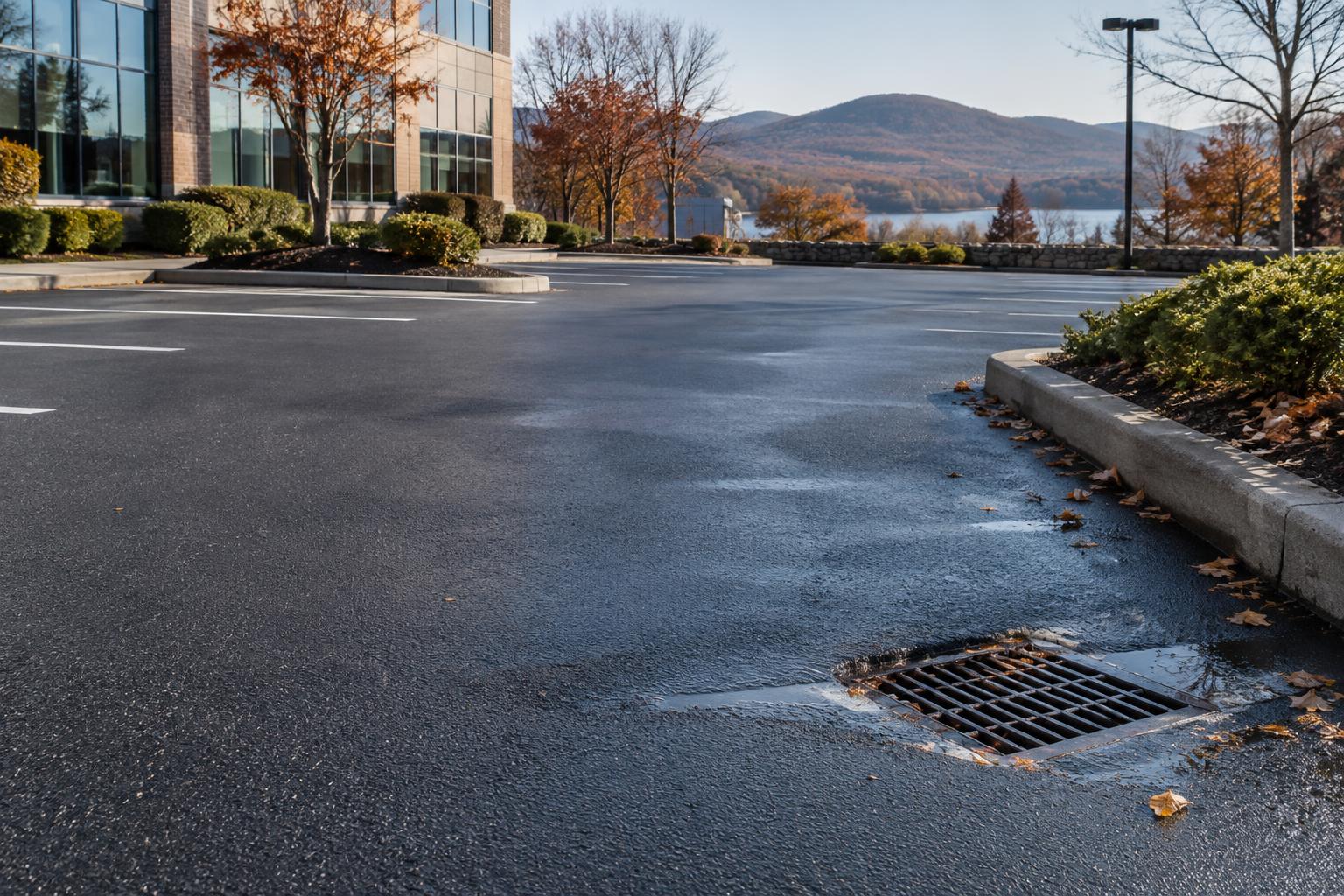
A recurring puddle or soft, sinking spot in the pavement is rarely just a surface problem. Water sitting in the same place year after year usually means something underneath isn't draining the way it should, and paving over that spot without investigating it first tends to produce the same complaint again within a season or two. Checking for blocked inlets, eroded edges, and runoff paths before choosing a surface treatment can save a property from repeating an expensive mistake. On sloped office park sites, tracing water from the uphill boundary down to its intended outlet matters too, since runoff redirected by one repaired zone can end up pooling at a building entrance or a neighboring parking bay instead.
Turn Zones Into a Rolling Budget
Once zones are mapped and treatments are matched to problems, the next step is turning that information into numbers a property manager can actually plan around. A budget that updates itself based on real conditions is far more useful than one built on guesswork five years out.
What Belongs in the Budget Register
A rolling budget register works best as one entry per zone and proposed project, tracking condition, recommended treatment, approximate quantity, target year, dependencies, and the date of the estimate. Spending generally sorts into three buckets: routine care like inspections and crack treatment, localized repairs for defined problem spots, and major renewal covering larger resurfacing or reconstruction work along with related drainage and striping. Near-term budgets should carry more detail and verified quantities, while projects further out can stay labeled as planning allowances that get refined as their year approaches. Keeping a separate, clearly labeled contingency for subsurface uncertainty, with written rules for when it can be used, keeps surprises from derailing the rest of the plan.
Deciding to Move, Defer, or Re-Scope a Project
Every project in the register eventually needs a decision, and that decision should follow the evidence rather than the original schedule. A project might move forward sooner than planned if damage is spreading faster than expected or if a recurring repair has stopped being practical. It might stay on its planned timeline when conditions match what was expected, or get deferred if inspection results still support continued service without leaving a known hazard unresolved. Sometimes a project needs re-scoping entirely, such as when testing reveals weaker support than assumed and a planned resurfacing needs to become a reconstruction instead.
Keep the Office Park Running During Work
An office park can't simply shut its doors during a paving project. Keeping tenants, deliveries, and visitors moving while work happens matters just as much as the paving itself, and it deserves its own section in the plan.
Phasing Around Occupancy and Access
Phasing should start with how the property actually gets used, rather than focusing solely on a count of total parking spaces. Which buildings get early arrivals, late departures, or frequent deliveries? Which zones serve as the only connection between otherwise separate parking areas? Underground utility work should happen before paving covers the affected ground, drainage and deeper repairs should follow a sequence that supports the final grades, and resurfacing should be broken into zones with workable alternate parking and clearly marked pedestrian routes. Closing both sides of an essential connecting aisle at the same time tends to create more disruption than it saves in schedule, so that kind of central zone often deserves its own separate phase.
What a Written Scope Should Cover
A written scope ties the construction plan back to the zone map and the condition records built up over the years. It should spell out mapped work limits and quantities, specified materials and compacted asphalt thicknesses, drainage adjustments, and accessible route requirements affected by the work. It should also cover phasing, temporary traffic control, tenant communication duties, and the criteria for reopening a completed zone. Naming who's authorized to approve changes on the owner's behalf, and requiring documentation of any concealed repairs before they're covered up, keeps the paper trail as reliable as the pavement itself.
A Decade of Decisions Beats One Big Deadline
A ten-year pavement plan earns its value through consistent decisions made year after year, not through a single large project scheduled far in advance. Zones that are tracked, treatments that are matched to actual problems, and a budget that adjusts as conditions change will serve a Town of Poughkeepsie office park better than a plan built around one fixed replacement date.
For property managers ready to start that process, planning pavement work with a clear zone map and a yearly review habit is a practical place to begin.
Company: Avello Asphalt & Construction Corp City: Poughkeepsie Address: 141 Daley Road Website: https://www.avelloasphalt.com
Mentioned in this blog post: Town of Poughkeepsie service area, Poughkeepsie service area
Have a property like this?
Tell us what you're seeing. We'll walk the site, explain the options plainly, and give you a clear scope.
Related Avello guidance
More blog posts
- Speed Bumps at Housing Authorities: Placement & Plow Clearance - Poughkeepsie
- Does Restriping Fix ADA Bank Parking? - East Fishkill Paving Contractor Explains
- Can a Medical Office Stay Open During Paving? Fishkill Contractor Explains
- What to Check Before Approving a Pre-Winter Crack Filling Bid in Dutchess County