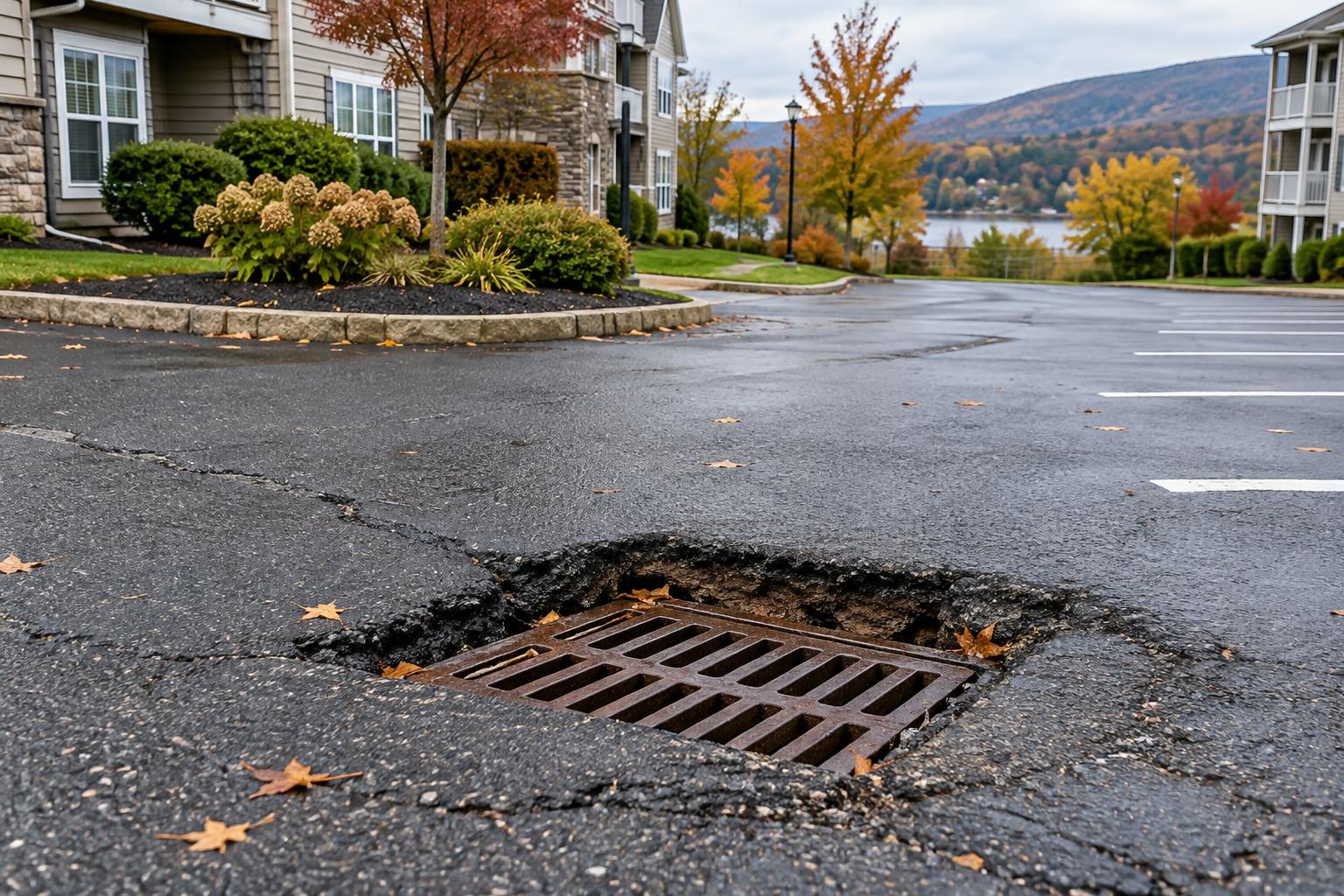
A sinking catch basin can reflect loose pavement around an intact structure, deteriorated supports beneath the grate, or settlement of the entire basin. Each needs a different repair. For Hyde Park HOA and condo properties, a useful assessment separates surface damage from structural movement, checks connected pipes, and confirms that water can still reach and leave the inlet. This guide explains repair choices, resident-access planning, Hudson Valley weather considerations, and the scope details boards need to compare proposals without paying for a surface patch that leaves the underlying problem unresolved.
Sinking catch basins at HOA and condo communities in Hyde Park: causes and repair options
Sinking catch basins usually need one of three repairs: rebuilding the pavement around a stable basin, rebuilding the support beneath its metal frame, or resetting or replacing a basin that has settled. If leaking pipe connections or weak ground caused the movement, those conditions also need correction. Adding asphalt around the grate alone will not fix an unsupported frame or a moving structure.
A catch basin is the drainage structure beneath a surface grate that collects runoff and sends it into connected piping. Its frame supports the grate, while the basin body and foundation carry loads into the ground. The surrounding asphalt has its own stone base and supporting soil, so it can sink even when the basin remains sound.
Common causes include poorly compacted backfill from original construction, deterioration beneath the frame, and soil washing into openings at joints or pipe penetrations. Water can soften the surrounding ground, while traffic repeatedly loads the weakened area. Settlement may also follow utility work near a basin if the excavation was not adequately restored.
For a Hyde Park community, the first decision is therefore diagnostic, not cosmetic: what actually moved, and why? At Avello, we distinguish parking-lot repair from drainage correction, while recognizing that a basin repair may require both. A useful proposal should explain that distinction before recommending how much pavement to remove.
Read the pavement, frame, and basin as separate conditions
Start with a surface inspection from stable pavement, without lifting the grate or stepping onto a visibly displaced frame. Note whether the depression surrounds the basin evenly, follows a pipe trench, or appears only on the traffic side. Photographs from consistent viewpoints help distinguish continuing movement from an old, stable mismatch in elevation.
- An intact, level frame surrounded by depressed asphalt suggests settlement in the pavement base or backfill.
- A tilted frame, rocking grate, or broken support material suggests a frame-support problem.
- Movement of the basin body together with the frame points toward foundation settlement or structural damage.
- A narrow depression following the outlet pipe suggests trench settlement or possible loss of soil near a pipe connection.
- Cracks, open gaps, and repeated patch edges show where water can enter and where earlier repairs may have stopped short.
The contractor should compare grate and pavement elevations, inspect accessible structural surfaces, and check pipe openings for separation or displaced material. Sediment removal may be necessary before the condition can be understood. Camera inspection can help where a buried connection or downstream restriction is suspected; it is not automatically required for every basin.
Watch runoff during ordinary rain from a safe location if possible. Water bypassing the grate is a different issue from water entering freely but backing up inside. Residents and maintenance staff should not enter a basin; entry may involve confined-space hazards and requires appropriate professional procedures.
Match the repair to the part that has lost support
The smallest durable repair is the one that reaches sound material and corrects the source of movement. That boundary may be close to the grate, or it may extend beyond the visible depression. Surface appearance alone cannot establish the excavation limits.
- Localized pavement reconstruction: Appropriate when the basin and frame are stable but nearby asphalt and base have settled. Remove damaged pavement, replace unsuitable material, compact the base, and repave to drain toward the inlet.
- Frame and grate resetting: Appropriate when the basin body is sound but the frame elevation or its supporting assembly needs correction. Rebuild the support with suitable materials and set the frame to the intended finished grade.
- Upper-basin rebuilding: Appropriate when deterioration is concentrated near the top of an otherwise serviceable structure. Reconstruct the affected walls or adjustment assembly rather than relying on asphalt to support the frame.
- Basin resetting or replacement: Appropriate when the body has moved, is substantially damaged, or cannot provide dependable support. Address the foundation and reconnect pipes as part of the work.
- Pipe-connection and drainage correction: Appropriate when open joints, displaced pipes, or unsuitable drainage geometry contribute to settlement. Correct these conditions alongside the structural or pavement repair.
A concrete collar may be appropriate in some designs, but it is not a universal remedy. It still needs reliable support and a detail suited to the structure and traffic. Similarly, resurfacing across the surrounding lot does not repair a deteriorated basin beneath it.
If temporary stabilization is needed before permanent work, the scope should label it clearly and explain its limitations. The board should know what remains unresolved and how the area will be managed until reconstruction.
Account for Hyde Park frost, snow equipment, and sloped drives
Hudson Valley freeze-thaw cycles can move water-bearing ground and widen existing openings around a basin. During spring thaw, soil may lose support as it becomes wet, making a previously modest depression more apparent. An inspection should distinguish seasonal movement from persistent settlement rather than assume every low grate needs the same adjustment.
Plows can strike a raised frame or catch an uneven pavement edge. Salt-laden meltwater can contribute to deterioration of susceptible concrete, mortar, and metal components over time. Ask the snow contractor where blades encounter abrupt transitions and where snow piles release meltwater toward the inlet.
On sloped Hyde Park sites, runoff may approach quickly enough to bypass a grate even when the pipe is open. Raising a frame to match adjacent asphalt without checking the approach grade can make collection worse. Conversely, lowering it too much may create an uncomfortable wheel drop or walking hazard.
Drainage correction may therefore include reshaping the immediate approach, not simply changing the frame height. Larger changes to inlet placement, pipe size, or runoff direction may need engineering review. The goal is to collect water without shifting the problem toward garages, sidewalks, neighboring land, or another low point.
April through November is the usual regional paving planning window, not a promise that every day is suitable. Asphalt availability, temperature, rainfall, and ground conditions govern scheduling. Structural repairs may also need curing time before pavement restoration or reopening, so weather and material requirements belong in the schedule.
Sequence the excavation so residents retain workable access
Catch basin work creates a concentrated excavation, often exactly where vehicles turn or enter a parking aisle. Phasing should revolve around that specific conflict rather than closing more pavement than necessary. A basin beside the only driveway needs a different access plan from one at the end of a spare parking row.
- Confirm ownership, repair limits, utility marking, access restrictions, and any required approvals before excavation.
- Establish barriers, resident notices, alternate parking, and a pedestrian route that does not cross the work zone.
- Sawcut and remove affected pavement, expose the structure, and verify the actual repair condition.
- Repair the foundation, basin, frame support, or pipe connections as required, documenting concealed conditions.
- Place and compact suitable backfill in controlled layers, then rebuild the pavement base.
- Restore asphalt and transitions, allow required curing or cooling, and inspect before reopening.
At multi-basin properties, completing one location before opening another can preserve parking and simplify resident directions. That approach must still account for connected drainage: work at one basin can affect another upstream. Forecast rain may require temporary runoff measures or a change in sequence while the system is open.
Maintain emergency access, refuse collection, deliveries, and accessible routes throughout the agreed phases. Temporary plates or crossings should never be assumed; any such arrangement needs suitable support, loading capacity, and approval for its intended use. The reopening decision should follow the repair materials and site conditions, not just the moment equipment leaves.
Seeing this on your property?
Avello walks the lot, scores the pavement, and gives you written findings — free, no obligation.
Require a written scope that explains both known and hidden work
A useful proposal does more than say “repair catch basin and patch asphalt.” It identifies each basin on a marked plan or photograph and states the observed condition. It should explain which components will remain, which will be rebuilt, and what evidence supports that choice.
Specify proposed removal limits, excavation assumptions, unsuitable-material handling, and the backfill and compaction approach. Pavement restoration should identify base preparation, asphalt materials, placement thicknesses, and tie-ins to existing pavement. Those details should match the actual traffic and supporting ground rather than copy an unrelated paving specification.
- Frame, grate, basin, and pipe-connection repairs, including appropriate traffic loading for replacement components.
- Target finished elevations and how runoff will reach the grate.
- Utility locating, including private facilities that may need separate locating.
- Permits, inspections, disposal, and responsibility for arranging each.
- Access restrictions, barriers, temporary drainage, cleanup, and reopening criteria.
- Documentation and written approval procedures if excavation reveals additional damage.
For concealed work, ask how quantities and added work will be measured and authorized. A defined allowance or agreed pricing basis can make unexpected findings easier to evaluate. The contractor should provide photographs or other documentation before covering conditions that change the scope.
In Hyde Park, confirm applicable requirements with the Town's building or engineering department before work begins. Private ownership does not automatically eliminate review, especially when repairs alter drainage or affect public infrastructure. A connection or work area affecting Route 9 may also require coordination with the relevant road authority.
Prepare board records and avoid the repairs that miss the cause
The manager can improve the assessment by gathering drainage plans, prior repair invoices, and photographs of the basin through different seasons. Include reports of grate movement, ponding, recurring sediment, and snowplow contact. Even incomplete records help show whether the condition is localized or part of a recurring pattern.
Confirm whether the association owns the basin, the connected piping, and the land where excavation would occur. Shared systems, easements, and public connections can divide responsibility. Establish who can approve additional work during excavation so the contractor is not left waiting with an open repair area.
A common mistake is treating cleaning as a structural repair. Removing leaves and sediment can restore flow, but it cannot rebuild broken frame supports or replace soil lost around a leaking connection. The reverse mistake is replacing the structure without checking whether a blocked outlet caused the original water problem.
Another mistake is repeatedly feathering asphalt around a sinking grate. Thin edges may break away, and the added material can conceal continuing movement or redirect water. A sound repair needs supported edges and a finished elevation that works for both drainage and traffic.
Finally, avoid comparing proposals solely by patch size. One contractor may include structural rebuilding and pipe reconnection while another includes pavement only. Compare the diagnosed cause, excavation assumptions, component repairs, and completion criteria before treating the proposals as equivalent alternatives.
Use a short approval checklist and verify the finished repair
Before approving work, the board should be able to explain the repair in plain language. For example: the basin stays, the damaged upper support is rebuilt, and the surrounding pavement is reconstructed because its base has settled. If that explanation is unclear, the proposal needs clarification.
- Identify what moved and the likely cause.
- Confirm ownership, utilities, and approval requirements.
- Match the repair to the pavement, frame, structure, and pipe condition.
- Agree on access, parking, and runoff arrangements.
- Set a written process for concealed-condition changes.
- Define final inspection, reopening, and documentation.
At completion, review whether the grate is seated securely and the surrounding transitions are suitable for expected vehicles and pedestrians. Look for abrupt lips, unfinished edges, and remaining depressions. A controlled water check can help confirm local flow toward the inlet, although it does not prove the system can handle every storm.
Keep photographs of the exposed repair and completed surface with the association's property records. Observe the area after rain and through the next spring thaw, noting renewed movement or unusual sediment accumulation. These observations support practical asphalt parking lot maintenance without assuming every future defect has the same cause.
We serve Dutchess County and the Hudson Valley from 141 Daley Road in Poughkeepsie, with parking-lot repair and drainage-correction services. For a calm review of your community's catch basin repair options, call Avello Asphalt & Construction at 845-454-3650 or request a free quote.
2026 Commercial Pavement Budget Planner
A contractor-built worksheet for budgeting parking lot and roadway work: cost ranges by scope, a condition-scoring sheet, phasing guidance, a bid-comparison checklist, and the questions to ask before you sign.
Common questions
Can we just add asphalt around a sinking catch basin?+
Only when inspection confirms that the structure and frame support are sound and the proposed pavement work addresses the actual defect. Asphalt cannot replace missing structural support beneath a frame. If the surrounding base has settled, removing and rebuilding that area is generally more appropriate than adding a thin surface layer. The finished approach must still direct water into the grate.
Does a sinking grate mean the entire catch basin needs replacement?+
No. The problem may be limited to the support assembly between the basin body and the metal frame. A sound basin can sometimes remain while that upper assembly is rebuilt. Replacement becomes more appropriate when the body is substantially damaged or the foundation needs reconstruction that cannot be addressed effectively in place. Inspection and exposure determine which option fits.
How long will residents lose access to nearby parking?+
That depends on excavation size, hidden conditions, repair materials, weather, and the location of the basin. Structural rebuilding may require curing before vehicles return, even if the surrounding asphalt is finished. Ask for separate milestones for excavation, structural work, paving, and reopening. The proposal should identify which spaces and routes remain available, rather than offer an unsupported single completion promise.
Can catch basin repairs be done during winter in Hyde Park?+
Some structural or temporary work may be possible, but frozen ground, water, curing requirements, and asphalt availability complicate permanent restoration. The usual April–November paving window offers more opportunities, subject to actual conditions. If work occurs outside suitable paving weather, the scope should distinguish temporary protection from permanent repair and explain how the area will be maintained until final pavement restoration.
Who pays if the basin connects to a public storm drain?+
A public connection does not by itself establish ownership of the basin or every section of pipe. Review association documents, drainage plans, easements, and available municipal records. The Town of Hyde Park can help clarify the appropriate department or authority to consult. Establish responsibility and any required permissions before authorizing excavation, particularly where the work approaches a road or shared drainage system.
What maintenance should follow a catch basin repair?+
Keep the grate clear of surface debris and arrange appropriate cleaning when sediment interferes with operation. Observe pavement and frame elevations after substantial rain, snow operations, and spring thaw. Record new gaps, rocking, or settlement rather than automatically ordering another patch. A simple basin-by-basin record helps the association recognize whether a repaired location remains stable or needs further investigation.
Avello provides free commercial pavement assessments across the Hudson Valley. No obligation — you keep the documentation either way.