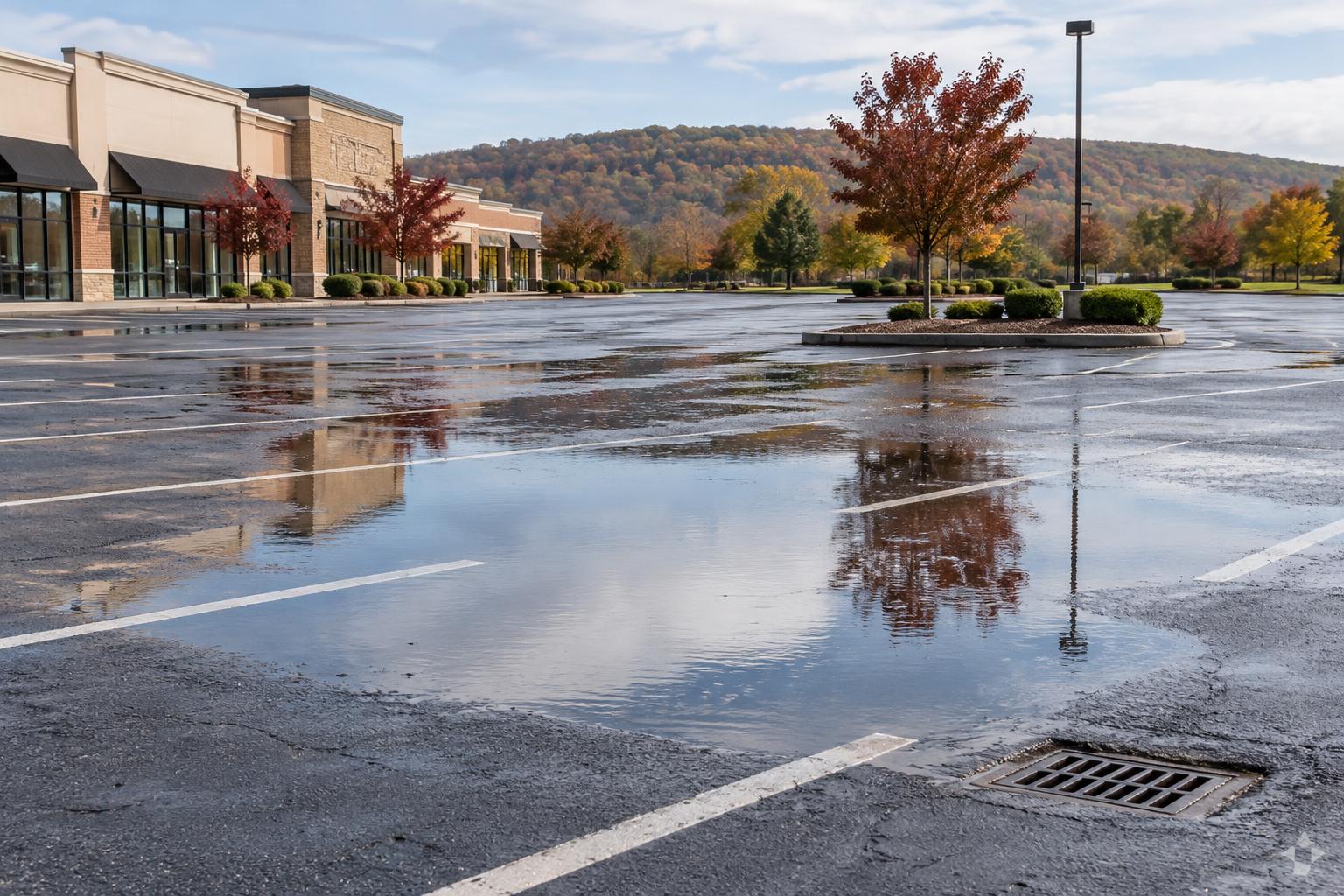
Water ponds when a parking lot cannot move runoff to a working outlet. At Fishkill shopping centers, the cause may be a settled parking bay, a raised patch, a clogged catch basin, damaged piping, or runoff arriving from higher ground. The right repair starts with pavement inspection, elevation measurements, and checking the entire drainage route. This guide explains how to distinguish surface problems from deeper issues, compare repair options, phase work around tenants and deliveries, and write a scope that addresses drainage without creating new problems at storefronts, accessible spaces, or neighboring properties.
Why does water pond on parking lots at shopping centers in Fishkill, and how is it fixed?
Water ponds when the pavement does not provide a continuous downhill path to an outlet that can accept it. At a Fishkill shopping center, that can mean a shallow depression between parking rows, a catch basin set too high, a blocked pipe, or more runoff reaching the lot than the drainage system can handle. The fix is to identify which part of that path is interrupted, then correct the pavement, drainage structure, piping, or contributing runoff.
The puddle itself does not identify the cause. Water surrounding a drain may indicate a blocked grate, but it can also mean the pavement has settled below the grate or the pipe downstream is backed up. A puddle without a nearby drain may need localized reshaping rather than another inlet.
Shopping centers make this problem more complicated because storefront thresholds, sidewalks, loading areas, and drive aisles all impose elevation limits. Repeated patches can gradually interrupt a route that once carried water away. On a sloped Fishkill property, runoff from upper parking rows or landscaped ground can collect near a lower entrance even when that entrance pavement is in reasonable condition.
At Avello, we approach drainage correction as a connected system, not simply a spot to fill. The useful question is: where does the water come from, where should it go, and what prevents it from getting there? Answering all three keeps the repair focused on the property’s actual condition.
Some water may remain briefly during rainfall or while snow melts. What deserves investigation is a recurring pond that persists after surrounding pavement drains, crosses a walking route, freezes repeatedly, or coincides with cracking and settlement. Record those patterns before choosing a repair.
Read the puddle, inspect the pavement, and measure the drainage route
Start with observations during rain and again after it ends, when safe access is available. Photograph the pond from fixed reference points and note its boundary, nearby drains, and whether water is flowing into it from elsewhere. A dry-weather walk-through alone can miss runoff crossing a drive aisle or water backing up around an inlet.
Next, look at the pavement within and around the wet area. An intact, smooth depression may be mainly an elevation problem. Wheel-path grooves, broken patch edges, or interconnected cracking can point to movement or inadequate support below the asphalt. These signs guide investigation, but they do not establish the depth of repair by themselves.
- A pond beside a raised patch or utility cover: the repair or structure may be acting as a small dam.
- Water around a catch basin while nearby pavement clears: inspect grate elevation, debris, and the downstream system.
- Cracking and repeated settlement in the same wet area: investigate the stone base and underlying soil.
- Water crossing the lot from an upper slope: trace runoff beyond the immediate puddle.
- Several basins backing up together: check for a shared downstream restriction or capacity problem.
Elevation measurements turn these observations into a repair plan. A contractor or surveyor, as appropriate, should compare the low area with drain rims, pavement high points, curb openings, sidewalks, and door thresholds. The stone base is the compacted support layer beneath the asphalt; selective cores or test openings may be needed to assess it.
Where pipe condition is uncertain, cleaning and camera inspection can help locate sediment, roots, displaced joints, or damaged sections. Staff should not enter drainage structures. Documented findings should distinguish what is confirmed from what remains an allowance for investigation.
Match the repair to the cause, from basin cleaning to reconstruction
The least disruptive repair is useful only if it resolves the actual restriction. Cleaning a working basin may restore drainage without paving. Conversely, adding asphalt around a basin with a damaged outlet pipe changes the surface but leaves water with nowhere to go.
- Clean grates, catch basins, and pipes when debris or sediment limits an otherwise functional system. Confirm flow afterward and arrange proper removal of collected material.
- Reset or rebuild a catch basin when its rim elevation, frame, or surrounding masonry prevents water from entering. Coordinate the finished grate height with the proposed pavement.
- Mill and reshape sound pavement when a localized high spot or depression interrupts surface flow. Milling removes asphalt to make room for corrected elevations without simply raising the whole area.
- Reconstruct a settled area when damaged asphalt, weak base, or unsuitable underlying soil cannot support a surface-only repair. Address the source of water affecting that support.
- Add or relocate an inlet, trench drain, or connecting pipe when surface reshaping alone cannot provide a suitable route. Verify outlet capacity and approval requirements first.
- Redesign a larger drainage area when several low spots, substantial uphill runoff, or constrained outlets make isolated repairs ineffective. Engineering may be needed.
A thin layer placed in a puddle is not automatically a durable patch. Asphalt needs a workable thickness, sound support, and properly formed edges; tapering it almost to nothing can leave a vulnerable edge. The proposed correction must also blend into surrounding pavement without creating a new ridge.
Full-lot replacement is not the default answer to one wet parking bay. Likewise, an overlay should not be treated as a drainage design by itself. Compare options by the cause they address, the elevations they achieve, and the unresolved conditions they leave behind.
Account for Fishkill’s slopes, winter operations, and spring thaw
Hudson Valley freeze-thaw cycles can make a modest drainage defect more troublesome. Water entering cracks or saturated support materials can contribute to movement as conditions freeze and thaw. Repeated settlement after winter is a reason to examine the pavement’s support, not just restore the surface appearance.
Spring thaw can reveal conditions that were less obvious during dry weather. Melting snow adds runoff while thawing soil may have reduced support strength. A repair plan should distinguish a stable depression from an area that moves seasonally, and allow wet or unsuitable material to be addressed before new pavement is placed.
Snow storage belongs in the drainage discussion. A pile placed over an inlet can obstruct collection, while a pile uphill of a storefront can send meltwater across a walking route. Plowing can also damage protruding structures and pavement edges; salt helps manage ice but does not correct the slope or reopen a restricted outlet.
April through November is the general paving season in the Hudson Valley, not a promise that every day is suitable. Air and surface temperatures, precipitation, ground condition, and asphalt availability govern the work. Drain inspection, design, and some preparatory tasks can be planned separately from weather-sensitive paving.
On sloped sites, the solution may involve intercepting runoff before it reaches the lower parking rows. That does not mean diverting it onto neighboring land, a public sidewalk, or a roadway. A shopping center near Route 9 must consider its own drainage boundaries rather than assume a roadside system is available for connection.
Confirm jurisdiction early. Depending on the address and proposed changes, coordinate with the Town of Fishkill or Village of Fishkill building or engineering department, as applicable. Public-road connections and stormwater changes may involve additional review.
Sequence drainage work around storefronts, deliveries, and safe access
Phasing should follow both the water route and the shopping center’s operating needs. A pavement phase is not ready just because its parking spaces can be closed; any pipe or outlet it relies on must also be ready. Otherwise, fresh pavement may surround an unfinished drainage connection.
- Confirm the repair design, outlet, utility locations, and required approvals. Map the construction limits and the access that must remain available.
- Establish barriers, pedestrian routes, delivery arrangements, and temporary drainage measures before excavation. Coordinate tenant notifications with the property manager.
- Clean, repair, or install downstream drainage components before closing up connected pavement areas. Verify that connections and structure elevations match the plan.
- Excavate or mill the designated phase, inspect exposed support, and resolve unsuitable material before placing new pavement.
- Pave and compact to the planned elevations, finish structure transitions, and check the intended flow path.
- Restore markings and reopen the phase when the contractor determines it is ready for traffic. Move barriers only after the next safe route is established.
Storefront access deserves its own plan. Keep accessible parking connected to a usable accessible route, rather than leaving an available space behind barriers. Do not improvise steep ramps or send pedestrians through delivery-truck movements to preserve parking capacity.
Loading areas may need a separate work window because turning trucks place different demands on access than customer cars. Coordinate refuse collection, fire access, and scheduled deliveries as well. Early or off-peak work can help, but it must fit local restrictions and the actual construction sequence.
The plan should also explain what happens if rain interrupts an open phase. Excavations, temporary pavement edges, and redirected runoff need protection. A clearly identified site contact helps tenants get consistent answers rather than conflicting reopening estimates.
Seeing this on your property?
Avello walks the lot, scores the pavement, and gives you written findings — free, no obligation.
Require a written scope that defines elevations, outlets, and verification
A useful drainage-correction proposal explains more than how much asphalt will be installed. It identifies the observed problem, the proposed cause-based repair, and where the water will go afterward. A marked plan or clear sketch helps everyone distinguish the repair area from the larger drainage area feeding it.
- Repair boundaries, affected parking spaces, drainage structures, and the intended direction of surface flow.
- Existing and proposed critical elevations, including drain rims, door thresholds, sidewalk connections, and accessible areas.
- Milling or excavation limits, pavement materials and layer thicknesses, base preparation, compaction requirements, and edge connections.
- Basin and pipe work, including connections, cleaning, inspection, disposal, and responsibility for confirming a suitable outlet.
- How concealed unsuitable material or damaged utilities will be documented, authorized, and handled as changed work.
- Permit, engineering, utility-location, inspection, and stormwater responsibilities, with exclusions stated plainly.
- Phasing, temporary access, barriers, markings, cleanup, reopening criteria, and drainage verification.
Accessible parking requires particular care because making pavement steeper is not always permissible. Under the ADA Standards, accessible parking spaces and access aisles generally may not exceed a 1:48 slope in any direction. The design should reconcile drainage with applicable accessibility requirements, including the adjoining route, rather than solve one problem by creating another.
Verification should be practical and defined. Elevation checks and an agreed controlled-water observation can reveal local low spots, while observation during suitable rainfall can show how the larger system behaves. A hose test does not establish whether a pipe network has enough capacity for major storms.
Avoid vague promises that the lot will have no water under any circumstances. Instead, document the intended drainage performance, applicable tolerances, inspection method, and process for addressing a discrepancy. That gives the owner a clearer basis for reviewing the completed work.
Prepare site records and avoid repairs that move the puddle elsewhere
Property managers can improve the assessment by bringing together information that is often scattered among maintenance staff, tenants, and ownership. Old drainage drawings, utility repair records, and photographs from wet weather can explain why a particular area behaves differently. Mark information that is uncertain so it can be verified in the field.
- Gather dated ponding photos and notes on rainfall, snowmelt, and how long water remains.
- Locate available site, drainage, utility, and previous pavement-repair drawings.
- Identify tenant entrances, accessible routes, deliveries, refuse pickups, and fire-access needs.
- Show roof-drain outlets, irrigation concerns, snow-storage areas, and known uphill runoff.
- Confirm property boundaries, drainage easements, and who maintains shared systems.
- Name one person authorized to approve scope changes and coordinate tenant notices.
A common mistake is approving a patch by area alone, without checking its finished height. Raising one bay can push water into the next bay or toward a storefront. Lowering a catch basin without checking pipe connections and structural condition can be equally incomplete.
Another mistake is treating recurring sediment as only a cleaning issue. If soil keeps washing from a landscape slope into a basin, the source also needs attention. Similarly, a roof outlet that discharges across pavement should be included in the drainage assessment rather than ignored because it is attached to the building.
Do not assume public utility markings identify every private line within the shopping center. Lighting circuits, irrigation, and private drainage may require separate locating arrangements. Resolving those responsibilities before excavation helps keep the scope and phasing realistic.
Finally, compare proposals on equivalent findings and repair limits. One may include base repair and drainage verification while another covers surface paving only. Those are different solutions, even when their outlined pavement areas look similar.
Check the finished drainage under real shopping center conditions
The final review should follow water from its source to its destination. Check the reshaped area, transitions into existing pavement, basin rims, and the route leading away from the repair. A neat-looking patch is not enough if an adjoining ridge still traps runoff.
Review the work before ordinary operations obscure the details. Confirm that construction debris has been removed from inlets and that pavement edges and structure frames are finished as specified. Where required, obtain inspection records for drainage components that are no longer visible.
After suitable rainfall, use the original photo locations to compare conditions. Note whether the original pond has cleared, whether water reaches the intended inlet, and whether any new collection point appears nearby. Record the weather and timing so the comparison is meaningful rather than based on two very different storms.
Separate a surface-construction concern from a downstream system limitation. If corrected pavement drains toward a basin that backs up, that observation deserves further system review. If water remains behind a new pavement ridge, compare the installed elevations with the written plan and agreed acceptance criteria.
Give maintenance and snow-removal crews a simple handoff showing drain locations, drainage paths, and snow-storage restrictions. This helps preserve the repair’s function without turning the handoff into a complicated manual. Keep those notes with the completed scope and inspection records for future property staff.
Avello Asphalt & Construction is based at 141 Daley Road, Poughkeepsie, NY, serving Dutchess County and the Hudson Valley. For help evaluating drainage correction at your Fishkill shopping center, call Avello at 845-454-3650 or request a free quote.
2026 Commercial Pavement Budget Planner
A contractor-built worksheet for budgeting parking lot and roadway work: cost ranges by scope, a condition-scoring sheet, phasing guidance, a bid-comparison checklist, and the questions to ask before you sign.
Common questions
Does every puddle mean the parking lot needs to be replaced?+
No. A localized depression in otherwise sound pavement may be corrected by milling and reshaping a limited area. A blocked basin may need cleaning rather than paving. Replacement becomes more relevant where investigation finds widespread pavement deterioration, weak support, or elevations that cannot be corrected locally. The decision should follow measurements and inspection, not the puddle’s appearance alone.
Why does water collect around a drain instead of going into it?+
The grate may be obstructed, the basin may contain sediment, or the connected pipe may be restricted or damaged. Another possibility is that surrounding pavement has settled below the grate, leaving water unable to climb into the inlet. If several drains back up together, the shared outlet also needs investigation. Cleaning and elevation checks help separate these causes before selecting repairs.
Can drainage repairs be completed while stores remain open?+
Often, work can be divided into phases while stores continue operating, but access depends on the repair location and drainage connections. Work directly across an entrance or shared drive aisle may require a coordinated closure window. The plan should preserve safe pedestrian access, accessible routes, deliveries, and emergency access. It should also identify temporary drainage arrangements and who decides when each phase can reopen.
Will adding another catch basin solve a persistent low spot?+
Only if the new basin can connect to a suitable outlet and the system can accept the additional flow. An inlet collects water; it does not make that water disappear. Surface elevations must bring runoff to it, and the pipe must carry it onward. Where downstream capacity or permission to connect is uncertain, those questions need resolution before installation becomes the preferred option.
Does a Fishkill shopping center need a permit for drainage correction?+
Requirements depend on the property’s jurisdiction and the work proposed. A limited pavement repair can be treated differently from a new drainage connection, changed discharge location, or broader site alteration. Confirm requirements with the Town of Fishkill or Village of Fishkill building or engineering department, as applicable. Work affecting a public roadway or regulated stormwater facilities may require coordination with other agencies as well.
What determines the cost of fixing parking lot ponding?+
The main factors are the cause, repair depth, affected area, drainage-structure condition, pipe access, and outlet requirements. Engineering, approvals, utility conflicts, disposal, and operating phases can also affect the scope. A surface correction and a repair involving excavation and pipe replacement are not comparable tasks. Ask for a written scope that separates confirmed work from allowances for concealed conditions so proposals can be evaluated fairly.
Avello provides free commercial pavement assessments across the Hudson Valley. No obligation — you keep the documentation either way.