
Can a Medical Office Stay Open During Paving? Fishkill Contractor Explains
Avello's take
This item looks at whether a medical office can stay open during paving and the planning that helps determine the answer. It explains why appointment schedules, patient drop-off, lab pickups, and deliveries belong at the center of the plan. It also covers when phased work makes sense, when a planned closure may be a better fit, and why pavement condition should guide the repair approach. Keeping access clear matters as much as deciding which areas need work.
For Hudson Valley property owners and managers, we see the value in connecting pavement decisions with the daily needs of the people using the property. A sensible next step is a review of the office calendar, available parking, patient routes, and pavement condition before settling on a schedule. From there, a written scope can define work areas, weather decisions, and how concealed repairs will be approved. That gives the practice and paving team a shared plan for both access and construction.
Key Takeaways
- Paving plans for medical offices work best when built around appointment patterns, patient drop-off, deliveries, and events rather than around the pavement alone
- A phased approach should keep at least one safe, clearly marked patient route open at all times, including temporary parking and pickup areas
- A small parking lot with a single narrow entrance may fit better with one planned closure instead of multiple construction phases
- Milling and resurfacing renews the surface but does not fix weak support or drainage problems hiding underneath
- A written scope should spell out phase boundaries, weather decisions, and the process for approving any concealed repairs found mid-project
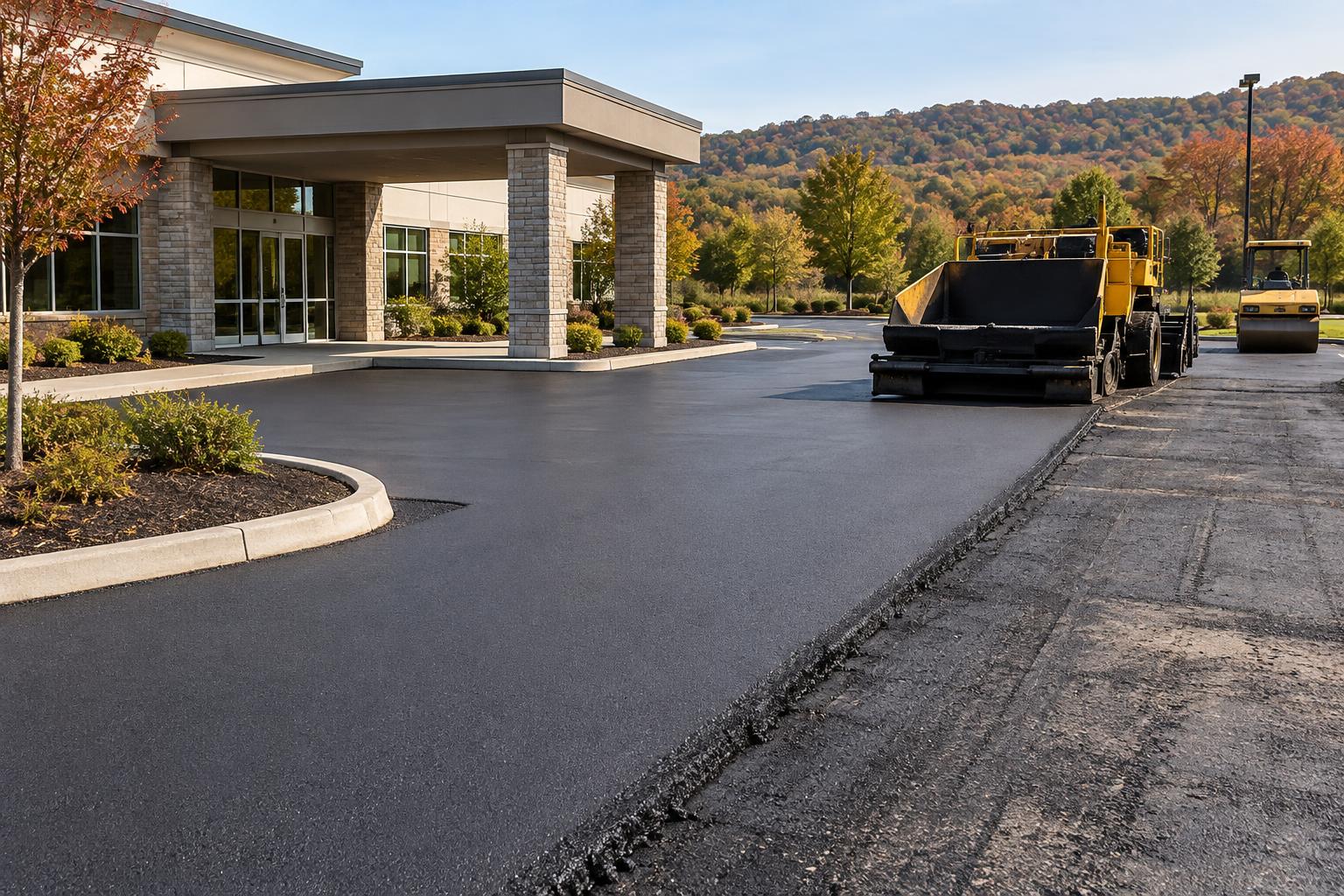
A paved parking lot might look like a simple maintenance job, but for a medical office, it touches nearly everything the practice depends on: patient arrivals, laboratory pickups, deliveries, and sometimes a scheduled clinic or screening event. Staying open during paving is often realistic when the construction plan is built around how the office actually runs, rather than around the asphalt alone.
Staying Open Is Possible With the Right Plan
The difference between a smooth paving project and a frustrating one usually comes down to sequencing. When work is divided into sensible phases that match the office's real traffic patterns, patients can keep arriving, parking, and leaving without confusion or risk. A detailed look at paving medical offices in Fishkill around services, patients, or events breaks down how that kind of planning comes together, from reading the pavement's condition to mapping out each phase around the patient visit.
A quiet-looking lot in the evening might still need to accommodate a late lab pickup, a patient recovering from a procedure, or a caregiver circling back for someone. Treating the property as if it empties out completely after hours can produce a plan that looks tidy on paper but creates real problems once equipment shows up. A sounder approach starts with the calendar, then fits the pavement work around it.
Three general paths tend to work for medical properties: splitting the lot into sections and closing one at a time, scheduling one confirmed closure during a slower stretch, or combining small repairs now with a larger resurfacing project later. None of these options is automatically right. The choice depends on how much usable space remains once part of the lot is blocked off, and whether that space still lets patients reach the building safely.
Plan Around Patients, Not Just Pavement
Before choosing a paving approach, it helps to walk through the practice's actual operating rhythm. A clinic with steady morning appointments and a slower afternoon has very different paving needs than one running evening hours or weekend screenings.
Questions to Answer Before Choosing an Approach
A few straightforward questions tend to clarify which approach fits best:
- Which services must stay on site during construction, and which could shift to another day without much disruption?
- What times do patients typically arrive and leave, including the minutes before and after their actual appointment?
- Can every patient reach an open entrance without crossing anywhere near active equipment or fresh asphalt?
- Where will staff, caregivers, delivery drivers, and transport vehicles park while part of the lot is closed?
- Who at the practice has the authority to approve schedule changes and send updated instructions to patients?
These answers shape the entire plan. A practice that knows its laboratory pickup window, for instance, can make sure that specific area stays clear and accessible even while other sections are closed for paving.
When a Planned Closure Beats Phasing
Phasing works well when there's enough room to keep a genuinely safe route open at all times. A large lot with multiple entrances can often absorb a few days of partial closures without much trouble. A small lot served by a single narrow driveway presents a different problem. Trying to squeeze patients, construction equipment, and delivery trucks through one tight access point can create more risk than it solves.
In those tighter situations, a short, clearly announced closure during a confirmed slow period often works better than forcing an awkward multi-phase schedule. The goal is choosing the option that keeps people safe while finishing the work efficiently, rather than avoiding disruption at any cost.
Let Pavement Condition Drive the Scope
Before any phase gets scheduled, the pavement itself needs an honest look. Walking the property when it's dry reveals cracks, loose stone, broken edges, and old patch jobs. A second walk-through after rain shows where water pools or crosses the paths patients actually use to reach the door.
That inspection should extend past the parking stalls themselves. Entrance aprons, pickup spaces, and areas near drains or sidewalks often carry different stress than the rest of the lot, since they see repeated turning or sit at the center of drainage patterns.
Matching Repairs, Resurfacing, or Reconstruction to What's Found
Not every square foot of pavement needs the same fix. Depending on what the inspection turns up, a few different approaches may apply across the same property:
- Isolated potholes or broken edges surrounded by otherwise solid pavement usually call for localized removal and patching.
- Surface wear without any sign of underlying movement may suit an asphalt overlay, as long as the existing pavement is sound enough to support it.
- A worn surface combined with elevation concerns near curbs or drains often points toward milling and resurfacing, which removes a set amount of old asphalt before installing new material.
- Recurring depressions, wheel ruts, or cracks that keep returning through past repairs usually signal a deeper problem that calls for full reconstruction of the supporting layers.
Milling and resurfacing renews what's on top, but it does not automatically correct weak support or drainage trouble sitting underneath. If a low spot keeps coming back year after year, covering it with new asphalt only delays the same issue from resurfacing later, often literally.
Build a Phase Plan Around Every Patient Visit
Once the condition assessment is done, the next step is mapping out what a patient visit actually looks like from start to finish: arriving, parking or being dropped off, walking to the entrance, and eventually heading back to the car. That includes patients using mobility aids or recovering from a procedure, since a parking space does no good if the path from it crosses unfinished pavement or active equipment.
Steps From Mapping the Visit to Reopening the Area
A workable phase plan tends to follow a consistent sequence:
- Confirm the operating calendar, noting high-volume appointment days, procedures, lab pickups, and any special events.
- Set up the temporary arrangement, including parking, pickup zones, pedestrian routes, barriers, and signs, before the first section closes.
- Clear the work area completely, keeping patient movement separated from hauling, milling, or paving equipment.
- Finish any underlying repairs, like drainage corrections or base work, before the new asphalt goes down.
- Pave and finish the section, including transitions, markings, and any controls needed for everyday use.
- Inspect the finished area with the practice's designated contact before moving barriers and reopening it for patients.
A freshly milled surface shouldn't be assumed safe for walking or driving just because the equipment has moved on. Loose material, uneven transitions, and exposed structures all need a proper check first. If no phase can offer a genuinely usable patient route, a short planned closure is often the more responsible choice. Phasing should solve a scheduling problem, not create a new one.
Account for Weather, Thaw, and Sloped Drainage
The general paving season across the Hudson Valley runs from spring through fall, but that window is a planning range rather than a guarantee of good conditions on any given day. Temperature, moisture, and the specific type of work planned all affect what's realistic for a given date.
Spring thaw deserves particular attention, since supporting material can stay wet or soft well after the surface looks dry. That softness can affect how well new asphalt holds up if the timing is off. On a sloped property, water running from uphill pavement or landscaped areas needs somewhere to go once construction changes the grade, and raising one section with an overlay can unintentionally redirect runoff toward the building or a neighboring property if the planning doesn't account for it. Temporary drainage matters during construction too, since an unprotected excavation or trapped runoff near an entrance can turn into its own hazard before the project is even finished.
Put Access and Approval Terms in Writing
A scope that simply says to "repave the parking lot in phases" leaves far too much unresolved. A clear, attached plan should mark the work limits, phase boundaries, building entrances, and temporary routes so everyone involved can see exactly what changes and when.
What the Scope Should Spell Out
A thorough written scope typically covers several categories of detail:
- Removal limits, milling depths, and the materials or compacted thicknesses planned for the site.
- Known base repairs, drainage corrections, and edge details connecting to existing pavement.
- How any concealed unsuitable material found during the work will be documented, priced, and approved before continuing.
- Phase order, working hours, closure limits, and responsibility for moving barriers between sections.
- Temporary patient access, parking arrangements, and entrance signage the office needs to provide.
- Weather decisions, reopening criteria, and the process for approving any written changes mid-project.
Keeping these details specific to the property, rather than relying on generic language, helps avoid confusion once equipment is on site. It's also worth confirming which local jurisdiction oversees the address, since driveway changes or work near a public right-of-way may require coordination with the responsible road authority.
Preparing Staff, Patients, and Vendors
Once the scope is settled, the practice's own preparation matters just as much as the paving plan itself. A single coordinated calendar works better than scattered instructions, especially if multiple practices share the same lot.
Patients need practical information, not a construction briefing. Messages should identify the usable driveway, where to park, which entrance to use, and how to reach reception for help, using consistent wording across appointment reminders, phone scripts, and posted signs. A short pre-closure checklist tends to catch the details that otherwise slip through: confirming a primary contact with decision authority, approving the phase map, verifying any off-site parking permissions, notifying staff and vendors, and walking the temporary patient route before the first section closes.
A Workable Patient Route Decides the Outcome
Every piece of this planning points back to one central question: can patients get from their car to the front door safely, at every stage of the project? When the answer is yes, phasing lets the practice keep running while the lot gets the attention it needs. When the answer is no, for even one phase, a short planned closure usually serves patients and staff better than forcing an unsafe workaround.
The pavement condition, the weather window, and the written scope all feed into that same decision. None of them matter much on their own if the finished plan doesn't protect a clear, safe path for the people walking it every day. Getting that part right from the start tends to make everything else, from scheduling to reopening, fall into place with far less friction.
For a practical starting point, review options for commercial parking lot paving before setting a construction date, so the plan accounts for both pavement condition and patient access from day one.
Company: Avello Asphalt & Construction Corp City: Poughkeepsie Address: 141 Daley Road Website: https://www.avelloasphalt.com
Mentioned in this blog post: Poughkeepsie service area, Fishkill service area
Have a property like this?
Tell us what you're seeing. We'll walk the site, explain the options plainly, and give you a clear scope.
Related Avello guidance
More blog posts
- Speed Bumps at Housing Authorities: Placement & Plow Clearance - Poughkeepsie
- Does Restriping Fix ADA Bank Parking? - East Fishkill Paving Contractor Explains
- 10-Year Asphalt Pavement Plan for Office Parks - Poughkeepsie Paving Contractor
- What to Check Before Approving a Pre-Winter Crack Filling Bid in Dutchess County