Trailer Landing Gear Pavement Damage: Hudson Valley Paving Contractor Explains
Avello's take
A foot-shaped dent beneath a parked trailer can tell a different story from an ordinary pothole. This item explains how trailer landing gear concentrates weight on a small area and can push asphalt down. It covers the signs that help distinguish surface damage from problems in the supporting base. It also explains when a targeted asphalt repair may be enough, and when repeated sinking calls for deeper investigation or a designed concrete dolly pad.
For Hudson Valley property owners and managers with trailer parking, that distinction matters when planning repairs. We see the value in matching the repair to the actual load, drainage conditions and parking habits rather than treating every depression alike. A sensible next step is an inspection while the trailer space is empty, with photos and a review of past repairs. Where damage keeps returning, core samples or a small test area can help clarify what needs attention beneath the surface.
Key Takeaways
- Repeated dents under trailer landing gear usually point to concentrated point loading rather than normal pavement wear
- Isolated dents can often be fixed with a targeted asphalt patch, but recurring sinking in the same spot signals a need for deeper investigation and possibly a designed concrete dolly pad
- Concrete support pads should be sized and placed around where landing gear actually sits, since trailer length and parking habits vary across a fleet
- Wet seams, ponding water, and spring softness near trailer spaces often mean drainage or base problems need attention alongside any surface repair
- Matching repair depth and pad design to the loads a property actually carries keeps industrial lots from fighting the same damage year after year
Industrial-park lots in Poughkeepsie take a beating from more than daily truck traffic. Parked trailers resting on their landing gear put all their weight onto two small support feet, and over time, that concentrated pressure can push asphalt down faster than tires ever would. Getting the fix right starts with figuring out whether the damage is a surface problem or something happening further below, a distinction covered in detail in this report on trailer parking and dolly pad damage at industrial parks in Poughkeepsie.
Why Trailer Feet Keep Denting Your Lot
A parked trailer disconnected from its tractor shifts its front-end weight onto landing gear, the retractable support legs positioned near the nose of the unit. Those legs rest on a surface area far smaller than a tire's footprint, so the same trailer weight gets concentrated into a tiny point rather than spread across a wheelbase. Asphalt that handles rolling truck traffic just fine can still sink under that kind of stationary, concentrated load, especially during warm weather when the material softens slightly, or in spots where the ground underneath is already wet or weak.
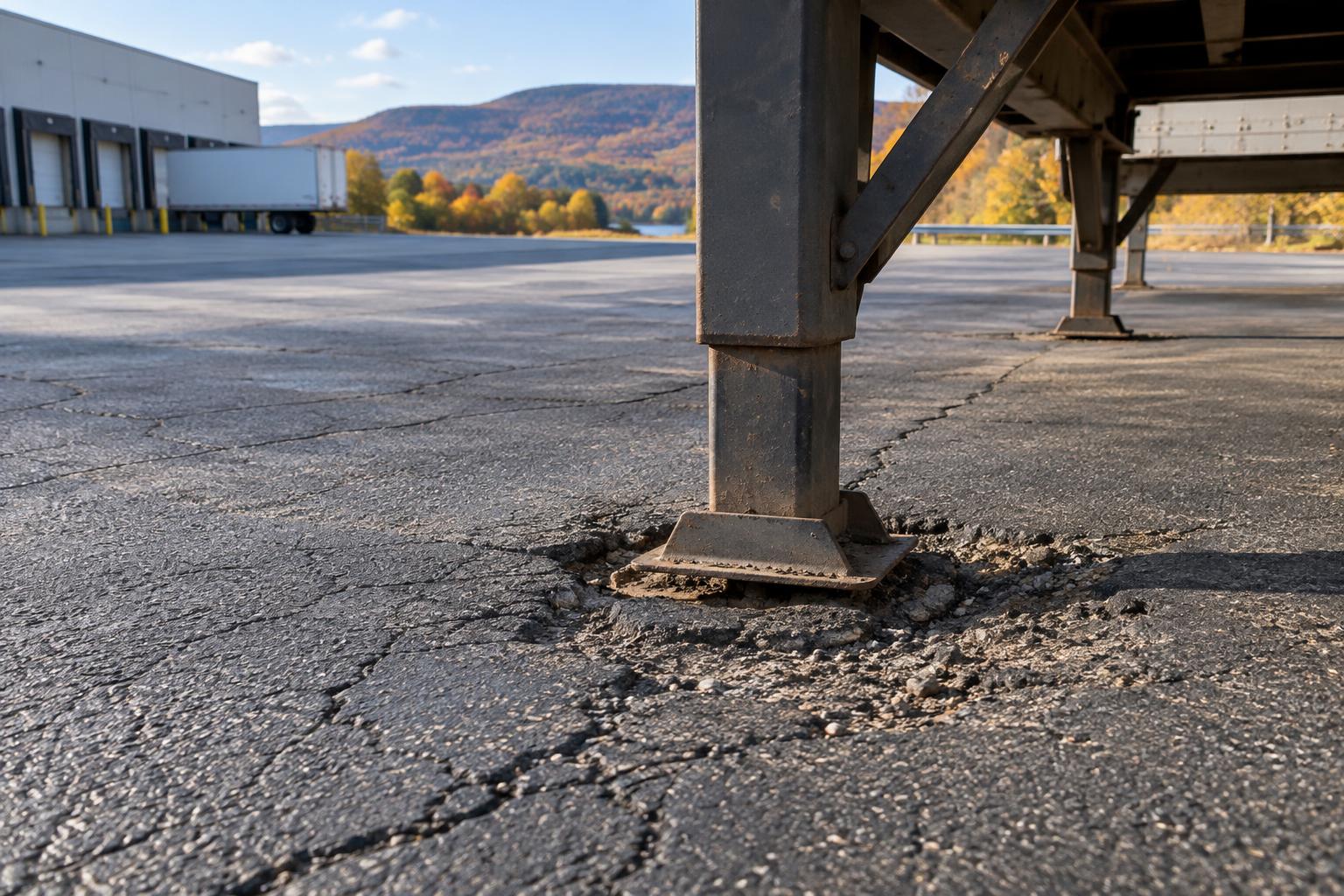
This matters because the damage pattern looks different from ordinary wear. A pothole from traffic usually forms where water and repeated wheel loading break down the surface over a wide area. A landing-gear dent, by contrast, often shows up as a tight, foot-shaped depression with asphalt pushed up slightly around its edges. Recognizing that difference early changes how the repair gets scoped, since treating a point-load problem like a routine pothole can mean paying for the same patch twice.
Spotting the Real Cause Beneath Landing Gear
Figuring out what is actually happening under a damaged space takes more than a quick glance. The surface tells part of the story, and the supporting layers underneath tell the rest; skipping that step is how repeat damage keeps happening in the same spots year after year.
Signs to Check While Spaces Sit Empty
Inspections should happen when a trailer space is empty, never underneath an unsupported trailer resting on its gear. Walking the lot with a camera and a stall number in hand turns a vague complaint into a documented pattern. A few things worth checking for:
- Foot-shaped indentations with asphalt raised slightly around the edges, which point to concentrated loading pushing material outward.
- Broken asphalt that extends beyond the footprint of the landing gear itself, suggesting the problem reaches past the surface layer.
- Cracked concrete with uneven edges or visible movement, which can mean the pad has lost support underneath.
- Mud, wet seams, or water appearing under load, a clue that moisture has compromised the base.
- Scraped marks or bent hardware impressions, sometimes a sign equipment was set down with landing gear positioned too low.
Comparing a damaged space to a nearby space that has held up well can also be revealing. If both spots see similar trailer traffic but only one keeps failing, something about that specific location, drainage, soil, or old repair work is likely at play.
Why History and Core Testing Matter
A visual inspection cannot tell anyone how thick the pavement actually is, whether reinforcement exists in a concrete pad, or how strong the soil is underneath. For damage that keeps returning, pulling core samples or opening a small test area gives a clearer picture of what is really going on beneath the surface. This step separates a shallow material issue from a foundation that will keep failing no matter what gets placed on top of it.
Repair history is just as telling. Several small patches applied to the same landing-gear spot over time usually mean the pavement and the parking use do not match up well. A single damaged area next to an otherwise stable row, on the other hand, may only need a narrow, contained fix rather than a full redesign of the parking layout.
Matching the Repair to the Damage
Once the cause is clear, the repair choice should follow logically rather than defaulting to whatever is fastest. A thin surface patch placed over a weak base rarely lasts, since the same point load that caused the original dent will keep pressing down on whatever sits above it.
For an isolated defect where the surrounding pavement and the base underneath remain sound, a localized asphalt removal and replacement is often enough. The key is removing all the compromised material rather than feathering a thin layer over the depression and hoping it holds. When damage extends down into the supporting aggregate, a full-depth repair becomes the more sensible choice, since it rebuilds the base in compacted layers before new asphalt goes down on top. A surface patch handles damage that stops at the top layer, while a full-depth patch is built for failures that reach the ground underneath. Choosing the wrong one usually just delays the same repair bill.
Where landing gear repeatedly sinks into the same spot despite good asphalt work, a designed concrete dolly pad often makes more sense than continuing to chase the damage with patches. A dolly pad is a reinforced concrete landing area built specifically to carry those concentrated point loads without sinking, and it does not need to cover an entire parking stall to do its job.
Sizing and Placing Concrete Dolly Pads Correctly
A well-built pad placed in the wrong spot still leaves a property with the same problem. Before setting pad boundaries, it helps to observe where trailers actually park and measure the real landing-gear positions for the equipment using that row, since trailer length alone does not predict where the support feet will land. A standard 40-foot container chassis typically places its landing gear about 33 feet from the back of the trailer, while a 20-foot chassis sits closer to 11 feet from the back, a gap wide enough that pads sized off the wrong assumption miss the mark entirely.
Asking a few operational questions up front saves a lot of guesswork later:
- Are trailers dropped loaded, stored empty, or loaded up again while still detached?
- How long does a typical trailer sit in one space?
- Does the mix of equipment change by season or by tenant?
Dock-planning guidance commonly used for pad design accounts for a fully loaded trailer transferring weight through two point loads, often figured around 25,000 pounds each and spaced roughly 6 feet apart, a useful benchmark for understanding just how concentrated these loads really are compared with rolling tire traffic.
Layout choices also matter here. Individual pads tend to work well for fixed, consistently used spaces where the same type of equipment parks in the same spot every time. A continuous concrete strip running the length of a parking row can handle more variation in where different trailers land, as long as it covers the full range of likely landing-gear positions rather than just the average one. Where parked trailers on dolly jacks or sand shoes create these nonstandard loads, confining that activity to specific, well-defined areas can also make the overall pavement design more economical, since the rest of the lot does not need to be built to the same standard.
Freeze-Thaw, Spring Softness, and Drainage Risks
Hudson Valley weather adds another layer of complexity that a dry-climate repair plan would never need to account for. Water working its way into cracks and into the seam between asphalt and concrete can freeze and expand during winter, gradually loosening edges and widening existing defects, particularly where that water has no clear path to drain away.
Spring thaw deserves its own attention, since the surface can look perfectly dry while the ground underneath is still saturated and far less able to support concentrated loads. A sound-looking pavement section can still deform if its supporting base has lost strength after taking on water, which is part of why comparing how a space performs in late winter versus spring often reveals problems that a single inspection would miss. Walking the lot specifically after thaw is a useful habit for catching freeze-thaw damage before it turns into a repeat repair call.
On sloped properties, tracing runoff from above a damaged area matters just as much as checking the water right around a dented spot. A new concrete pad built without attention to existing grade can end up blocking water that used to flow freely, pushing it toward a building, another tenant's space, or back underneath adjoining asphalt instead. Pad elevations and the transition between concrete and asphalt need enough thought to avoid creating a water trap or a raised lip that catches a plow blade during winter maintenance.
Phasing Repairs Without Losing Trailer Parking
For dolly-pad work, the bigger operational challenge is usually finding somewhere for displaced trailers to go rather than closing a travel lane. Counting how many spaces a given phase will take out of service, including the buffer area needed for excavation equipment, helps set realistic expectations before work starts. A workable sequence generally looks something like this:
- Confirm trailer movements, tenant contacts, and a temporary parking layout before equipment shows up on site.
- Empty and barricade the first work area, keeping excavation boundaries clearly separated from active trailer traffic.
- Locate utilities, remove damaged material, and inspect what the exposed base actually looks like.
- Address any unsuitable base material or drainage issues before new pavement or concrete goes down.
- Build the pad and surrounding repairs, then protect the area while materials cure or develop strength.
- Restore markings and transitions, inspect the finished work, and reopen before moving to the next phase.
Reopening a new concrete pad should follow the specified strength requirement rather than a guess based on how hard the surface looks or feels. A pad that appears solid is not proof it can carry a fully loaded trailer, which is why the acceptance method and who signs off on reopening need to be spelled out ahead of time rather than decided informally on the day. Fresh asphalt needs similar patience, since temperature and mix type both affect how soon it can handle a concentrated stationary load without landing gear leaving a fresh dent in work that just got finished.
What a Complete Repair Scope Should Spell Out
A proposal that simply says "repair parking area" leaves too much room for misunderstanding once work begins. A scope written around the actual support conditions gives property managers something they can compare across bidders and hold a contractor to later. Useful scopes typically spell out:
- The equipment and loading assumptions used to choose the repair or pad design in the first place.
- Removal limits, excavation depths, and how existing concrete and asphalt edges will be treated.
- Base preparation, compaction requirements, and a clear process for approving extra unsuitable-material removal if it turns up.
- Material dimensions, specified concrete strength, reinforcement, joint layout, and curing requirements.
- Finished elevations and how drainage ties into the surrounding grade.
- Phase boundaries, protection measures, and the exact conditions that must be met before reopening to loaded trailers.
Copying the dimensions of an existing pad without question is a common misstep, since that old pad's sizing may be part of why the damage happened in the first place. A scope that connects repair quantities back to actual landing-gear positions makes it far easier to judge whether a lower bid is cutting corners or simply scoping less work.
Preparing Your Property Before the Crew Arrives
A bit of preparation before an assessment or a repair crew shows up tends to pay off in a faster, more accurate scope. Gathering a few things ahead of time gives a contractor real information to work from instead of guesswork:
- Mark damaged spaces and photograph them with trailers removed from the area.
- Note trailer types, whether they typically sit loaded or empty, and where landing gear tends to land.
- Pull together any pavement drawings, utility records, or past repair history available.
- Record ponding locations, snow-storage areas, and any seasonal changes in how soft the pavement feels.
- Confirm where displaced trailers can go temporarily and who has authority to approve that move.
A few mistakes show up again and again on properties dealing with this kind of damage: patching only the visible footprint without checking what is underneath, placing new concrete over ground that was never actually fixed, and sizing pads off painted stall lines instead of where landing gear really sits. Returning loaded trailers to a pad before it has met its specified strength is another one worth watching for, since it can undo careful work in a single afternoon.
Lasting Fixes Match Support to Actual Loads
The properties that stop fighting the same landing-gear damage year after year tend to share one habit: they treat trailer parking as its own category of pavement use rather than lumping it in with ordinary truck traffic. Industrial yard pavement works best when planned around the loads it will actually carry, whether that means rolling trucks, forklifts, or stationary trailers resting on small support feet. Separating these zones, even informally, makes it easier to put the right kind of support exactly where it is needed instead of over-building or under-building the whole lot.
A sound long-term plan usually blends a few things together: pavement that is already performing well left alone, targeted asphalt repairs where the base is sound, and concrete support built specifically where concentrated loads justify the extra cost. That kind of approach keeps the project focused on the actual problem rather than turning into a blanket resurfacing job that does not address why the damage happened in the first place.
For property managers weighing repair options, a useful first step is lining up actual landing-gear positions and loading patterns before calling a contractor, so any proposal that comes back can be judged against the way the lot is really being used. Thinking through industrial lot paving options with that information in hand tends to produce a repair that holds up far longer than one chosen on looks alone.
Company: Avello Asphalt & Construction Corp City: Poughkeepsie Address: 141 Daley Road Website: https://www.avelloasphalt.com
Mentioned in this blog post: Poughkeepsie service area
Have a property like this?
Tell us what you're seeing. We'll walk the site, explain the options plainly, and give you a clear scope.
Related Avello guidance
More blog posts
- Speed Bumps at Housing Authorities: Placement & Plow Clearance - Poughkeepsie
- Does Restriping Fix ADA Bank Parking? - East Fishkill Paving Contractor Explains
- 10-Year Asphalt Pavement Plan for Office Parks - Poughkeepsie Paving Contractor
- Can a Medical Office Stay Open During Paving? Fishkill Contractor Explains