Trailer parking damage usually needs more than a surface repair when landing gear repeatedly sinks into asphalt. Industrial-park managers should distinguish isolated surface wear from weak support, drainage problems, and concentrated loading at trailer feet. This article explains when asphalt repair makes sense, when a designed concrete dolly pad is a better fit, and how to define the work around actual trailer positions. It also covers Hudson Valley weather, repair sequencing, tenant preparation, and the written details needed to compare proposals without overlooking concrete strength, pad placement, or underground conditions.
Why trailer feet damage pavement—and what fixes the problem
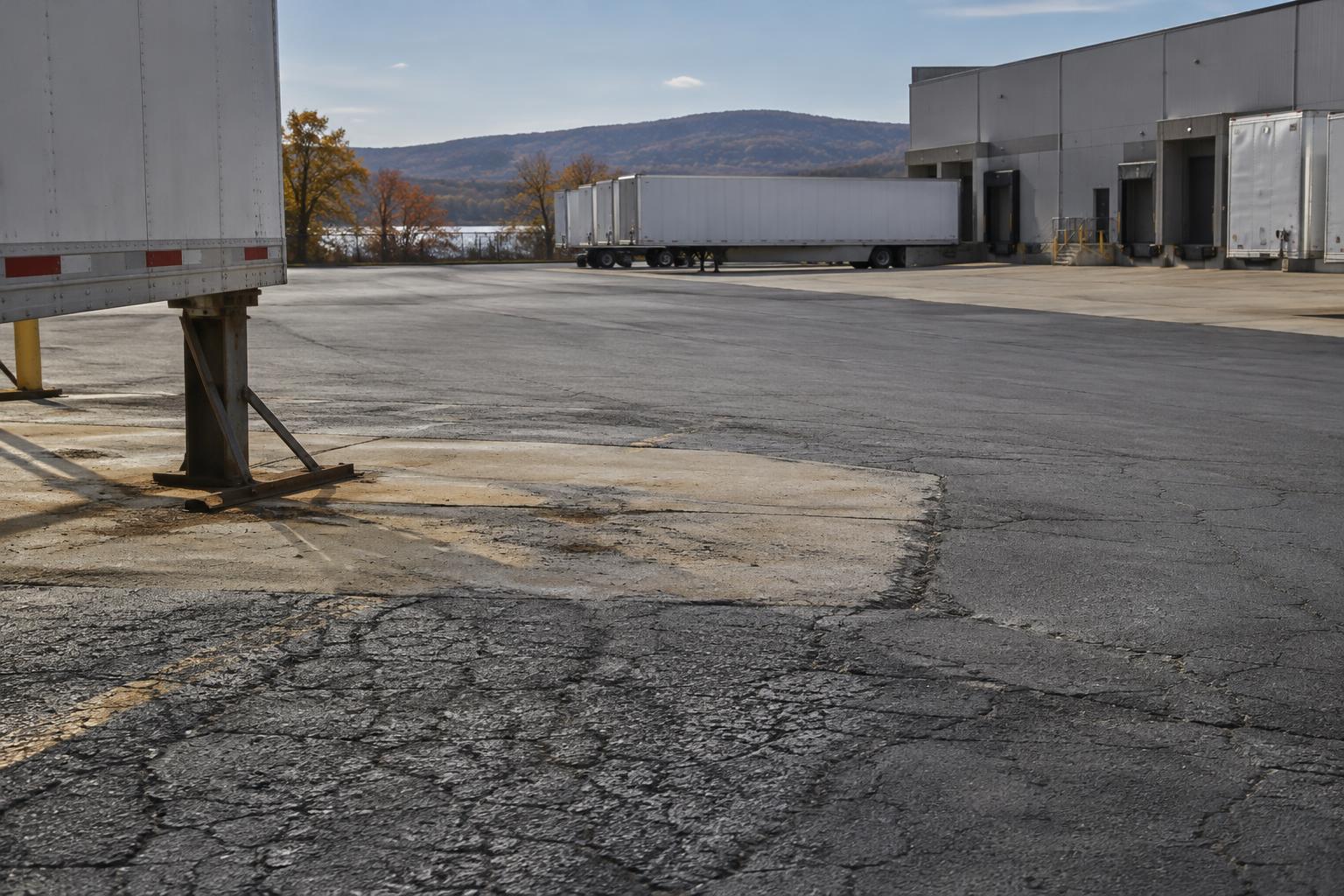
At industrial parks in Poughkeepsie, depressions beneath parked trailer feet usually point to concentrated loading, not simply old pavement. A detached trailer transfers part of its weight through its landing gear, the support legs near the front. Those small contact areas can indent asphalt, especially during warm weather or where the material underneath is wet or weak.
The direct answer is to repair damaged pavement according to its depth and cause, then provide support suited to repeated trailer parking. A localized asphalt repair can fit an isolated defect where the pavement structure remains sound. Repeated sinking beneath landing gear often calls for a properly designed concrete dolly pad, together with any necessary base and drainage repairs.
A dolly pad is a reinforced or otherwise engineered concrete landing area positioned beneath trailer support feet. It is not automatically a full concrete parking stall. Depending on the equipment and parking arrangement, it may be an individual pad or a continuous strip crossing several trailer spaces.
Before choosing either approach, confirm what tenants mean by “dolly.” Some mean semitrailer landing gear; others mean separate converter dollies or other support equipment. Those have different contact points, so the repair must match the equipment actually parked there.
The key distinction is between supporting moving truck tires and supporting a stationary trailer on small feet. Pavement that carries normal truck traffic may still deform under long-duration point loads. We evaluate the support location, surrounding pavement, and water conditions together rather than treating every indentation as an ordinary pothole.
Read the damage at the landing gear, pad edges, and surrounding asphalt
Start with an inspection when the affected spaces are empty. Photograph each defect with its stall number, and note whether it aligns with landing gear, tires, or a concrete joint. A shallow mark under a trailer foot tells a different story from a broad depression extending across the parking space.
- Foot-shaped indentations with raised asphalt around them: signs that concentrated loading has displaced the surface.
- Broken asphalt extending beyond the landing-gear footprint: a reason to investigate the pavement and supporting layers.
- Concrete cracks with uneven edges or visible movement: possible loss of support, settlement, or inadequate structural capacity.
- Chipped pad edges where feet land near the boundary: a placement or pad-size issue as well as a repair issue.
- Mud, wet seams, or water emerging under load: clues that moisture and underlying support need attention.
- Scraped surfaces and bent hardware marks: possible damage from moving equipment with landing gear set too low.
Compare occupied and unoccupied areas, but do not inspect beneath an unsupported trailer or disturb loaded landing gear. Tenant personnel should handle trailer movement using their established procedures. Record whether damage appears only under heavily loaded trailers or also under empty equipment.
Surface inspection cannot establish pavement thickness, concrete reinforcement, or soil strength. Depending on the condition, cores, test openings, or an engineer’s evaluation may be appropriate. These checks help distinguish a shallow material problem from a weak foundation that would remain beneath a new surface.
Also review repair history. Several small patches at the same landing-gear position suggest the parking use and the pavement support are mismatched. A single damaged spot beside an otherwise stable row may justify a much narrower repair.
To understand the work behind these options, compare Avello’s industrial lot paving, parking lot repair services.
Choose between asphalt repair, concrete repair, and new dolly pads
The realistic options range from a limited repair to a redesigned support area. The right choice depends on the condition below the surface and whether trailers will continue placing weight in the same locations. A new material alone does not solve a poor layout or water-softened base.
- Localized asphalt removal and replacement fits isolated damage where adjacent pavement and underlying support are serviceable. Remove compromised material rather than feathering a thin layer over a depression.
- Full-depth asphalt repair fits areas where both pavement and supporting aggregate need replacement. It can restore the parking surface, but repeated landing-gear loading may still require a dedicated pad.
- Limited concrete repair can fit sound pads with localized surface or edge damage. Repair selection should account for the depth of deterioration and whether the repaired edge will carry trailer feet.
- Concrete panel replacement fits pads with significant settlement, displaced cracks, or extensive deterioration. The work should address support beneath the panel, not just replace its visible surface.
- New concrete dolly pads fit recurring concentrated loads in consistent parking positions. Their dimensions, thickness, reinforcement, joints, and base should be designed for the intended equipment and site conditions.
An asphalt overlay can improve a worn surrounding surface, but it is not a substitute for correcting deep landing-gear depressions. Similarly, filling cracks does not restore support beneath a moving concrete slab. Keep surface maintenance separate from structural repairs when comparing proposals.
Temporary load-spreading plates may be useful under a tenant’s approved equipment procedures, but improvised plates are not a permanent pavement design. Their size, stability, condition, and placement matter. They should not conceal damage that still needs assessment or create obstacles for plowing and walking.
Place dolly pads where the trailers actually land
A durable pad in the wrong location is still a poor solution. Before setting its boundaries, observe actual parking positions and measure the landing-gear locations for the equipment using the row. Trailer length alone is not enough because support-leg positions and parking habits can vary.
Ask tenants whether trailers are dropped loaded, stored empty, or loaded while detached. Confirm how long they stay and whether the equipment mix changes seasonally. The designer needs credible operating information rather than a generic description of “heavy trucks.”
Individual pads can suit fixed, well-controlled spaces with consistent equipment. A continuous concrete strip may better accommodate variation across a parking row, but it still needs sufficient front-to-back coverage. Neither arrangement should depend on drivers placing every landing-gear foot precisely on an edge.
Show the intended landing zone on a layout drawing and check it against stall markings, backing movements, trailer overhang, and adjoining circulation. Coordinate pad joints so routine foot placement is considered in the design. Where necessary, an engineer should determine how slab edges, joints, and reinforcement will handle the loading.
Finished elevations also matter. A pad should meet adjoining pavement without a raised lip that catches plow blades or a recessed edge that collects water. Its surface and the surrounding grade must support the equipment safely while directing runoff to an appropriate outlet.
After construction, restore markings that make the landing zone obvious. Give tenants a simple parking diagram if the intended trailer position changes. Good placement reduces repeated edge loading and helps preserve the value of the repair without requiring drivers to guess where the concrete begins.
Account for Poughkeepsie freeze-thaw, spring softness, and sloped drainage
Hudson Valley weather can turn a small opening beside a dolly pad into a recurring support problem. Water enters cracks and pavement-to-concrete seams, then freezes and expands. Repeated freeze-thaw cycles can loosen edges and widen existing defects, especially where water has no easy path out.
Spring thaw deserves particular attention. The surface may look dry while the supporting ground remains wet and less able to carry loads. Comparing late-winter observations with spring conditions helps explain why a trailer space performs differently across the year.
On sloped industrial properties, trace runoff from above the parking row, not just water immediately around a damaged foot position. A new concrete strip can interrupt existing surface flow if its elevations are poorly coordinated. Water should not be redirected beneath adjoining asphalt, toward buildings, or into another tenant’s operating area.
Plowing adds another consideration at asphalt-to-concrete transitions. Raised edges and loose repairs can catch blades, while snow storage can keep a landing area wet during melt periods. Salt and repeated wetting can also contribute to concrete deterioration, so concrete materials, finishing, curing, and winter maintenance should be coordinated.
April through November is the general paving planning window in the Hudson Valley, not an assurance that every day is suitable. Asphalt placement depends on temperature, weather, and a properly prepared base. Concrete work has its own temperature protection and curing requirements, particularly near the beginning and end of that window.
If the project changes drainage, grading, or the developed site layout, confirm applicable requirements with the City or Town of Poughkeepsie building or engineering department, depending on the parcel. Do that before construction assumptions become fixed.
Phase the work around trailer relocation and concrete strength
For dolly-pad work, the operating constraint is often unavailable trailer storage rather than a closed travel lane. Count the spaces that will be removed from service in each phase, including the buffer needed for excavation and construction access. Then identify where those trailers can safely go without overloading an unsuitable part of the property.
- Confirm trailer movements, tenant contacts, and the temporary parking layout before equipment arrives.
- Empty and barricade the first work area, keeping excavation boundaries separate from active trailer feet and vehicle movements.
- Locate relevant utilities, remove damaged materials, and inspect the exposed support conditions.
- Resolve unsuitable base material and drainage issues before placing the new pavement or concrete.
- Build the pads and surrounding repairs, then protect them while the materials develop the required condition for use.
- Restore transitions and markings, review the completed area, and reopen it before moving to the next planned phase.
Concrete reopening should follow the specified strength requirement and the project’s acceptance method. A surface that looks hard is not proof that it can support a loaded trailer. The scope should state who authorizes reopening and whether testing is required, rather than relying on a casual calendar estimate.
Fresh asphalt also needs appropriate protection before concentrated stationary loads are applied. Temperature, mixture, and intended use affect that decision. Keep landing gear off newly repaired asphalt until the contractor’s project-specific instructions allow it, and distinguish normal vehicle access from permission to drop loaded trailers.
Build weather flexibility into tenant notices. If a phase stays closed longer because of rain, cold, or uncovered ground conditions, the alternate parking arrangement should remain workable. That is more useful than promising an exact reopening time before the support conditions are known.
Put support details and reopening conditions in the written scope
A clear proposal should describe what will support the trailers, not merely state “repair parking area.” Include a marked drawing showing pad boundaries, pavement repairs, joints, and affected drainage features. Separate the known work from items that can only be confirmed after excavation.
- The equipment and loading assumptions used to select the repair or pad design.
- Removal limits, excavation depths, and the planned treatment of existing concrete and asphalt edges.
- Base preparation, compaction requirements, and a process for approving additional unsuitable-material removal.
- Asphalt materials and compacted thicknesses, plus concrete dimensions, specified strength, reinforcement, joints, and curing requirements where applicable.
- Finished elevations, drainage tie-ins, and treatment of transitions between concrete and asphalt.
- Utility coordination, permit responsibilities, testing, inspections, and any engineering services included or excluded.
- Phase boundaries, tenant responsibilities, protection measures, marking restoration, and conditions for reopening to trailer loads.
- Cleanup, disposal, documentation, and the process for authorizing changes before extra work proceeds.
Do not assume that every existing pad can be copied. Its dimensions may be part of the reason damage developed. If a design is required, establish who supplies it and how the contractor will resolve differences between the drawing and conditions uncovered on site.
Keep repair quantities traceable to the layout. That makes it easier to compare proposals offering different pad coverage or different amounts of base replacement. A larger concrete area is not automatically better, but it should be clear whether the proposed footprint accommodates the actual landing-gear range.
We approach industrial-lot paving and parking-lot repair by connecting those details to the intended use. The useful question is not simply what surface will be installed, but how the repaired area will support daily trailer storage.
Prepare the property and avoid repeat landing-gear repairs
Owners and managers can make the assessment more productive by gathering a few operating details beforehand. Maintenance records, photographs, drainage complaints, and a basic parking plan help identify repeated patterns. Tenant input is especially valuable where the equipment mix has changed since the original pavement was built.
- Mark damaged spaces and photograph them with trailers removed.
- Identify trailer types, typical loaded or empty storage, and landing-gear positions.
- Gather available pavement drawings, utility information, and previous repair records.
- Record ponding, snow-storage areas, and seasonal changes in pavement softness.
- Confirm alternate trailer parking and who has authority to move equipment.
- Assign one property contact to approve field changes and communicate reopening instructions.
Common mistakes include patching only the visible footprint, installing concrete over unresolved soft ground, and sizing pads from painted stall lines instead of actual landing-gear positions. Another is returning loaded trailers before the new support area meets its reopening requirements. Each can undermine otherwise careful workmanship.
After the work, add the landing zones to routine property inspections. Check whether feet are consistently reaching the intended area, whether pad edges remain level, and whether water collects at transitions. Review those observations after spring thaw and after tenants change equipment or parking practices.
A useful plan may combine sound existing pavement, targeted asphalt repairs, and concrete support only where concentrated loads justify it. That keeps the project focused on trailer parking rather than replacing unrelated areas. The goal is a stable, understandable parking arrangement that fits the property’s daily use.
For trailer parking and dolly-pad repair planning in Poughkeepsie or Dutchess County, call Avello Asphalt & Construction at 845-454-3650 or request a free quote.
2027 Commercial Pavement Budget Planner
A contractor-built worksheet for budgeting parking lot and roadway work: cost ranges by scope, a condition-scoring sheet, phasing guidance, a bid-comparison checklist, and the questions to ask before you sign.
Common questions
Does every trailer parking space need a concrete dolly pad?+
No. The need depends on trailer loads, storage duration, landing-gear contact areas, pavement construction, and ground conditions. Some spaces remain serviceable without dedicated concrete support. Recurring foot-shaped depressions are a reason to reassess the arrangement. Where trailers repeatedly park loaded in consistent positions, a designed dolly pad may be more appropriate than repeatedly replacing asphalt beneath the feet.
Can we fill landing-gear dents with asphalt and keep using the spaces?+
That may suit a limited defect, but the damaged material and underlying support should be assessed first. Placing a thin patch into a depression does not necessarily restore structural support, and the same concentrated load can deform it again. If the parking use will remain unchanged, consider whether a deeper repair or dedicated landing pad is needed. Reopening instructions should specifically address trailer feet, not just tire traffic.
How long must trailers stay off a new concrete dolly pad?+
There is no single reopening period that fits every pad. Concrete mixture, temperature, curing, slab design, and trailer loading all affect the decision. The project documents should define the required strength, how it will be verified, and who authorizes loading. Plan temporary trailer storage around that requirement. Do not treat a dry-looking surface or permission for light access as approval to place loaded landing gear.
Can a cracked concrete dolly pad be repaired instead of replaced?+
Sometimes. A stable pad with localized surface damage may be a candidate for a compatible repair. Displaced cracks, rocking sections, settlement, or repeated edge breakage require closer investigation because surface work cannot correct missing support underneath. The assessment should also check whether trailer feet land too close to edges or joints. Replacement may be appropriate where the pad’s structure or footprint no longer suits its use.
What should asphalt parking lot maintenance guidelines include for warehouse trailer areas?+
For warehouses and industrial parks, maintenance guidelines should track landing-gear zones separately from ordinary parking and drive lanes. Record indentations, broken pad edges, wet seams, displaced cracks, and changes after spring thaw. Keep drainage paths clear and note where plows strike transitions. Guidelines should also define how damaged spaces are assessed and how tenants receive restrictions, rather than treating every defect as a routine surface patch.
Do dolly-pad repairs need approval in the City or Town of Poughkeepsie?+
Requirements depend on the parcel and the proposed work. A limited in-place repair may be treated differently from new concrete areas, grading changes, or drainage modifications. Confirm the applicable process with the City or Town building or engineering department before finalizing the scope. The proposal should identify who handles any required applications, drawings, inspections, and related coordination so those responsibilities are clear before construction.
Avello provides free commercial pavement assessments across the Hudson Valley. No obligation — you keep the documentation either way.