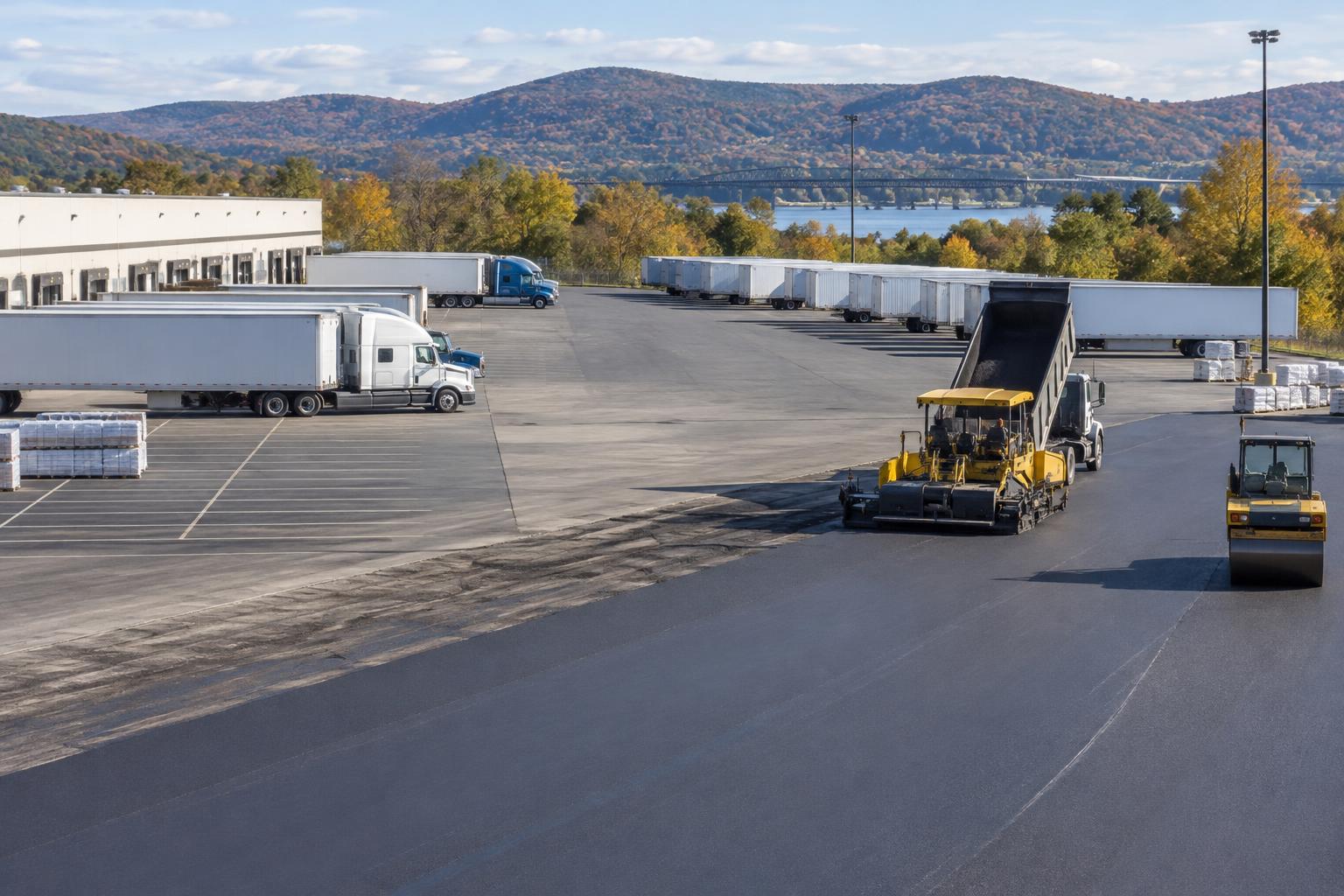
A trucking yard can often stay operational during paving, but each active work zone must close to traffic. The key is to plan around truck movements, dock access, trailer storage, and pavement reopening—not simply divide the property into equal pieces. This guide explains how to assess existing pavement, select appropriate repairs, establish workable phases, and coordinate dispatch with the paving crew. It also covers Hudson Valley weather, drainage, written scope requirements, and the preparations that help Poughkeepsie yard managers maintain freight service while work progresses.
Paving trucking and logistics yards in Poughkeepsie without stopping operations
Yes, a trucking or logistics yard can often remain open during paving. The workable approach is to close one controlled area at a time while keeping a separate, usable route between the entrance, active docks, and available trailer spaces. Trucks cannot share the active paving zone, and fresh asphalt cannot become a shortcut before it is released for traffic.
The first planning question is not how much pavement fits into one workday. It is which yard functions must remain available throughout that day. A terminal that needs continuous gate access has different constraints from a distribution yard that can temporarily shift receiving to another group of doors.
At Avello, we approach that question through the operating layout: where tractors turn, where drivers check in, where trailers wait, and where pedestrians cross. A phase boundary must leave enough room for the vehicles actually using the yard. A route that works for a pickup may not work for a tractor-trailer backing toward a dock.
Keeping the business open does not necessarily mean keeping every door and parking position available. Temporary trailer relocation, revised appointments, or a short, planned restriction at a shared entrance may still be necessary. A single-access property with no workable bypass may need an agreed traffic pause rather than a promise of uninterrupted vehicle movement.
For a Poughkeepsie operation, this plan should also keep waiting trucks inside the property rather than shifting queues onto public roads. The goal is continuous essential service with controlled adjustments, not normal traffic moving through a construction area. That distinction makes the schedule realistic from the start.
Read pavement condition alongside the yard’s truck movements
Walk the yard with both the facilities manager and someone who understands daily dispatch. Map pavement damage together with operational trouble spots. Drivers often know where loaded trailers rock, where a wheel drops beside a drain, or where backing movements repeatedly push and wrinkle the surface.
Separate surface wear from possible problems below the asphalt. Loose aggregate and shallow surface deterioration may be limited to the upper pavement. Interconnected cracking, recurring potholes, deep ruts, or movement under truck loads can point to weakness in the supporting layers and deserve closer investigation.
The base is the compacted material beneath the asphalt, while the subgrade is the underlying soil. New asphalt cannot reliably correct weak support simply by covering it. Where conditions are uncertain, pavement cores or test openings can help establish existing thickness and reveal what is underneath; the appropriate investigation depends on the site.
- Gate approaches and tight turns where tires repeatedly twist against the pavement.
- Dock approaches, trailer landing-gear positions, and long-term loaded-trailer storage.
- Ruts, settled patches, cracked utility trenches, and pavement edges without support.
- Drain inlets, standing-water areas, and locations where runoff crosses truck routes.
- Pedestrian paths, accessible parking, utility covers, and fixed dock elevations.
Review the yard after rain when practical, and ask how it behaves during spring thaw. Distinguish a depression in the asphalt from a blocked inlet or a broader grading issue. The final assessment should identify which areas can receive surface work, which need deeper repair, and which require further evaluation before a firm repair method is selected.
To understand the work behind these options, compare Avello’s industrial lot paving, milling and paving services.
Choose repairs that match both pavement needs and access limits
A busy yard does not always need one treatment across its entire footprint. The best plan may combine deeper repairs at loaded-trailer positions with milling and paving along travel lanes. Different treatments can fit within one phasing plan, provided their excavation, drainage, and reopening requirements are coordinated.
- Localized full-depth repair: Remove damaged asphalt and address unsuitable material beneath it where deterioration is concentrated. This fits isolated weak areas when the surrounding pavement remains serviceable.
- An asphalt overlay: Place a new asphalt layer over suitable existing pavement after necessary repairs. This can fit structurally sound areas where added height will not interfere with drainage, docks, gates, or accessible routes.
- Milling and paving: Remove a specified depth of existing asphalt and replace it. This helps maintain elevations at inlets and transitions, but it does not eliminate deeper support problems unless those are repaired separately.
- Reconstruction: Remove and rebuild pavement and supporting layers where widespread weakness or unsuitable grades justify more extensive work. This generally requires more staging space and a longer closure for the affected area.
Evaluate each option against the access it consumes. A deeper repair can leave an excavation that needs secure separation from traffic. Milling may preserve a usable temporary surface in some circumstances, but exposed edges, loose material, drainage, and utility covers must be evaluated before trucks are allowed across it.
Avello’s industrial lot paving and milling-and-paving services are relevant here because the work must fit an operating industrial property. The treatment should follow the condition assessment, not a preference for the fastest surface improvement. Where loading patterns or support conditions require it, an engineer can help establish the pavement section and repair limits.
Avoid selecting an overlay solely because it appears least disruptive. Raising a surface can create difficult transitions or redirect water, and covering weak areas can leave the underlying problem unresolved. Operational convenience matters, but it must work alongside a suitable repair.
Sequence the work around a continuous freight route
Start with a simple yard drawing showing the truck route that must remain available. Then place construction phases around it. Equal-sized rectangles are rarely the answer because entrances, dock aprons, and turning areas carry different operational importance.
- Confirm the active route. Check turning movements, overhead restrictions, gate clearance, pedestrian separation, and room for a disabled vehicle without blocking all access.
- Create temporary capacity. Clear an alternate trailer row or staging area before removing the first operating area from service. Confirm any off-site storage permissions and access arrangements in advance.
- Complete an initial phase that supports later work. A finished storage or circulation area can become the temporary operating space for the next phase once it is ready for traffic.
- Shift docks or trailer rows in manageable groups. Keep enough maneuvering space available for the doors that remain active, not just an open strip in front of them.
- Schedule shared bottlenecks separately. Entrance throats, scales, and narrow connections may need dedicated work windows, controlled crossings, or a planned pause in vehicle movements.
- Inspect and release each phase. Move barriers only after the contractor and designated yard representative confirm that the area is ready for its intended use.
Phase boundaries should account for the paving equipment as well as trucks. The crew needs room for material deliveries, rollers, and safe equipment movement without repeatedly crossing active freight traffic. Too many tiny phases can create extra joints and mobilizations while making the yard harder to navigate.
Construction joints—the lines where separate paving passes or phases meet—need deliberate placement and preparation. Where practical, avoid locating them in the most demanding turning or concentrated loading areas. The scope should also address temporary transitions so trucks are not expected to climb abrupt pavement edges.
Build a weather fallback into the sequence. If the next phase cannot start, dispatch should know which completed areas remain available and which closures stay in place. A fallback plan is more useful than a schedule that assumes every shift will proceed unchanged.
Give dispatch, drivers, and the paving crew one daily operating plan
A phasing drawing only works when drivers receive the current version. Assign one yard contact who can approve operational changes and one contractor contact who can confirm construction status. Dispatch, gate staff, and dock supervisors should receive the same short update before each shift affected by the work.
That update should name the open entrance, available doors, closed trailer rows, and approved waiting area. Explain whether traffic is one-way and where drivers must stop for instructions. For visiting carriers, include the changes in appointment messages rather than relying entirely on signs they will see after entering.
Arrange trailer moves before the crew arrives. Confirm that tractors and authorized drivers are available to relocate dropped trailers, including those belonging to outside carriers. A paved area cannot be cleared on schedule if no one has permission or equipment to move the trailers occupying it.
Keep construction deliveries separate from freight arrivals where possible. Asphalt trucks need a predictable approach and unloading sequence, while outbound loads need a clear exit. If routes must cross, establish a controlled crossing with assigned responsibility rather than leaving drivers to negotiate around moving equipment.
Reopening must be a positive decision, not an assumption based on appearance. Asphalt needs sufficient cooling, and readiness depends on the mix, weather, pavement section, and intended loading. Heavy turning, parked loaded trailers, and concentrated landing-gear loads may need different restrictions from straight-through vehicle travel.
Common mistakes include moving barriers early, allowing drivers to improvise routes, and assuming nighttime work removes every conflict. Night work still requires lighting, staffing, material availability, and any applicable local approvals. Before reopening, check transitions, utility covers, drainage access, markings or temporary guidance, and the separation between trucks and people.
Account for Hudson Valley weather without losing the next phase
The April–November paving season is a useful planning window in the Hudson Valley, not an assurance that every day within it is suitable. Rain, surface temperatures, daylight, and asphalt plant availability affect scheduling. Cooler conditions can reduce the time available to place and compact asphalt properly.
Spring thaw deserves particular attention in a truck yard. Moisture and thawing soil can reduce support beneath pavement even when the surface looks reasonably intact. If an opened area reveals soft or wet material, the plan should allow evaluation and correction rather than forcing the next layer into place to preserve an unrealistic schedule.
Freeze-thaw cycles make water management important at both permanent and temporary stages. Water entering cracks or weak transitions can contribute to deterioration as temperatures change. Temporary drainage must remain functional while sections are milled, excavated, or waiting for their next pavement layer.
On a sloped Poughkeepsie property, closing a downhill section can affect runoff from the entire yard above it. Check where water will go during each phase, not only after final paving. Barriers, stockpiles, and temporary ramps should not inadvertently send water toward docks, buildings, neighboring land, or active work areas.
Plowing and salt also belong in the operating review. Ask where snow is stored, whether meltwater crosses trailer lanes, and where plow blades catch uneven transitions or raised structures. Winter maintenance plans should reflect any changed islands, pavement edges, drainage structures, or traffic markings.
Leave operational flexibility between phases rather than allocating every trailer position immediately after a predicted completion time. If rain postpones paving, the yard needs a workable place for freight already scheduled to arrive. Avoid opening more pavement than the crew can reasonably stabilize and protect under the expected conditions.
Put construction details and operating commitments in the written scope
A clear scope should describe both what will be built and how the yard will function during construction. A proposal that says only “mill and pave yard” leaves too much unresolved. Attach a marked plan with repair limits, phase boundaries, and the truck routes that remain available.
- Existing-condition assumptions, investigation results, and any areas requiring further evaluation.
- Milling limits and depths, excavation limits, base repairs, asphalt materials, and specified compacted pavement thicknesses.
- Grade and drainage work, inlet adjustments, utility-cover elevations, and transitions at docks, gates, and adjoining pavement.
- Phase sequence, working windows, minimum operational access, and the method for communicating schedule changes.
- Temporary ramps, barriers, signs, pedestrian routes, controlled crossings, and responsibility for maintaining them.
- Trailer relocation, equipment staging, construction delivery access, and removal of milled or excavated material.
- Pavement joints, cleaning and bonding between layers, compaction requirements, and any specified testing.
- Traffic-release criteria, final markings, cleanup, inspection, and the process for documenting completed work.
Also state how hidden conditions will be handled. If excavation reveals unsuitable support beyond the original allowance, identify who reviews it and who authorizes a change. Dispatch should receive notice of any resulting access restriction before the contractor expands the work area.
Confirm permitting with the appropriate City or Town of Poughkeepsie building or engineering department, depending on the property’s jurisdiction and proposed work. Changes to access, drainage, grading, or public right-of-way conditions can involve additional review or another responsible agency. Assign that coordination explicitly rather than assuming it belongs to someone else.
The same applies to accessible routes and underground utilities. Identify affected pedestrian connections, arrange required utility locating before excavation, and address private utilities that may require separate locating. Written responsibility keeps these tasks from becoming last-minute obstacles to an otherwise workable phase.
Prepare the yard before the first closure: a manager’s checklist
The most useful preparation is a joint walkthrough with the phase drawing in hand. Follow the proposed truck route from gate to dock and back out. Review it against the largest regular vehicle combination and the actual backing movements, not just a passenger vehicle’s path.
Bring the upcoming freight schedule, trailer inventory, and known dock restrictions. Flag unusual arrivals, long-term storage, driver shift changes, and times when receiving and shipping overlap. This gives the contractor a realistic picture of the space that can be released without disrupting essential service.
- The work zone is empty, and someone is authorized to move any remaining trailers.
- Active docks have usable approaches and sufficient maneuvering space.
- Dispatch, gate staff, carriers, and affected tenants have the current route plan.
- Construction deliveries and freight traffic have coordinated access.
- Barriers, signs, pedestrian paths, and temporary transitions are ready.
- Drainage remains open, and underground utility coordination is complete where needed.
- The weather fallback and traffic-release decision makers are identified.
- A short handoff inspection is scheduled before the next traffic switch.
Avoid treating the checklist as a one-time kickoff document. A trailer row that was clear yesterday may be occupied by the next shift, and a usable alternate route may become a waiting area. A brief daily check is usually more practical than trying to resolve those conflicts after equipment is positioned.
The strongest plan leaves room for both freight and sound construction practices. It makes temporary limitations visible, assigns decisions to specific people, and only opens completed pavement when it is ready for its intended use. That is how a yard can keep serving customers while its pavement is renewed.
To discuss a phased paving plan for your Poughkeepsie or Dutchess County yard, call Avello Asphalt & Construction at 845-454-3650 or request a free quote.
2026 Commercial Pavement Budget Planner
A contractor-built worksheet for budgeting parking lot and roadway work: cost ranges by scope, a condition-scoring sheet, phasing guidance, a bid-comparison checklist, and the questions to ask before you sign.
Common questions
Can our yard stay open if it has only one entrance?+
Sometimes, but the entrance geometry controls the answer. There may be room to maintain a protected lane while the other portion is worked on, provided trucks can turn safely and the crew has sufficient separation. A narrow entrance may instead require short, scheduled traffic pauses. The plan should identify where arriving trucks wait without blocking a public road and how essential access is maintained.
How soon can loaded trucks use the new asphalt?+
There is no dependable universal reopening time for every yard. Cooling conditions, the asphalt mix, pavement thickness, and the intended loading all matter. Straight-through traffic is different from tight steering movements or leaving a loaded trailer on landing gear. Ask for written traffic-release criteria and any temporary restrictions. Keep barriers in place until the contractor confirms readiness for the specific use planned.
Is weekend or overnight paving the best way to avoid interruptions?+
It can help when freight volume is lower, but it is not automatically the best choice. Asphalt availability, lighting, noise requirements, crew access, and yard staffing still need coordination. Night temperatures can also affect placement and compaction. Compare the actual truck schedule with these constraints. A daytime phase with a reliable alternate route may interfere less than overnight work at a shared gate.
Can trucks drive on the milled pavement between shifts?+
In some situations, a milled surface can serve as temporary access after inspection and preparation. It must not have unsafe drop-offs, exposed structures, unstable areas, or loose material that creates a hazard. Drainage and transitions also need attention. Do not assume every milled area will remain open. The scope should identify approved temporary routes, any operating restrictions, and who maintains them between work shifts.
What should we ask a paving company about commercial paving services for a live yard?+
Ask how the company will preserve truck circulation, coordinate asphalt deliveries, separate pedestrians, and release completed phases. Request a plan showing dock access and trailer staging, not just paving quantities. Also ask how unexpected base repairs and weather changes will be communicated. A useful proposal connects the construction method to your daily operating requirements and clearly states which yard functions will be temporarily unavailable.
Do we need to move every trailer off the property?+
Not necessarily. Many phased projects move trailers between available areas as work progresses. The yard must still have enough space for safe circulation, backing, and construction access. Count usable positions rather than simply counting empty spaces on a drawing. If the property is already full, temporary off-site storage or adjusted trailer arrivals may be needed. Arrange permissions, drivers, and movement instructions before the first closure.
Avello provides free commercial pavement assessments across the Hudson Valley. No obligation — you keep the documentation either way.