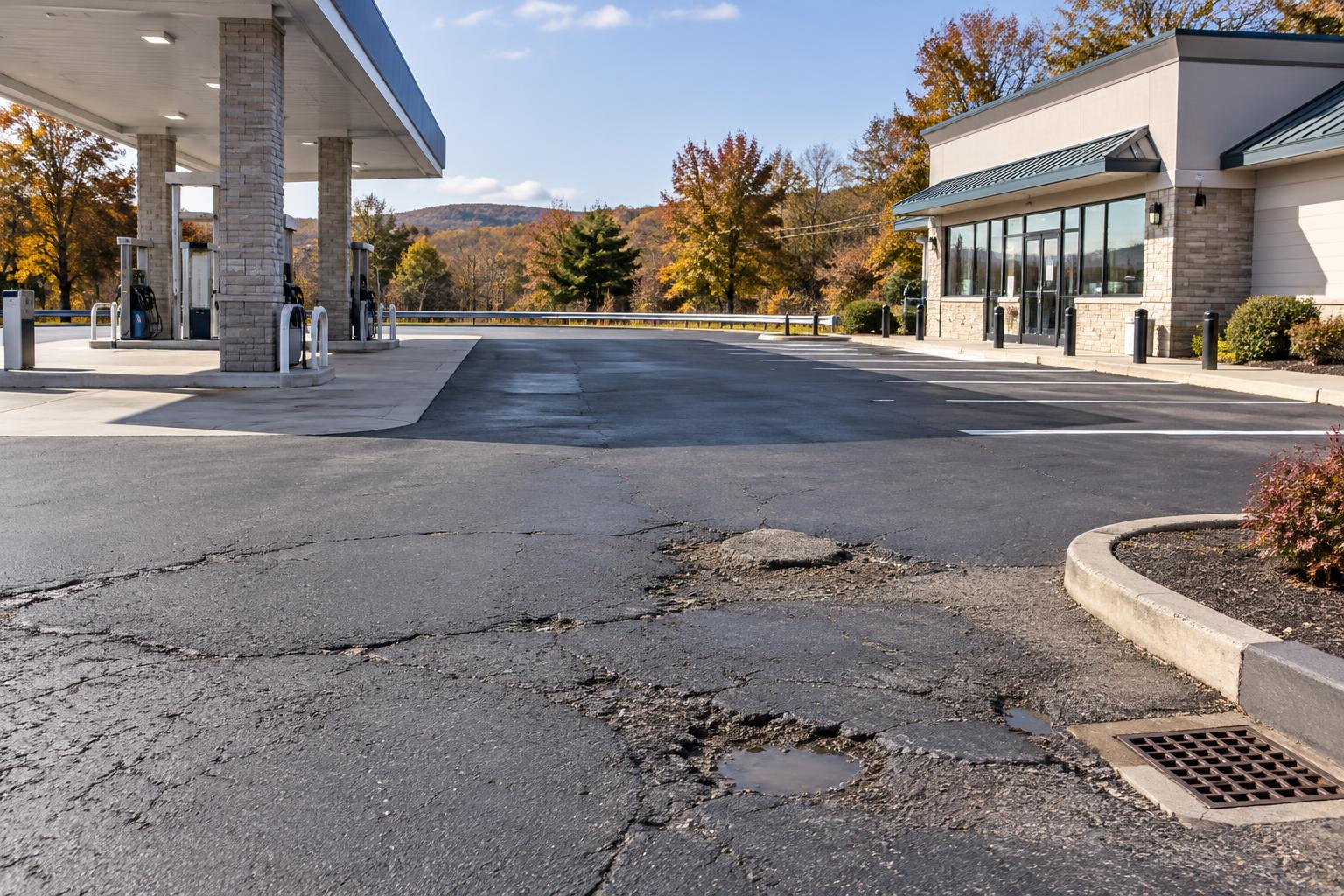
Gas stations and convenience stores should treat entrance and drive-lane potholes as both pavement problems and traffic-management problems. Start by checking whether damage is limited to the asphalt or extends into wet, loose support material beneath it. Choose temporary patching, cut-and-patch repair, or a larger repair area accordingly. Plan work around fuel deliveries, customer turns, pedestrian access, and underground fuel-system equipment. In Union Vale, freeze-thaw weather, spring-softened ground, and runoff from sloped sites all affect the repair plan. A clear scope should explain repair boundaries, drainage, operating phases, and reopening conditions.
How should gas stations and convenience stores in Union Vale handle potholes at entrances and drive lanes?
Start by separating the damaged area from traffic, then determine whether the pothole needs a temporary patch or a permanent cut-and-patch repair. Do not choose the repair solely by how wide the opening looks. A small hole over wet, loose material can need deeper work than a broad area of shallow surface wear.
For a gas station, location matters as much as condition. A pothole at the driveway throat—the narrow connection between the road and the property—affects nearly every customer. Damage beside a dispenser, tank fill connection, or monitoring cover also requires coordination with the people responsible for the fuel system.
We recommend treating the property as a series of customer movements: entering, approaching a pump, parking at the store, and exiting. Mark the damaged areas along those paths and identify where a repair closure would create a conflicting turn or block a delivery. This makes the pavement plan useful to the store manager, not just the paving crew.
- Mark potholes and loose edges, and provide a clearly defined route around the work area.
- Inspect pavement, drainage, and nearby fuel-system features before selecting the repair depth.
- Use a temporary patch where weather or operating conditions prevent permanent work.
- Schedule permanent repairs in controlled phases, then reopen each area only after the contractor releases it.
On Union Vale properties, also establish whether the damaged entrance is entirely private pavement or overlaps a public-road apron or right-of-way. That boundary can change who approves the work and how traffic must be managed. A private-lot repair should not quietly expand into road work without that check.
Read the pavement around the hole, not just the missing asphalt
Inspect the site in daylight and, if practical, again after rain. Photograph each pothole with a recognizable reference point, such as a pump island or driveway sign. Record whether water remains in the opening, whether vehicles strike its edge, and whether the same location has been patched before.
Look beyond the hole for loose stones, crumbling edges, depressions, and connected cracks. Surface wear with firm surrounding asphalt may allow a localized repair. A sunken wheel path, moving patch, or water carrying fine soil up through cracks suggests that the supporting material also needs attention.
- An isolated opening with firm edges: a localized asphalt repair may fit after loose material is removed.
- A hole surrounded by soft spots or settlement: investigate the aggregate base, the compacted stone beneath the asphalt.
- Several adjoining patches breaking apart: evaluate one larger repair footprint rather than another collection of small plugs.
- Damage beside a utility cover, concrete island, or trench: inspect the transition and coordinate with the equipment owner.
- Soft or oily pavement: identify the spill source and obtain appropriate cleanup guidance before paving.
Visual checks cannot establish the full condition beneath the pavement. The contractor may need test openings or to evaluate the base after damaged asphalt is removed. The written plan should explain how additional excavation is approved if the exposed material is wet, unstable, or otherwise unsuitable.
Keep inspection activity out of active vehicle paths and away from fuel-system openings. Store staff can document visible conditions, but they should not probe around tanks, piping, or electrical equipment. Existing fuel-system drawings and service records are more useful than assumptions about what lies beneath a pothole.
To understand the work behind these options, compare Avello’s pothole repair, parking lot repair services.
Choose between temporary patching, cut-and-patch work, and larger repairs
Temporary patching is useful when a pothole needs attention but weather, material availability, or site scheduling prevents permanent work. Cold patch is a repair material that can be placed without a hot-mix paving operation, following its product requirements. It should be compacted and monitored, especially where turning tires or plow blades can disturb it.
A permanent cut-and-patch repair usually starts by cutting back to sound pavement, removing damaged asphalt, and examining the base. Unsuitable supporting material is removed and replaced as needed before new asphalt is placed and compacted. The finished repair should meet surrounding pavement smoothly without creating a ridge or a low spot.
A larger parking-lot repair fits when several potholes occupy the same turning path or entrance strip. Joining those areas into a defined repair can reduce the number of joints exposed to turning wheels and water. That does not automatically mean the whole property needs resurfacing; the repair boundary should follow observed conditions.
Infrared asphalt repair reheats existing asphalt so it can be reworked with added material where appropriate. It may fit selected shallow defects where the base is sound, but it cannot correct wet support material or a deep depression by itself. At a fuel site, heating equipment also requires a site-specific safety review and compliance with applicable operating restrictions.
Fuel-softened asphalt needs a different conversation from ordinary winter damage. Covering contaminated or softened material does not address the source, and removed material may require special handling. Coordinate spill assessment and cleanup with qualified personnel before deciding what pavement can remain.
At Avello, we separate pothole repair from broader parking-lot repair by the actual extent of the damage. The useful question is not which method sounds most advanced. It is which method addresses the surface, support, and water conditions at that particular location.
Phase entrance and pump-lane work around real customer movements
Keeping a station operating means more than leaving a gap between cones. Drivers need enough space to enter, recognize the route, turn toward an available pump, and exit without crossing an excavation. Walk the proposed layout with the store manager before equipment arrives.
Where the property has two usable entrances, one may remain available while the other is repaired, provided the remaining driveway supports the needed movements. A single narrow entrance may require a planned closure instead. Half-width construction is only practical when the remaining pavement and turning space are adequate; it should not be assumed.
- Confirm delivery schedules, customer peaks, approved access routes, and any required permissions.
- Set barriers and directions before cutting pavement, and close affected pumps where necessary.
- Remove damaged material, inspect the exposed base, and complete approved supporting repairs.
- Place and compact asphalt, finish transitions, and remove debris from adjoining travel lanes.
- Check the completed phase and reopen it when conditions permit before moving barriers to the next area.
Fuel deliveries need their own review because a tanker’s path and unloading position can occupy much more space than a passenger vehicle. Do not schedule excavation across fill access or expect a tanker to improvise a route through the work area. Coordinate deliveries with the supplier and preserve required access to site safety equipment.
Customers also need a usable walking route from available parking and pumps to the store. Keep that route separated from machinery and open pavement, including the accessible entrance connection. Reopening should depend on asphalt temperature, stability, weather, and expected turning loads—not simply on whether the crew has finished placing material.
Account for Union Vale weather, plows, and downhill runoff
Hudson Valley freeze-thaw cycles let water enter pavement openings, freeze, expand, and loosen surrounding material. Passing vehicles then break away weakened edges. A patch that leaves water flowing through the same joint may require repeated attention even if its surface initially looks smooth.
Spring thaw can leave the support beneath asphalt wet and soft. That is why a permanent repair may require more than removing the visible pothole, particularly in a low entrance or wheel path. Excavation should reach material that can support proper compaction rather than stopping at an arbitrary depth.
April through November is the general paving season in the Hudson Valley, not a promise that every day within those months is suitable. Rain, cold surfaces, overnight temperatures, and asphalt-plant availability influence scheduling. During colder periods, a temporary repair may provide a practical bridge to suitable permanent-repair conditions.
Plowing can catch raised patch edges or pull loose material from an already worn opening. Deicing salt helps maintain winter access, but it does not prevent moisture from entering cracks or the pavement base. Review snow-storage locations so melting piles do not repeatedly feed an entrance pothole or block a drainage inlet.
On sloped Union Vale sites, follow water from the uphill edge through the fuel area and toward its intended outlet. A repair should not create a small dam that sends runoff toward the store, onto an accessible route, or into the public road. Changes to fuel-area drainage may also affect spill-control arrangements and deserve review beyond the paving surface.
For work that changes a driveway apron, road connection, or drainage arrangement, confirm requirements with the Town of Union Vale’s appropriate building or engineering contact. The road-owning agency may also need to approve work within its right-of-way. Establish those responsibilities before setting the construction schedule.
Put repair boundaries, fuel-site protections, and reopening in writing
A clear scope gives the owner, manager, and contractor the same picture of what will happen. For a gas station, it should connect each repair area to an operating phase and identify nearby fuel-system equipment. A marked photograph or simple site sketch often makes the written description easier to follow.
- Repair locations, measured boundaries, and how cuts will extend into sound pavement.
- Asphalt removal depth and the process for inspecting and approving additional base work.
- Replacement base material, asphalt mix, compacted thicknesses, and placement requirements appropriate to the location.
- Compaction equipment suited to the repair dimensions and protection of adjacent concrete and equipment.
- Finished grades, drainage direction, joints, and smooth transitions at covers, islands, and existing pavement.
- Utility locating, private fuel-system verification, and responsibilities for protecting tanks, piping, and electrical components.
- Traffic barriers, pump closures, customer walking routes, delivery coordination, and reopening decisions.
- Debris removal, any pavement-marking restoration, exclusions, and handling of unexpected conditions.
Avoid a scope that simply says “fill potholes” when the proposed work includes excavation or permanent asphalt replacement. It should distinguish a temporary patch from a repair intended to replace damaged pavement and support. Otherwise, two parties can use the same phrase while expecting different work.
Changes also need a defined approval path. Name the person who can authorize additional removal, and explain how the contractor will document conditions before proceeding. This is especially useful when a regional facilities manager controls spending but a local store manager supervises daily access.
Prepare the property with a short manager’s checklist
Good preparation starts with information the store already has. Share fuel-delivery times, busy periods, prior patch locations, drainage complaints, and any recent underground work. Include site drawings and fuel-system service contacts where available, while recognizing that drawings still need field verification.
Arrange required utility locating before excavation and identify private systems that may need separate locating. Do not assume a public utility mark identifies every privately owned fuel line or electrical conduit. Agree on who will coordinate with qualified fuel-system personnel if work approaches those features.
- Confirm the work areas and the entrance, pumps, and parking spaces affected in each phase.
- Coordinate fuel, food, beverage, and waste-service deliveries with the repair schedule.
- Move portable displays, bins, and other items out of the work and equipment-access areas.
- Share underground-system records and confirm locating responsibilities.
- Approve customer directions and a protected walking route to the store.
- Identify one on-site contact and one person authorized to approve changes.
- Confirm weather updates, cleanup expectations, and who authorizes reopening.
Brief every shift, not just the manager present when the crew arrives. Staff should know which pumps are unavailable, where customers should enter, and whom to contact if a barrier is moved. Clear directions reduce the chance that a cashier gives customers a route that conflicts with the contractor’s layout.
Use the reopening discussion to review the next operating period as well. A surface ready for ordinary access may still need care around tight stationary steering or heavy deliveries while it cools further. Follow the contractor’s site-specific instructions rather than assuming every repaired area behaves the same way.
Avoid repeat-patch habits and inspect the repair after reopening
The most common mistake is adding material without removing loose edges or evaluating what supports the patch. Another is building a mound above the surrounding asphalt in the hope that traffic will finish compacting it. That can leave an uncomfortable transition, redirect water, and expose the patch to plow contact.
Compaction matters particularly at entrances because vehicles brake, accelerate, and turn across the same small area. A repair needs equipment that can compact its corners and edges, not just its center. Narrow or irregular openings may need to be enlarged into a practical shape for proper construction.
Other mistakes are operational: leaving confusing cone gaps, scheduling a fuel delivery during excavation, or reopening a pump approach before the new asphalt can tolerate turning traffic. Treating fuel-system covers as ordinary pavement obstacles is another avoidable problem. Their access and protection need to remain part of the plan from inspection through cleanup.
After reopening, inspect the repair following rain and during routine property walks. Look for standing water, loose edges, settlement, and a noticeable step at the joint. Keep dated photographs so a new change can be distinguished from an older surrounding pavement condition.
For practical asphalt parking lot maintenance guidelines, start with that simple record, keep drainage paths clear, and review recurring damage rather than endlessly repeating the same patch. We approach entrance and drive-lane repairs as part of how the business actually works. The aim is sound pavement, understandable access, and a repair plan the manager can use.
To discuss pothole repair or parking-lot repair in Union Vale, call Avello Asphalt & Construction at 845-454-3650 or request a free quote.
2027 Commercial Pavement Budget Planner
A contractor-built worksheet for budgeting parking lot and roadway work: cost ranges by scope, a condition-scoring sheet, phasing guidance, a bid-comparison checklist, and the questions to ask before you sign.
Common questions
Can we stay open while entrance potholes are repaired?+
Often, but the site layout determines what is practical. Two suitable driveways may allow one entrance to remain available while the other is repaired. A single narrow entrance may need a planned closure. The contractor should review turning space, customer walking routes, pump access, and delivery movements before proposing phases. Remaining open should not depend on customers driving beside an unprotected excavation.
Should we use cold patch during winter?+
Cold patch can be a practical temporary option when hot-mix work is not suitable or available. The opening still needs preparation and compaction according to the material’s requirements. Turning tires, moisture, and plowing can disturb temporary patches, so include them in routine inspections. When conditions improve, reassess whether permanent cut-and-patch work or a deeper base repair is needed.
Is infrared asphalt repair a good choice near fuel pumps?+
It is not an automatic choice. Infrared repair uses heat, so proximity to dispensing equipment, tank connections, and potential vapors requires careful review under applicable site safety rules. It also suits only certain pavement conditions. It cannot correct an unstable base or replace needed excavation. The method should be selected after both pavement suitability and fuel-site restrictions are understood.
Why does the same pothole return after patching?+
Recurring damage often points to an unresolved condition: water entering the repair, loose surrounding asphalt, insufficient compaction, or weak supporting material. Repeated turning loads can also expose weaknesses in a small patch. The next inspection should include the surrounding pavement and water path, not just the opening. Removing a larger defined area may reveal what repeated surface filling has left untouched.
How soon can cars and fuel deliveries use new asphalt?+
There is no single reopening time that fits every patch. Asphalt temperature, weather, repair thickness, compaction, and vehicle movements all matter. Tight turns and heavy delivery traffic place different demands on a repair than straight passenger-car travel. Ask for reopening criteria in the scope and a field decision after placement. Schedule fuel deliveries around that decision rather than a presumed clock time.
Do entrance repairs require permission from Union Vale?+
Requirements depend on the location and nature of the work. Confirm with the town’s appropriate building or engineering contact whether a proposed repair needs review, particularly if it changes drainage or the driveway connection. Work within a county or state road right-of-way may involve that road-owning agency as well. Establish property boundaries and approval responsibilities before construction is scheduled.
Avello provides free commercial pavement assessments across the Hudson Valley. No obligation — you keep the documentation either way.