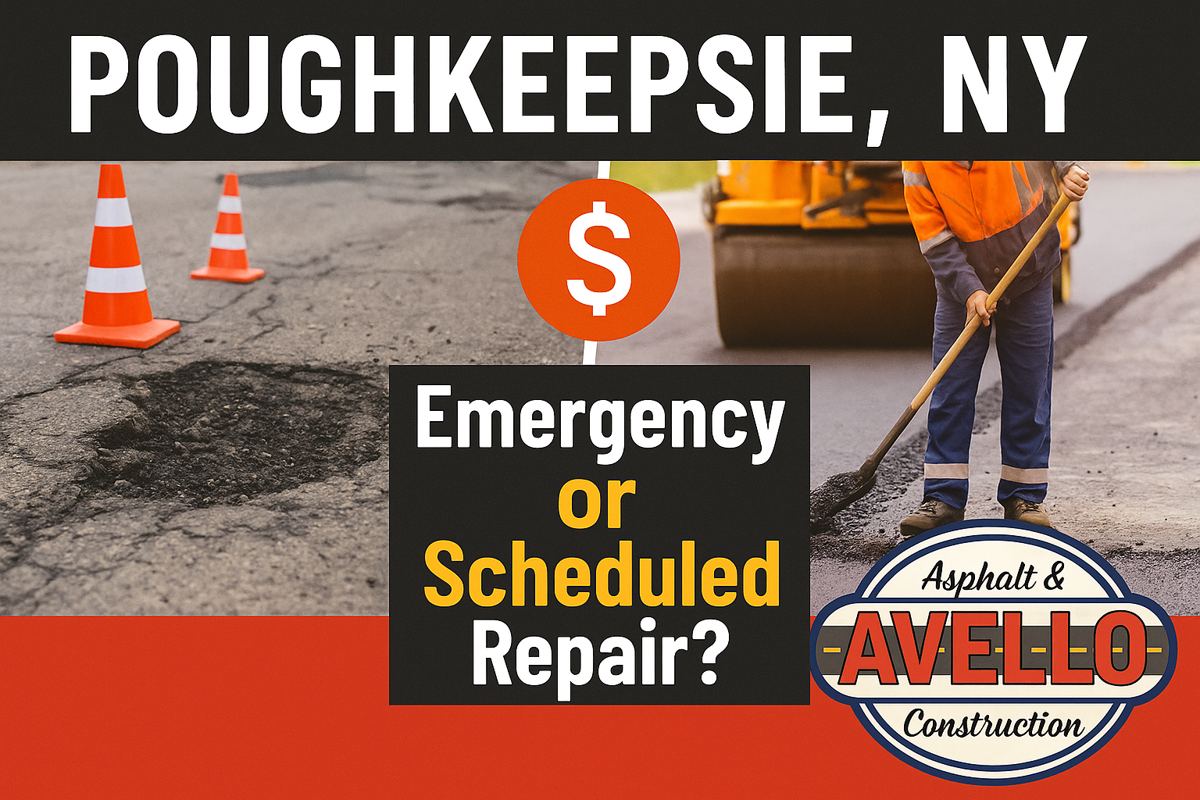
The right response depends on location, depth, loose material, traffic, water, and whether the surrounding pavement is stable. A rapid repair can restore safer use until permanent work is practical. A scheduled repair allows better preparation, defined limits, traffic planning, and correction of underlying conditions. Some potholes are isolated; repeated potholes can signal drainage or support problems that deserve a broader review.
Choose the response by risk and condition
A pothole in a low-speed corner is different from one in an entrance, accessible route, fire lane, truck path, or busy travel lane. Consider how people and vehicles encounter it, whether loose material is spreading, and whether water is present. The immediate objective may be to restore use safely; the permanent objective is to address the full damaged area.
When a rapid response is useful
- The defect is in a critical travel or access path.
- Loose material or sharp edges are affecting normal use.
- Weather or operating constraints prevent full permanent work.
- A temporary repair is needed to stabilize the area until a planned construction window.
- The property needs a documented short-term action while a larger scope is reviewed.
What scheduled repair makes possible
Planned repair allows the contractor to define limits beyond broken edges, remove unsuitable material, inspect the base, correct localized support where needed, compact in controlled lifts, and create sound transitions. It also allows the property to communicate closures, move vehicles, redirect deliveries, and protect pedestrian routes.
Look beyond the hole
- Is the surrounding pavement cracked or moving?
- Does water pond or flow through the area?
- Has the same location been repaired before?
- Do trucks turn, brake, or stand there?
- Is the defect next to a drain, trench, utility, curb, or pavement edge?
- Are similar defects appearing along the same route?
Seeing this on your property?
Avello walks the lot, scores the pavement, and gives you written findings — free, no obligation.
Temporary and permanent are different scopes
A temporary repair is not necessarily poor work when its limited purpose is stated clearly. It becomes a problem when it is presented as permanent without addressing unstable edges, support, or drainage. The proposal should identify the intended service, preparation, material, and conditions that may affect longevity.
Coordinate the work with the property
For busy Poughkeepsie properties, the repair plan should account for peak traffic, deliveries, school or resident schedules, emergency access, and reopening. Several repairs can often be grouped into logical zones to reduce repeated disruption.
Talk through the right level of repair
Avello can review the pothole and the pavement around it, explain whether a short-term response is appropriate, and outline a permanent repair or broader plan when needed.
2026 Commercial Pavement Budget Planner
A contractor-built worksheet for budgeting parking lot and roadway work: cost ranges by scope, a condition-scoring sheet, phasing guidance, a bid-comparison checklist, and the questions to ask before you sign.
Common questions
Is a temporary pothole repair ever appropriate?+
Yes. It can restore safer use when weather, access, or timing prevents permanent work, provided its temporary purpose is clear.
Why do potholes return in the same place?+
Recurring defects may involve water, unstable support, traffic loading, weak edges, or a repair that did not extend to sound pavement.
Does the entire lot need paving because of potholes?+
Not automatically. Isolated potholes can be repaired. Repeated defects across several areas may justify a condition review and phased plan.
Can repairs be done while the property stays open?+
Often, yes. Work zones can be phased around access and traffic, though the affected area must remain closed during preparation, placement, compaction, and initial reopening time.
What photos help when requesting a review?+
Include a close view, a wider view showing location and traffic, any standing water, nearby drains or edges, and something that gives a sense of scale.
Avello provides free commercial pavement assessments across the Hudson Valley. No obligation — you keep the documentation either way.