Bollards vs Wheel Stops: Equipment Protection in Hopewell Junction New York
Avello's take
In this guide, we explain how bollards and wheel stops serve different purposes at manufacturing facilities in Hopewell Junction. Wheel stops help position parked cars and light vehicles. They are not designed to protect equipment from moving industrial vehicles. We look at how vehicle routes, equipment locations, and access needs shape barrier choices. The guide also covers foundations, pavement conditions, and placement that keeps walking routes clear.
For Hudson Valley property owners and facility managers, those details matter well beyond the choice of a post or parking block. Freeze-thaw cycles can shift footings and crack pavement around posts. Surface-mounted bollards generally need suitable structural concrete, rather than asphalt alone, for anchoring. A sensible next step is a site review that maps traffic, identifies what needs protection, and checks pavement and drainage at proposed locations. That gives planning a practical starting point before a barrier layout or installation schedule is settled.
Key Takeaways
- Wheel stops position parked cars and light vehicles; they are not built to stop a forklift, delivery truck, or other moving industrial vehicle from reaching equipment
- Choosing the right barrier depends on how vehicles move through the site, what needs protecting, and how much access must stay open, not simply which post looks sturdiest
- Structural surface-mounted bollards generally need a proper concrete foundation; asphalt alone usually cannot anchor one safely
- Hudson Valley freeze-thaw cycles can shift footings and crack pavement around posts, so drainage and foundation depth deserve attention before installation begins
- Phased installation can keep receiving areas open during the work, as long as the schedule separates active construction from curing time
Manufacturing plants juggle forklifts, delivery trucks, parked cars, and foot traffic in the same square footage, often within a few feet of expensive equipment. Picking the wrong piece of hardware to manage that traffic is an easy mistake to make, and an expensive one to fix after a vehicle strike. Avello Asphalt & Construction Corp's guide to bollards, wheel stops, and protection at manufacturing facilities breaks down how facility teams in Hopewell Junction can match the right barrier to the right risk.
Wheel Stops Won't Stop a Forklift
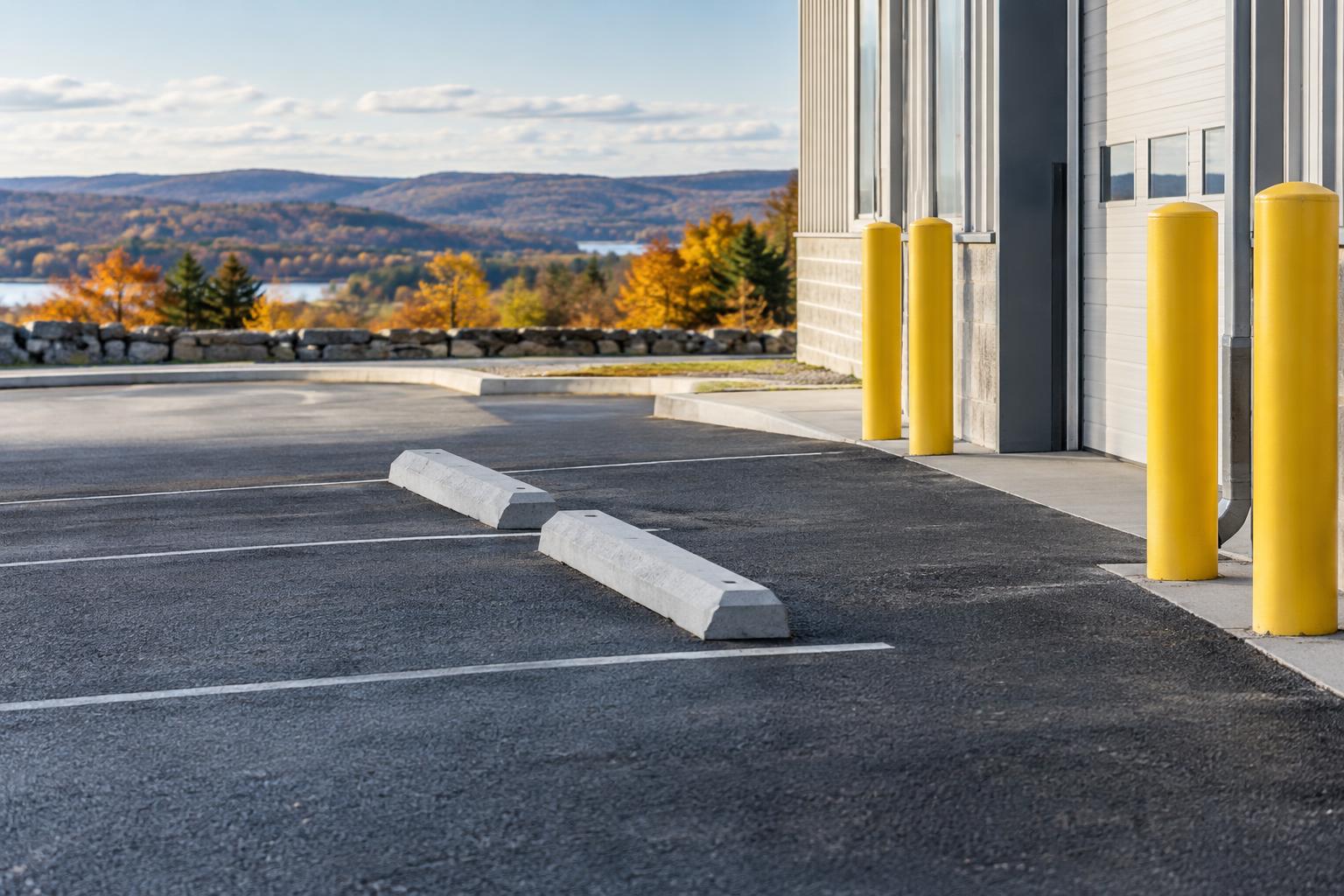
Wheel stops do one job well: they give drivers a physical cue for where to stop a parked vehicle. That is useful in an employee lot or a visitor space, where the goal is tidy, consistent parking rather than crash protection.
Problems start when a wheel stop gets asked to do a bollard's job. A low concrete or rubber block positioned for a sedan has no chance against a forklift, pallet jack, or box truck moving at even a slow speed. Equipment, building corners, electrical cabinets, and piping connections exposed to that kind of moving traffic need a barrier engineered for impact, not a parking aid repurposed as a shield. Facilities that rely on wheel stops to guard process equipment are often working from an assumption that has never been tested against an actual vehicle strike.
Matching the Barrier to the Risk
The right barrier depends on what is being protected, how vehicles move near it, and how much access needs to stay open. A shipping-door jamb facing regular truck traffic has a different exposure than an outdoor electrical cabinet near an employee walkway, and a one-size-fits-all approach to bollard spacing rarely holds up once real traffic patterns are mapped out. Fixed, embedded bollards often suit permanent assets where a dedicated foundation can be built. Surface-mounted bollards can work where the existing concrete is strong enough and the anchoring details match manufacturer requirements. Removable bollards offer occasional access for equipment swaps or maintenance, provided someone manages the keys, storage, and ice-free sockets. A longer exposed edge may call for an engineered rail instead of a row of individual posts.
Why Foundations Decide What Protects What
A bollard's visible post is only part of the system. Embedded bollards rely on a complete post-and-foundation assembly, where loads travel from the steel into a concrete footing sized for the expected impact. Treating the post and its foundation as separate decisions is one of the more common planning errors, since a foundation built for light-duty use will not suddenly perform better because a heavier-looking post sits on top of it.
Surface-mounted bollards raise a related concern. These systems generally need suitable structural concrete to anchor into, and asphalt alone is typically not an appropriate substrate for that kind of anchor. Existing concrete still needs a look at thickness, reinforcement, cracking, and edge distance before anyone assumes it can take a new mounting system.
Placing Wheel Stops Without Creating Trip Hazards
Wheel stops that make sense from a parking standpoint can become a hazard if they land in a walking path. Good placement keeps wheel stops centered in the parking space, sized no wider than the vehicle itself, and finished in a contrasting, ideally retroreflective color so people can see them clearly. Leaving roughly three feet of open space between stops gives pedestrians room to pass without stepping over hardware. Positioning each stop so a parked vehicle's bumper does not hang over an adjacent sidewalk helps keep that pedestrian route clear, and wheel stops should stay measured from where the vehicle actually stops rather than from the painted stall line alone. At accessible parking spaces and their access aisles, wheel stops can actually help by keeping vehicle overhangs from narrowing the required clear width, so placement there deserves the same deliberate approach as anywhere else on site.
Checking the Pavement Before Anchoring Anything
Before any post goes in the ground, a walking inspection of every proposed location pays for itself many times over. Look for cracking around existing anchors, depressed pavement, loose aggregate, patched utility cuts, standing water, and movement at concrete edges, then mark what is found on a simple site plan. A shallow surface chip might need only a small patch, while interconnected cracking and settlement often point to weakness in the base material underneath.
A leaning or damaged post deserves the same scrutiny. It could reflect a vehicle strike, frost movement, a cracked footing, or some combination of all three, and simply replacing the cover without investigating the cause tends to invite a repeat failure. Old anchor holes, abandoned foundations, and recent excavation areas are worth noting too, since they can signal unknown conditions below the surface. Where records are incomplete, a core sample or small test opening can help confirm what the pavement structure can actually support before a final design gets locked in.
Laying Out Protection Around Real Plant Traffic
A layout drawn from a midday walkthrough can miss the traffic that actually defines the risk. Shift changes, waste collection, maintenance lifts, and delivery windows all bring different vehicles through the same space, and a workable plan accounts for all of it rather than just the cars visible during a single visit.
Truck Turning, Backing, and Equipment Service Clearances
Truck bodies, mirrors, and rear overhang often swing outside the tire path, which means setting posts from a parking stripe alone can leave a barrier too close for comfort. A turning-path review, or a controlled field observation during an actual delivery, tends to reveal clearance needs that a tape measure on an empty lot cannot. Barriers also need enough standoff distance from the asset they protect, since some systems are designed to move or deform slightly under impact. Maintenance access matters just as much: a technician standing beside an electrical cabinet needs room to open doors, pull cable, or remove a panel without a bollard in the way.
Keeping Pedestrian and Accessible Routes Clear
Protection near entrances should guide people naturally rather than squeeze them into tight gaps. Wheel stops need to stay out of walking routes entirely, and bollard lines should intercept vehicle paths without blocking required exits or accessible circulation. Reviewing the proposed layout with the facility's safety lead, alongside whoever manages applicable accessibility requirements, catches conflicts before concrete gets poured. Before any excavation starts, coordinating the required utility-location process matters, since manufacturing sites often carry private electrical feeds, process lines, and communication cabling that public utility markings do not cover.
Surviving Hudson Valley Freeze-Thaw and Snowplows
Winter in the Hudson Valley puts foundations through real stress. Footings set above the local frost line can shift upward as the ground freezes and thaws, which can misalign a bollard or crack the pavement around it. Water that backs up behind frozen or clogged bollard drains adds to that movement, so drainage detailing around each foundation deserves the same attention as the foundation itself.
Snowplow operators create a different kind of risk. A plow driver who cannot clearly see a post is liable to strike it, damaging the plow and the bollard alike. Planning snow-storage areas and plow routes as part of the layout, rather than as an afterthought, reduces that risk considerably. For locations where bollards need to come out seasonally to ease plowing, removable sleeves can be specified for exactly that purpose. Visible marking and a routine inspection after winter maintenance help catch misalignment or foundation cracking before it becomes a bigger repair.
Phasing Work to Keep Receiving Open
Installation does not have to shut down an entire facility at once. Dividing the work into zones, built around the plant's actual operating calendar rather than a generic construction schedule, can keep receiving, shift changes, and maintenance access running while work proceeds elsewhere. That typically means confirming the layout and utility information up front, setting temporary barriers and alternate routes, then sequencing excavation, foundation work, and pavement restoration zone by zone.
Curing time deserves its own line in the schedule, separate from active construction. A concrete surface that looks dry is not automatically ready for anchors or vehicle loading, and release criteria should come from the product and design requirements rather than a visual guess. Where an existing protected asset has to stay in service, agreeing on temporary separation before removing old hardware keeps the exposure from growing during the transition. A brief handoff walkthrough between phases, checking for loose anchors, open sockets, and leftover debris, keeps a reopened zone genuinely ready for traffic.
Protection Fails Without Foundation Coordination
A protection plan built around posts alone, without matching attention to foundations, pavement restoration, access, and winter conditions, tends to fail at the point nobody was watching. A bollard with an undersized footing, a wheel stop sitting in a walking path, or a foundation that traps water near the frost line can all look fine on installation day and cause problems months later. Coordinating these pieces together, rather than treating hardware as separate from the pavement work around it, keeps a protection system doing its job through a full Hudson Valley year.
For a facility weighing bollards against wheel stops for the first time, starting with an honest inventory of vehicle movement and protected assets makes every other decision easier. For planning a layout that holds up through freeze-thaw cycles and keeps receiving open during construction, a coordinated bollard and wheel stop installation plan is a practical place to begin.
Company: Avello Asphalt & Construction Corp City: Poughkeepsie Address: 141 Daley Road Website: https://www.avelloasphalt.com
Mentioned in this blog post: Hopewell Junction service area, Poughkeepsie service area
Have a property like this?
Tell us what you're seeing. We'll walk the site, explain the options plainly, and give you a clear scope.
Related Avello guidance
More blog posts
- Why Utility Trench Patches Fail - Beacon NY Medical Office Asphalt Paving Repair
- Speed Bumps at Housing Authorities: Placement & Plow Clearance - Poughkeepsie
- Does Restriping Fix ADA Bank Parking? - East Fishkill Paving Contractor Explains
- 10-Year Asphalt Pavement Plan for Office Parks - Poughkeepsie Paving Contractor