Why Asphalt Bids Vary So Much? Red Hook, NY Paver Explains Senior Living Sites
Key Takeaways
- Two paving bids for the same Red Hook senior living lot can look completely different because one includes milling, failed-area repairs, or drainage tie-ins that the other simply leaves out
- A trustworthy bid spells out repair quantities, compacted asphalt thickness, milling depth, base work, and striping in enough detail to compare line by line against a competing proposal
- Resurfacing costs shift based on how much pavement must be milled out, how many failed areas need rebuilding, and how much of the property must stay open to residents and medical transport during the work
- A written scope should explain what is proposed, why it makes sense, and what the pricing covers
- Reviewing bids side by side for exclusions and assumptions often reveals the real reason one total is thousands of dollars higher than another
Reviewing paving bids for a senior living community rarely comes down to picking the lowest number at the bottom of the page. Two contractors can walk the same parking lot, write proposals for the same general area, and still land on totals that differ by a wide margin. The reason almost always traces back to what each bid actually includes, not how skilled or honest either contractor happens to be.
Same Lot, Wildly Different Bids
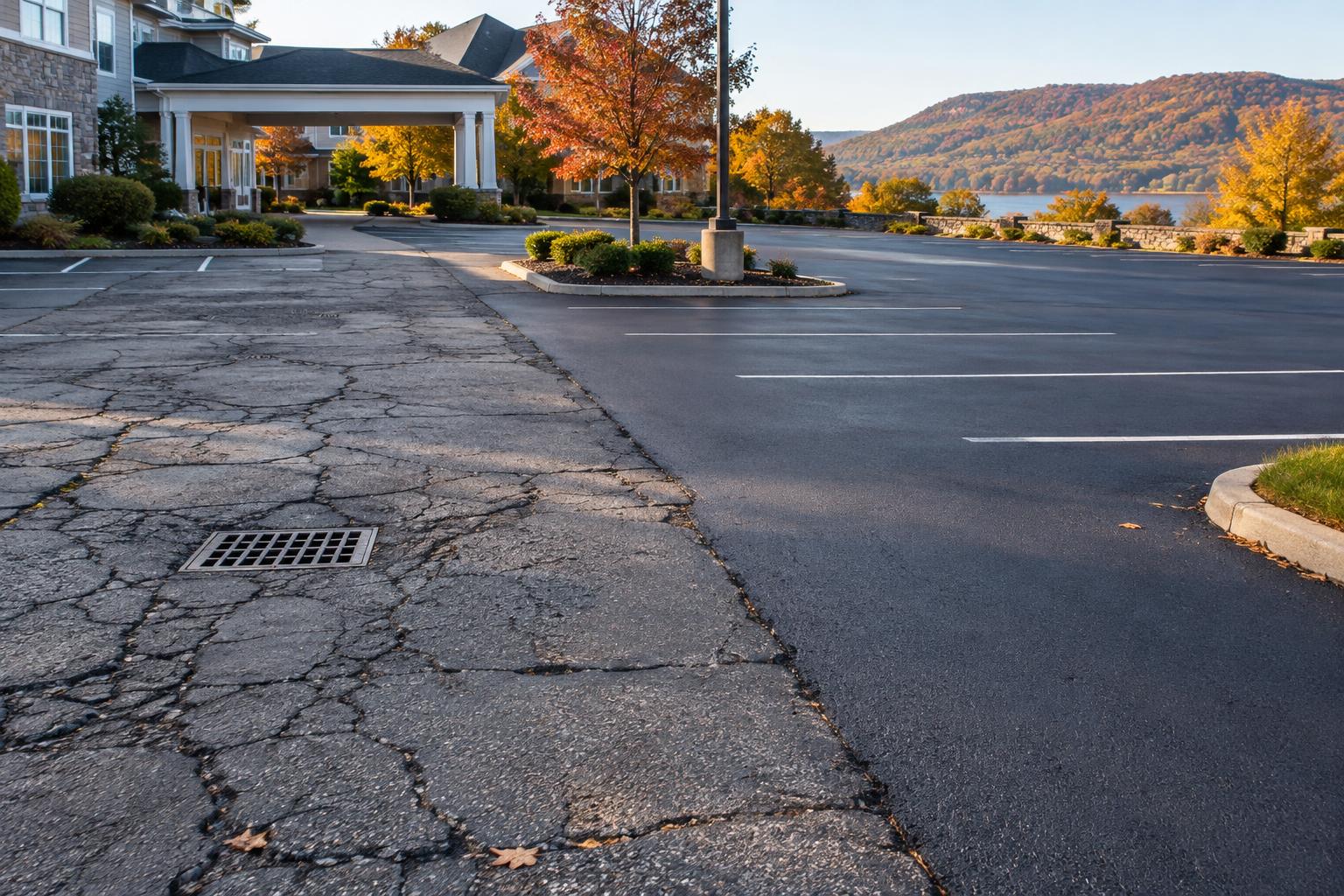
Picture two bids sitting side by side on a facilities manager's desk, both for the same entrance drive and resident parking area. One comes in noticeably lower, and it's tempting to assume the higher bid is padded or the lower one is a great deal. In reality, the gap usually traces back to scope differences that aren't obvious at a glance: one contractor may have priced a simple overlay, while the other planned to mill out failed sections first and rebuild the base underneath.
This matters more for senior living communities than almost any other property type. Residents depend on stable, predictable walking surfaces and clear vehicle access for everyday life and for emergencies. A bid that skips necessary repairs to hit a lower price can leave a property with pavement that fails again within a year or two, creating safety hazards and unplanned costs right when a board or administrator thought the project was finished.
Comparing Red Hook senior living paving bids comes down to reading the written scope behind each number, line by line, before deciding which bid actually solves the property's pavement problem.
Read the Scope Before the Price
A proposal's price only carries meaning once the scope behind it is understood. The written scope should describe exactly what condition the pavement is in, what repairs are planned, and how deep the work goes. Skipping this step is how two very different projects end up compared as if they were identical.
What Pavement Condition Findings Should Show
A solid pavement assessment starts with reviewing maintenance history and visually inspecting the surface before any repair approach gets chosen. Cracking patterns, alligatored areas, standing water, and edge deterioration all point to different things happening below the surface. When a visual review alone doesn't give a clear enough picture, cores can be pulled to examine both the existing asphalt and the subbase underneath it.
A bid built on a documented condition assessment should spell out findings in plain terms: where the pavement is failing, how severe the damage is, and why a particular repair method was chosen. If a proposal jumps straight to a price without describing what was found on-site, that's a sign the scope needs more detail before it can be fairly compared to another bid.
Repair Quantities, Milling Limits, and Depth
Quantities are where bids quietly diverge the most. One proposal might call for milling 2 inches across the entire lot, while another mills only the worst sections and resurfaces the rest. Milling removes existing asphalt down to a chosen depth, creates a surface that new pavement can properly bond to, and can help correct drainage grades. Removing too little leaves damaged material in place; removing too much wastes material and money.
A clear bid should state:
- The square footage of pavement being repaired versus simply resurfaced
- The milling depth and the total area being milled
- The compacted asphalt thickness planned for the new surface
- The square footage of base repair, where the subgrade itself needs rebuilding
Pavement thickness also needs to match the traffic the lot carries and the strength of the soil underneath it. A senior living community's main loop, used by delivery trucks and medical transport vehicles, needs a sturdier design than a quiet overflow parking area. When soil conditions underneath a lot aren't well understood, they're generally treated as poor in pavement design, which calls for a thicker section to carry the same traffic safely.
Features Easy to Overlook on Paper
Some of the most consequential differences between bids have nothing to do with the asphalt itself. Drainage and accessibility work can add real cost, and traffic control planning can make or break how livable a property stays during construction.
Drainage Work and Resident Accessibility
Drainage problems rarely show up as a separate line item unless a bid specifically calls them out. Adjusting catch basins, raising utility covers to match a new grade, and correcting low spots that collect water all take extra time and material. A bid that quietly skips this work may look cheaper, but standing water left unaddressed tends to accelerate pavement failure in the exact areas residents and staff cross most often.
Accessibility deserves the same written confirmation. ADA-compliant access routes need specific slopes, smooth transitions, and durable surfaces that hold up over time, especially along paths used by residents with mobility devices. A bid should state plainly whether accessible routes are being rebuilt to current standards or simply resurfaced over existing grades that may already be out of compliance.
Traffic Control, Phasing, and Open Access
For an occupied senior living site, how the work happens matters as much as what work happens. Phasing a project in sections allows one part of a lot to stay open while another is under construction, which keeps main entrances and emergency routes clear. Clear safety boundaries, barricades, and signage protect residents and staff from wet asphalt, equipment, and temporary grade changes during active work.
A detailed bid should describe how traffic control will be handled throughout the project, including how medical transport and emergency vehicle access stay open at every phase. It should also address how temporary pavement edges or lips will be managed so they don't become trip hazards between phases. A bid silent on these details may be assuming a level of site disruption that a senior living community simply cannot accept.
Why the Totals Don't Match
Once the scope differences are visible, the price gap usually makes a lot more sense. The totals rarely reflect two contractors pricing the same job differently. They usually reflect two different jobs being compared as though they were one.
Common Line Items One Bid Skips
Some items get left out of lower bids more often than others, usually because they're easy to omit without the omission being obvious:
- Milling and the disposal of removed asphalt
- Full-depth base repair in failed areas, rather than resurfacing over them
- Drainage adjustments, including catch basin and utility cover work
- Striping and ADA-compliant markings after paving is complete
- Traffic control, phasing, and mobilization costs for occupied sites
Any one of these left off a proposal can account for a meaningful chunk of the price difference between two bids for the same lot.
What Each Paving Approach Typically Costs
Different repair approaches carry very different price ranges, which is part of why totals can vary so widely depending on which approach each contractor proposes. Installed cost ranges generally run as follows: sealcoating and crack sealing cost between $0.35 and $0.75 per square foot, patching and localized repair cost between $4.00 and $9.00 per square foot, an overlay costs between $3.50 and $6.50 per square foot, mill-and-overlay work costs between $5.00 and $9.00 per square foot, and full-depth removal and replacement costs between $8.00 and $15.00 per square foot.
Sealcoating alone is a maintenance step and does not address a failing base, so a very low bid built around sealcoating does not compare fairly against a bid proposing structural repair. On a 20,000 square foot lot, sealcoating with two coats of asphalt emulsion, crack preparation, mobilization, and traffic control runs around $0.34 per square foot, while an overlay for a similarly sized lot runs roughly $36,095. Those figures show why reading the scope first changes how a number on a page should be interpreted.
A Side-by-Side Bid Checklist
Comparing bids becomes far more manageable with a consistent list to check each proposal against. Before signing anything, it helps to confirm each bid states:
- The documented pavement condition findings and how they were determined
- The square footage of repair work versus resurfacing, listed separately
- The milling depth and total area being milled
- The compacted asphalt thickness for the new surface
- Any base repair or subgrade work, including square footage
- Drainage adjustments, including catch basins and utility covers
- Whether ADA-compliant access routes are being rebuilt or resurfaced
- Traffic control and phasing plans for keeping the site operational
- Striping and pavement markings included after paving
- Exclusions, meaning anything explicitly not covered by the price
Walking through this list against every bid received turns a confusing stack of numbers into a much clearer comparison.
Compare Scope First, Price Second
The lowest total on a proposal rarely tells the whole story on its own. A bid that costs more upfront but includes full-depth repair of failed areas, correct drainage adjustments, and a phasing plan that keeps emergency access open is often the better long-term value for a senior living property, even if the number at the bottom looks less appealing at first glance.
Taking the time to line up each bid's scope, quantities, and exclusions before comparing totals protects both the budget and the residents who depend on safe, predictable access every day. For communities working through this process, Avello Asphalt & Construction Corp's bid-comparison checklist for commercial paving projects can make it easier to ask the right questions before any contract gets signed.
Company: Avello Asphalt & Construction Corp City: Poughkeepsie Address: 141 Daley Road Website: https://www.avelloasphalt.com
Mentioned in this blog post: Poughkeepsie service area, Red Hook service area
Have a property like this?
Tell us what you're seeing. We'll walk the site, explain the options plainly, and give you a clear scope.
Related Avello guidance
More blog posts
- Asphalt Paving Estimate: What to Expect -Auto Dealership Wappingers Falls, NY
- Low Bid or Lowest Cost? Rhinebeck Paving Contractor Weighs Hidden Asphalt Risks
- Campus Drop-Off Loop Paving Before November Ends: Poughkeepsie Paver's Window
- Mill & Overlay vs Reconstruction? Pleasant Valley Paver Guides Highway Depts