Campus Drop-Off Loop Paving Before November Ends: Poughkeepsie Paver's Window
Avello's take
This item looks at late-season paving for campus drop-off loops in Poughkeepsie and the Hudson Valley. It explains how surface temperature, wind, and asphalt thickness affect the time crews have to place and compact the pavement. It also covers the need for a dry, stable, frost-free base. Alongside those paving conditions, the article discusses phased scheduling and a pre-paving meeting to coordinate work around students, buses, and daily campus access.
For Hudson Valley property owners, facilities managers, and boards, those details matter because paving plans need to account for both weather and the people using the site. We see this as a planning discussion, not simply a date on the calendar. A sensible next step is a review of pavement conditions, the proposed scope, and access needs before setting the work schedule. That gives the team a basis for discussing suitable paving conditions and how the loop can remain usable as work moves forward.
Key Takeaways
- Fresh asphalt needs a surface temperature of at least 50°F for thin lifts and 40°F for lifts of 100 mm or more, which narrows the paving calendar as November temperatures drop in the Hudson Valley
- Compacting the mat usually has to finish before the asphalt cools below roughly 175 to 180°F, so cold air and wind can shrink the available working time to well under 10 minutes on thin layers
- A stable, dry, frost-free base is required before paving starts, since placing asphalt over frozen or unstable ground is not allowed under the specifications that govern this kind of work
- Phased scheduling and a pre-paving meeting about a week ahead can keep a school drop-off loop usable for students and buses while the work moves forward
- A free Pavement Risk Snapshot is available to help a facilities team weigh timing and scope before November closes the paving window
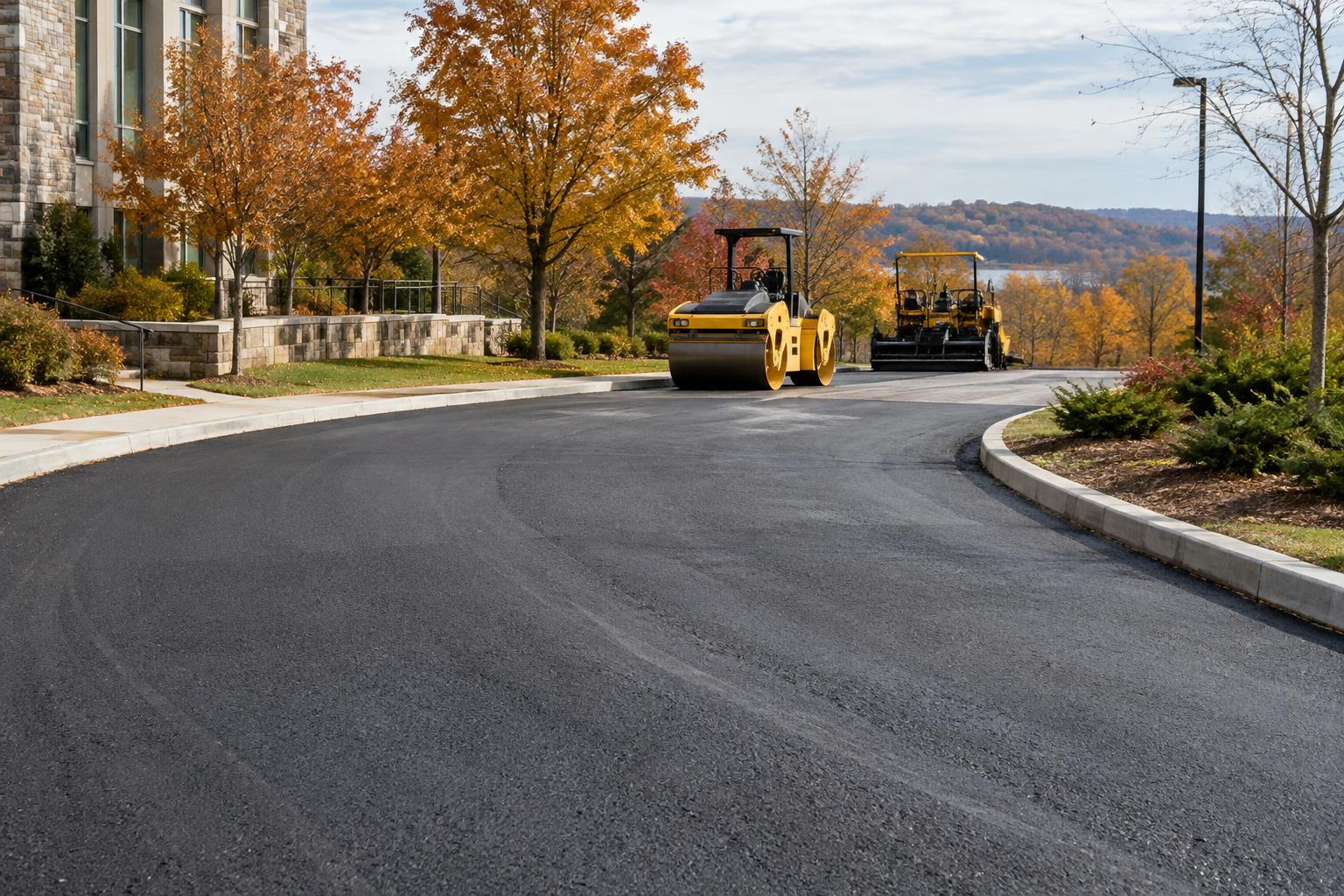
A school drop-off loop takes a beating every single weekday: buses idling, parent cars queuing, and foot traffic crossing the pavement before the first bell. When that loop starts showing cracks, ruts, or standing water, facilities managers across the Hudson Valley know the clock is ticking toward winter. Late October and November offer one of the last realistic chances to get asphalt work done before freezing temperatures shut the door until spring.
The Closing Window for Loop Paving
Asphalt paving depends heavily on weather, and that dependency gets more serious as the calendar moves deeper into fall. Warm-season paving windows exist for a reason: hot-mix asphalt needs enough heat in the air and in the ground to stay workable long enough for crews to spread, shape, and compact it properly. Once temperatures drop consistently into the 40s or lower, especially overnight, the margin for error shrinks fast.
For a campus drop-off loop, this urgency pairs with another pressure: the loop cannot simply shut down for weeks while a crew works. School operations, bus schedules, and student safety all depend on that access point staying usable. A recent blacktop paving construction report walks through how these timing and access questions get handled together, which is exactly the kind of coordination a facilities manager needs heading into November.
Waiting too long does not just risk losing the season. Patching a failing loop through an entire winter of plows, salt, and freeze-thaw cycles tends to make the eventual repair bigger and more expensive. Acting within the next few weeks, while conditions still allow proper placement, protects both the budget and the safety of everyone using that loop.
Why Temperature Controls the Timeline
Asphalt is not a material that tolerates guesswork regarding temperature. Guidance on hot-mix placement is specific: the mix should never go down on a wet surface, and the surface itself needs to meet a minimum temperature before paving starts. Those thresholds reflect how quickly a thin layer of hot asphalt loses heat to a cold surface and cold air, and how little time that leaves for workers to compact it into a dense, durable layer.
Minimum Surface Temperatures by Lift Thickness
The thickness of the asphalt layer, called the lift, determines how much heat it holds and how fast it cools. Thicker lifts retain warmth longer, so they can be placed at lower surface temperatures. Thinner lifts cool almost immediately, so they need a warmer starting surface to have any real working time.
- A compacted lift of at least 100 mm (about 4 inches) can be placed on a surface as cool as 40°F
- A lift between 50 mm and just under 100 mm needs a surface temperature of at least 47°F
- A lift under 50 mm (roughly 2 inches) requires a surface temperature of at least 50°F
This is one reason lift thickness matters for a drop-off loop repaving project. A thin overlay might look like a quick fix, but it is also the layer most vulnerable to cold weather, since it has the least heat to spare once the paver passes.
The Compaction Clock Before Asphalt Cools
Once asphalt leaves the paver, a countdown begins. Compaction needs to happen before the mix cools below its cessation temperature, generally somewhere around 175°F to 180°F. Below that point, the material stiffens too much for rollers to squeeze out air voids and achieve proper density. Cold air and wind speed up that cooling dramatically, which is exactly the combination fall weather tends to deliver.
Thin layers are especially unforgiving. Even under good conditions, a thin mix can reach its cessation temperature in under 10 minutes, and cold-weather guidance suggests that if conditions do not allow at least 10 minutes for compaction, adequate density is unlikely. A late-season example from Billings, Montana illustrated the difference clearly: a single 3-inch compacted lift offered about 60 minutes of compaction time, while two separate 1.5-inch lifts offered only 20 and 18 minutes each. That kind of gap explains why crews working in cooler weather often favor fewer, thicker lifts, tighter coordination between trucks and the paver, close-behind rolling, or added roller capacity to keep pace with a shrinking window.
Getting the Base Ready for Pavement
No amount of careful timing on the asphalt itself matters if the ground underneath is not ready to receive it. The base layer, whether it is existing compacted stone, an old pavement surface being overlaid, or fully reconstructed subgrade, has to provide a stable, uniform foundation. Asphalt placed over a weak or inconsistent base will fail early no matter how well the mix itself was handled.
Dry, Stable, and Free of Frost
Guidance on placement standards is direct about base conditions: the base must be firm, compacted, substantially dry on the surface, and clear of loose or foreign material. Paving over a frozen subgrade or an unstable roadbed is not permitted. As fall temperatures swing overnight, a base that looked fine during the day can develop frost by early morning, which means timing checks around daily conditions becomes part of the planning, not an afterthought.
A facilities manager does not need to be a paving engineer to understand the stakes here. If water has been pooling in low spots around the loop, if there are soft or spongy areas when walked on, or if drainage issues have been noted in past seasons, those are signals worth raising before a paving date gets locked in. Evaluating drainage and base condition ahead of scheduling, along with the loads the pavement will carry, such as daily bus traffic, is standard practice when preparing a commercial or institutional paving project for lasting results.
Coordinating Work Around Student Drop-Off
A parking lot sitting empty overnight is one thing. A drop-off loop that dozens of families and multiple buses rely on every school morning presents a different challenge entirely. Paving work on a live campus access point has to be sequenced carefully so the loop never becomes fully unusable during school hours.
Phasing to Keep the Loop Operational
Breaking the project into sections, rather than closing the entire loop at once, allows part of the drop-off area to remain open while another section is being milled, paved, or cured. Phased construction and strategic scheduling are common approaches for properties that need to stay operational during paving, and a school drop-off loop is a textbook case for this kind of planning. Work might be scheduled for after-school hours, weekends, or a planned closure window communicated well in advance, depending on what the campus calendar allows.
A Pre-Paving Meeting to Align Everyone
Before equipment shows up, bringing together the people responsible for placement, inspection, and material supply in a single pre-paving meeting, roughly a week ahead of the work, helps surface scheduling conflicts and logistical details before they become on-site problems. For a school campus, that meeting should also include whoever manages traffic flow, student safety, and communication with parents. Clear signage, temporary traffic patterns, and a specific day-by-day plan reduce confusion on the first morning the loop looks different than usual.
Choosing Full-Depth or Mill-and-Overlay
Not every drop-off loop needs the same repair approach, and choosing the right one affects both cost and how long the pavement will last. Two common paths exist for commercial and institutional pavement, including school loops, each suited to different levels of damage.
- Mill-and-overlay removes a defined depth of the failing surface, often around 1.5 to 2 inches, addresses any base failures found underneath, and installs a fresh hot-mix layer on top. This approach works well when the base is still structurally sound but the surface has aged, cracked, or rutted.
- Full-depth construction removes and rebuilds the pavement structure down to the subgrade, which is the stronger option when the base itself has failed, drainage problems run deep, or the loop needs to be engineered for heavier loads like buses and delivery vehicles.
Selecting between these two comes down to what an assessment of the existing pavement and base actually shows, along with the traffic loads the loop carries daily. A loop that only sees car traffic may have different needs than one that handles a full bus fleet twice a day. Matching the repair method to the real condition of the pavement, rather than defaulting to the cheaper option, tends to produce a longer-lasting result and a better use of the maintenance budget over time.
Why Waiting Past November Raises Risk
Once the reliable paving window closes for the season, a damaged drop-off loop does not get a break. It keeps absorbing bus weight, freeze-thaw cycling, plow blades, and de-icing salt through the entire winter. Cracks that seemed minor in October can widen significantly by March, and water that gets into the base during freezing weather can cause much more serious structural damage than a simple surface issue.
That often turns a mill-and-overlay candidate into a full-depth reconstruction project by the time spring paving season arrives, which means more cost and a longer project timeline. It can also mean months of working around hazards like potholes, heaving pavement, or drainage failures in an area where student safety is a daily concern. Addressing the loop now, while conditions still support proper placement and compaction, is a more controlled and often more economical path than managing a worsening problem through an entire winter season.
For a facilities team weighing timing, scope, and budget before the season closes, Avello Asphalt & Construction Corp's campus drop-off loop paving guidance and a free Pavement Risk Snapshot can help turn planning into a scheduled repair before winter sets in.
Company: Avello Asphalt & Construction Corp City: Poughkeepsie Address: 141 Daley Road Website: https://www.avelloasphalt.com
Mentioned in this blog post: Poughkeepsie service area, Billings service area
Have a property like this?
Tell us what you're seeing. We'll walk the site, explain the options plainly, and give you a clear scope.
More blog posts
- Mill & Overlay vs Reconstruction? Pleasant Valley Paver Guides Highway Depts
- Why Loading Dock Aprons Wear First: LaGrange Paving Contractor Rebuilds Them
- Mill & Overlay or Full Rebuild? Hopewell Junction, NY Retail Plaza Paving Guide
- Asphalt Resurfacing vs. Full Replacement: Hudson Valley Experts Explain