Asphalt Paving Estimate: What to Expect -Auto Dealership Wappingers Falls, NY
Avello's take
This item looks at what belongs in an asphalt paving estimate for a dealership in Wappingers Falls. It explains why the written scope should identify the work area, base repairs, asphalt thickness, drainage corrections, and striping or accessibility work. It also covers how pavement and base condition shape the choice between patching, an overlay, and reconstruction. We see an important practical point in its discussion of phasing: the sequence of work needs to account for customer parking, vehicle inventory, and access to service bays.
For Hudson Valley property owners, managers, boards, and public works teams, the useful takeaway is to look beyond the bottom line. Written scopes make comparisons clearer when they describe the same work and separate areas with different traffic demands. We view a sensible next step as reviewing those scopes side by side, noting what is included and what remains unclear. That review can also clarify drainage needs and how access will be handled during construction.
Key Takeaways
- A useful dealership paving estimate clearly defines the work area, base repairs, asphalt thickness, drainage fixes, and striping or accessibility items so costs can be compared fairly
- Loading areas and drive lanes typically need a thicker binder course than standard parking stalls to handle repeated heavy vehicle loads
- Commercial parking-lot paving commonly runs $3.50 to $8.00 per square foot for new asphalt, while overlaying sound pavement runs $2.00 to $5.00 per square foot
- Phased construction can keep showrooms, service bays, and customer parking open during paving, though the right sequencing depends on how the scope is broken down
- Comparing written scopes line by line, rather than just the bottom-line price, reveals which bid actually covers the same work
Getting new asphalt for a dealership lot is a bigger decision than most repair jobs, mostly because customer traffic, vehicle inventory, and service drive access can never really stop for long. A clear, detailed estimate is the tool that keeps a project on budget and on schedule, while a vague one invites surprise costs halfway through the job.
What A Dealership Paving Estimate Must Define
A dealership paving estimate earns its usefulness by spelling out exactly what work will happen, where it will happen, and why. That means identifying the work area down to the square foot, calling out which sections need base repair versus simple resurfacing, specifying the asphalt thickness for each traffic zone, addressing drainage problems instead of paving over them, and listing striping and accessibility items separately from the asphalt work itself.
A general manager comparing proposals should expect each one to name the same categories of work, even if the dollar amounts differ. A proposal that holds up to comparison identifies the areas included, the base-repair locations, the compacted asphalt thickness, the drainage corrections, and whether striping and signage are part of the price or billed separately. When an estimate skips any of those categories, it becomes much harder to know what is actually being bought.
Dealership lots also carry unique pressures that a generic parking-lot estimate might miss. Vehicle inventory needs staging space during construction, service drive lanes cannot sit closed for long, and customer-facing areas need to look sharp the moment the crew leaves. A strong estimate accounts for those operational realities right alongside the pavement specifications.
Mapping The Work Area And Base Condition
Before any asphalt gets ordered, the estimate needs an honest picture of what is happening underneath the current surface. Base condition drives almost every decision that follows, from how thick the new asphalt needs to be to whether patching will even hold up over time.
Where Patching Ends And Overlay Begins
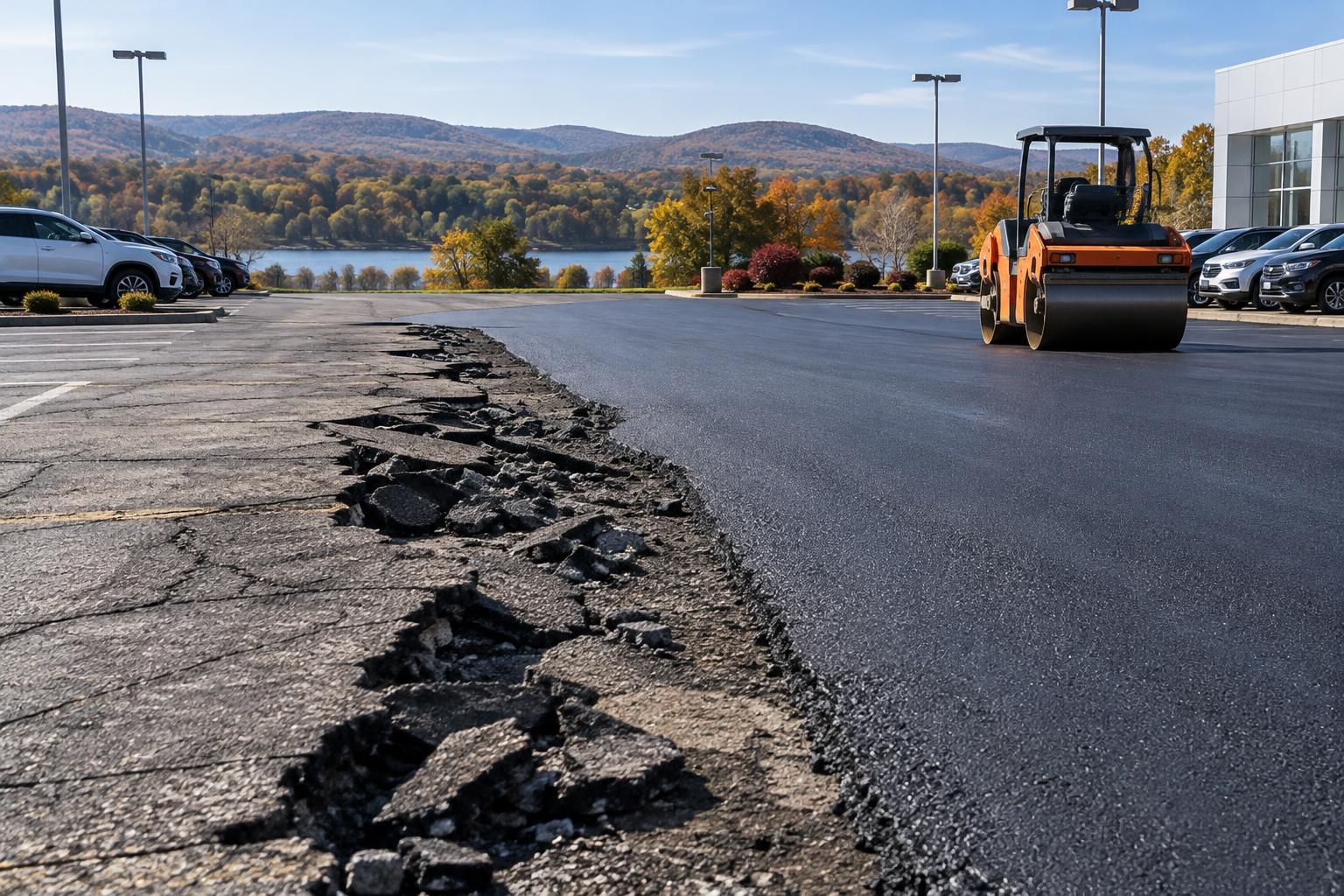
Small cracks and isolated potholes are reasonable candidates for patching, but once damage spreads across a large share of the lot, patch-and-repeat work stops making financial sense. A general repair guideline suggests pricing out an overlay rather than continuing to patch once about 30% of the lot needs repair work. For a dealership lot, that threshold matters because scattered patches in customer parking rows look inconsistent and wear unevenly compared to the surrounding pavement, while an overlay creates a uniform surface across the whole property.
When Failed Base Points To Reconstruction
An overlay works well when surface wear is widespread but the base underneath remains structurally sound. Reconstruction becomes the better path when the base itself has failed, when drainage needs regrading rather than a quick fix, or when years of accumulated overlays have raised the pavement so high that it interferes with curb heights or doorway elevations. A dealership estimate should name which scenario applies to each section of the lot, since paving over a failed base just delays a more expensive fix down the road.
Asphalt Thickness For Dealership Traffic
Asphalt thickness is not a one-size-fits-all number across a dealership property. Customer parking stalls see light, occasional vehicle weight, while drive lanes and loading zones absorb constant, heavier traffic from service vehicles, delivery trucks, and inventory transport. Commercial parking-lot paving commonly runs $3.50 to $8.00 per square foot for new asphalt, while overlaying sound pavement runs $2.00 to $5.00 per square foot, figures that shift depending on which thickness and mix the estimate specifies.
Why Loading And Drive Lanes Need A Thicker Binder
For lots with loading-dock approaches, bus routes, or high-volume retail traffic, the estimate should build in a thicker binder course underneath the surface layer. A dealership service drive or inventory staging area faces similar repeated heavy loading, so the same logic applies: a thin asphalt section that works fine for a customer parking stall will often rut or crack prematurely under a loaded delivery truck or a tow trailer making repeated passes. A clear estimate separates these zones and assigns each one the thickness it actually needs, rather than applying a single blanket spec across the entire property.
Drainage, Striping And Accessibility Items
Asphalt thickness solves a structural problem, but drainage and accessibility solve a functional one. Both deserve their own line items in a dealership paving estimate, since skipping them tends to create headaches that show up long after the crew has left the site.
Fixing Ponding Water, Not Just Resurfacing Over It
Water that keeps pooling in the same spot after every rain signals a grading problem, and resurfacing over it will not make it go away. Correcting that kind of ponding calls for regrading or added drainage structures, not another layer of asphalt laid at the same slope. For a dealership, standing water near the showroom entrance or service drive creates both a safety hazard and an unflattering first impression, so an estimate that addresses the actual cause is worth more than one that just promises a fresh-looking surface.
Accessible Stalls, Signage And Curb Details
New construction and major resurfacing projects often separate finishing and compliance items from the core asphalt work. That typically includes accessible stalls, curbing, wheel stops, required signage, and striping layout. Breaking these out as their own line items helps a general manager see exactly what is included for ADA-compliant access routes, rather than guessing whether striping and signage are bundled into a single lump sum.
Phasing Work Around Customers And Vehicles
A dealership cannot simply close for a week while paving crews work through the lot. The estimate should describe how construction will be sequenced so customer parking, test-drive access, and service drive operations stay functional throughout the project. That might mean dividing the lot into sections and completing one at a time, scheduling noisier or more disruptive work during slower business hours, or temporarily relocating inventory to a staged area while a section cures.
Phasing decisions affect both the schedule and the price, since breaking a project into multiple stages can add mobilization costs compared to a single continuous pour. A dealership general manager should expect the estimate to explain the proposed sequence, roughly how long each phase will take, and what access customers and staff will have at each stage.
What Changes The Cost Of Your Estimate
Several factors push a paving estimate higher or lower, and understanding them helps explain why two bids for the same lot can land far apart. Lot area, existing subgrade condition, grading and drainage needs, pavement thickness and mix, accessibility work, striping, traffic control, and material prices all play a role in the final number.
Size matters in a way that is easy to overlook. A 2026 cost guide notes that lot size affects the per-square-foot price because mobilization is a fixed cost, meaning smaller lots often carry a higher rate per square foot than larger ones. For reference, a 40,000 square foot lot overlay has been estimated at roughly $80,000 to $200,000 before base repair, striping, and contingency are added. Separately, localized patching and repair work is commonly priced between $4.00 and $9.00 per square foot, while sealcoat and crack-seal maintenance runs much lower, around $0.35 to $0.75 per square foot.
Beyond the baseline numbers, a few site-specific conditions tend to push costs past the published averages:
- Poor subgrade that needs extra excavation or stabilization before paving can begin
- Stormwater management requirements tied to local regulations
- Accessibility upgrades needed to bring older lots up to current standards
- Utility conflicts discovered once excavation starts
- Phased construction that adds mobilization trips and scheduling complexity
Comparing Bids Line By Line
Once a few estimates are in hand, the real work is making sure they can actually be compared. A bottom-line number means little if one bid covers full-depth reconstruction and another covers a thin overlay. Before lining up prices side by side, check that each proposal specifies the same asphalt mix, and separately identifies mobilization, subbase work, asphalt tonnage and thickness, accessibility work, striping, and any allowance set aside for unforeseen conditions.
Questions To Ask Before You Sign
A short list of questions can expose a lot about how carefully a bid was put together:
- Does the compacted asphalt thickness match for drive lanes versus standard parking stalls?
- Is base repair priced as a line item, or buried into a single lump sum?
- Are drainage corrections included, or does the bid just resurface over existing low spots?
- Are striping, accessible stalls, signage, and curb work itemized separately from the asphalt section?
- What allowance is built in for unforeseen subgrade conditions discovered during excavation?
- How is the work phased to keep customer and vehicle access open, and what does each phase cost?
A Clear Scope Protects Your Budget
A dealership paving project is really a budgeting exercise and an operations plan rolled into one. The strongest estimates treat both halves seriously, spelling out the work area, base condition, asphalt thickness, drainage corrections, and accessibility details, while also mapping out how construction will move through the property without shutting down the business. Avello Asphalt & Construction Corp builds plans around a property's specific use and requirements, with phased construction and strategic scheduling designed to keep operations running during the work.
For a Dutchess County dealership weighing multiple bids this season, the real advantage comes from treating the written scope as the main point of comparison, not just the final price. For a closer look at how a full scope should be organized before requesting quotes, this breakdown of commercial paving estimates for auto dealerships is a useful next step toward building out a complete budget.
Company: Avello Asphalt & Construction Corp City: Poughkeepsie Address: 141 Daley Road Website: https://www.avelloasphalt.com
Mentioned in this blog post: Wappingers Falls service area, Poughkeepsie service area
Have a property like this?
Tell us what you're seeing. We'll walk the site, explain the options plainly, and give you a clear scope.
Related Avello guidance
More blog posts
- Why Asphalt Bids Vary So Much? Red Hook, NY Paver Explains Senior Living Sites
- Low Bid or Lowest Cost? Rhinebeck Paving Contractor Weighs Hidden Asphalt Risks
- Campus Drop-Off Loop Paving Before November Ends: Poughkeepsie Paver's Window
- Mill & Overlay vs Reconstruction? Pleasant Valley Paver Guides Highway Depts