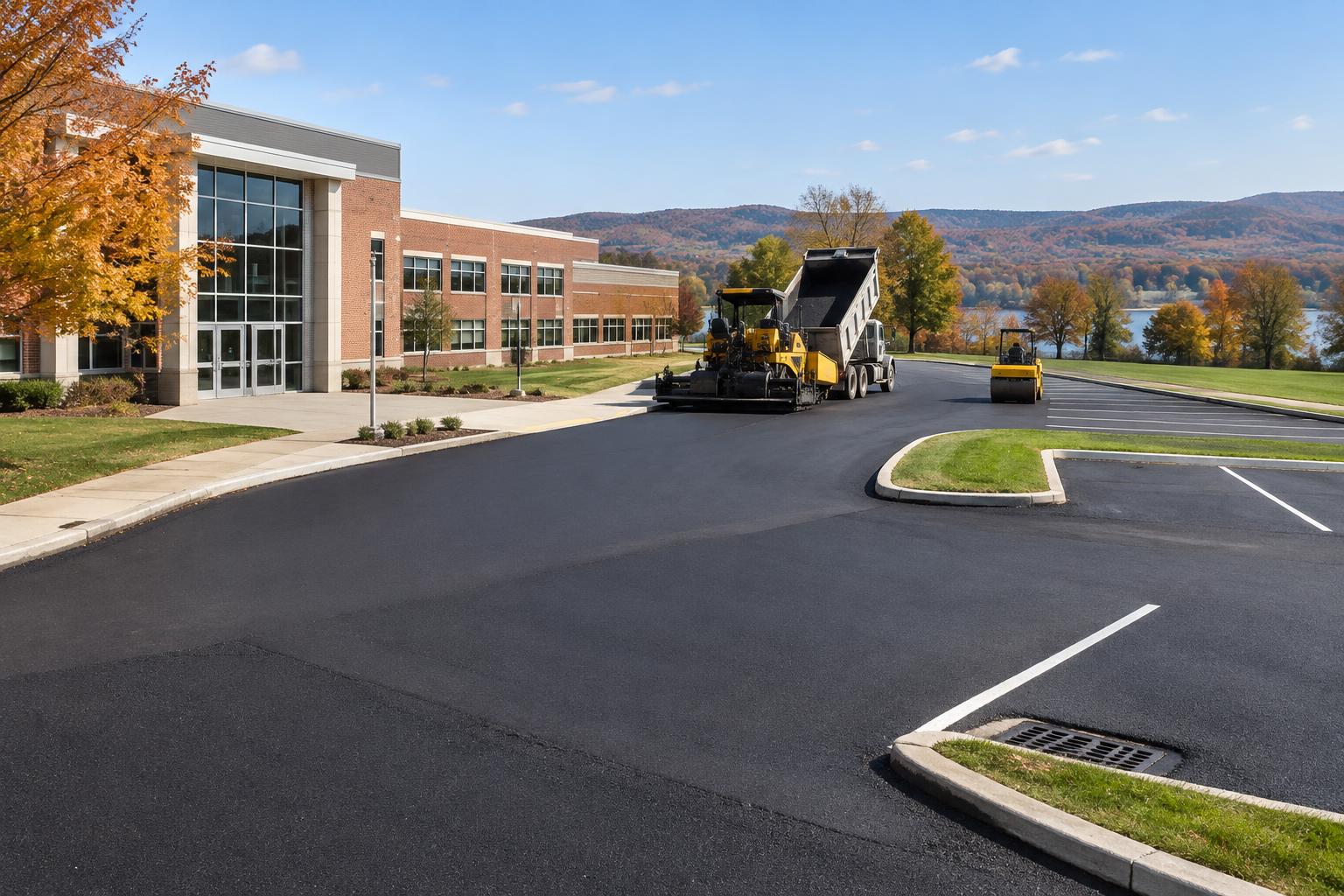
Schools in the City of Poughkeepsie should generally schedule major paving during summer recess, after checking summer school, meal programs, athletics, and building access needs. Start condition assessments and project planning during the preceding school year, then confirm repair needs after spring thaw. Smaller repairs may fit shorter breaks when weather and reopening requirements allow. A workable schedule includes drainage and base repairs, separate pedestrian routes, accessible entrances, pavement cooling, striping, and a weather allowance. The right date is the one that supports sound construction and a controlled return to school operations.
Schedule major school paving during summer recess, with room before reopening
Schools in the City of Poughkeepsie should generally schedule major parking lot and bus-loop paving during summer recess. Choose a window after regular school traffic ends, but leave time before staff preparation days, orientation, and the return of buses. Summer offers the best opportunity to separate construction from students without depending on a short holiday break.
Summer recess is not the same as an empty campus. Summer school, meal distribution, recreation programs, athletics, and custodial work may all continue. The best paving window is the period when those activities can use a separate entrance, move to another area, or pause through an already approved schedule.
Plan backward from the first date the finished lot must serve its normal users. Include demolition or milling, repairs beneath the asphalt, drainage adjustments, paving, cooling, pavement markings, signs, and a final walkthrough. Reserve additional room for rain and conditions discovered after the old surface is removed; the asphalt placement date alone is not the whole project.
Spring and fall can work for smaller areas or campuses with genuinely separate traffic routes. A weekend may suit a limited repair, but it is a poor default for a large lot with uncertain base conditions. Winter recess usually does not provide dependable conditions for planned hot-mix asphalt paving.
At Avello, we recommend choosing a primary construction window and an agreed weather alternative. Both should be checked against the school calendar before work is authorized. That gives facilities staff and administrators a shared answer when programs ask which areas will remain available.
Use the preceding school year to assess pavement and secure approvals
Begin planning during the school year before the intended summer work. A fall walkthrough can document worn areas, operational conflicts, and drainage concerns while normal school traffic is visible. Winter observations then help identify where ice develops, plows encounter raised edges, and snow storage obstructs drains or pedestrian routes.
Confirm the condition assessment after spring thaw. Freeze-thaw cycles can open cracks and expose weaknesses that were less obvious in autumn. Thawing ground can also remain wet or soft, so a warm afternoon is not enough evidence that the pavement base is ready for construction.
- Isolated cracks versus connected cracking in bus wheel paths or turning areas.
- Loose surface material, potholes, broken edges, and patches that have settled.
- Depressions or rutting where buses stop, turn, or wait.
- Water remaining after rain, especially near entrances and accessible routes.
- Raised utility covers, damaged catch basins, and uneven pavement at sidewalks.
- Areas hidden by parked vehicles that need a separate inspection.
Photographs and a marked campus plan make these observations useful during scope review. Surface appearance alone does not establish the condition of the supporting layers. Where recurring damage suggests deeper weakness, pavement cores or limited exploratory work may help a qualified professional determine whether surface treatment, localized rebuilding, or broader reconstruction fits.
Run the administrative schedule alongside the technical assessment. Public schools should confirm applicable purchasing, bidding, board approval, and capital-project requirements with their district team. For work affecting entrances, sidewalks, drainage connections, or the public right-of-way, ask the City of Poughkeepsie building or engineering department which local reviews apply, and separately confirm any school-specific state requirements.
To understand the work behind these options, compare Avello’s parking lot paving, milling and paving services.
Match the repair method to the school’s available construction window
The school calendar should help organize the work, not determine the repair method by itself. A short break does not make a surface-only repair appropriate where the supporting material is weak. First establish what the pavement needs, then identify a window long enough to complete that work properly.
- Localized repairs: Suitable when damage is limited and surrounding pavement remains sound. Removing damaged asphalt and correcting the affected base can fit a smaller work zone.
- Crack repair: May suit selected cracks in otherwise serviceable pavement. It does not correct movement beneath connected cracking or eliminate settled areas.
- Asphalt overlay: Adds a new asphalt layer where the existing pavement can support it and added height will not compromise drainage, curb exposure, or accessible connections.
- Milling and paving: Removes a controlled depth of existing asphalt before replacement. It can preserve important elevations at curbs, sidewalks, and entrances while renewing the surface.
- Full-depth reconstruction: Removes pavement and rebuilds supporting layers where widespread weakness or unsuitable grades make a surface replacement insufficient.
Bus loops deserve a separate assessment from staff parking. Repeated turning, braking, and standing loads place different demands on the pavement than passenger vehicles do. The written plan should identify whether the bus area needs different pavement construction rather than treating every paved space as interchangeable.
Mixed solutions often make sense on school grounds. A sound staff lot might need surface renewal while a damaged bus-turning area needs deeper rebuilding. Our parking-lot paving and milling-and-paving planning starts with those distinctions so the schedule accounts for the most involved work, not just the easiest portion.
Build Hudson Valley weather and sloped-site drainage into the dates
The Hudson Valley paving season generally runs from April through November, but those months are a planning range, not a promise that every day is suitable. Air temperature, surface temperature, rain, asphalt mix requirements, and layer thickness influence placement conditions. The contractor should confirm suitable conditions for the specified work before committing crews to pave.
Spring work needs particular care after a wet winter or prolonged thaw. Asphalt placed over a soft, saturated base will not solve the underlying problem. Schools considering spring recess should have an alternate plan if excavation reveals wet supporting material or the forecast does not support the planned installation.
Summer usually offers more scheduling flexibility, but rain can still interrupt excavation, base preparation, and paving. Hot weather also affects how soon new asphalt can accommodate concentrated loads and tight bus turns. Reopening should depend on actual pavement conditions and the contractor’s instructions, not simply the arrival of the next morning.
On sloped school sites, runoff should be traced from the uphill edge through the lot to an appropriate outlet. A new surface must not send water toward classroom doors, stairs, neighboring property, or an accessible crossing. Drainage corrections and elevation checks belong before final paving, especially where milling changes transitions around catch basins.
Winter operations should inform the finished layout as well. Plowing can catch uneven transitions, while snow piles can block drainage and create meltwater that later freezes. Review plow routes, snow-storage locations, and areas exposed to frequent salt application when choosing repairs and detailing edges; those observations help explain wear that a summer-only inspection may miss.
Phase construction around students, buses, and essential campus access
A school paving phase should be a complete, controllable work zone, not simply half of a parking lot. Identify who still needs the property each day and where they will enter, walk, park, unload, and leave. If safe separation cannot be maintained, relocating an activity or closing that area may be more practical than keeping it partly open.
- Confirm the daily campus schedule, establish barriers and signs, and approve temporary pedestrian and vehicle routes before equipment arrives.
- Arrange required utility locating and identify private underground services before excavation. Confirm access to hydrants, emergency routes, and service equipment.
- Mill or remove pavement within the designated phase. Keep students, families, and unauthorized vehicles away from exposed edges and construction operations.
- Inspect the exposed area, repair unsuitable base material, and complete drainage or utility adjustments before covering the work.
- Place and compact asphalt, protect it during cooling, and complete markings, signs, and transitions when conditions permit.
- Inspect and accept the phase for its intended use before moving barriers and opening the next work area.
Do not assume a milled surface is an acceptable temporary school route. Exposed covers, changes in level, and rough transitions can interfere with walking, wheelchairs, and vehicle movement. Any temporary use needs specific review and controls; accessible building access must remain workable throughout the project.
Coordinate bus access with the transportation director, including summer routes and driver training. Waste collection, kitchen deliveries, maintenance vehicles, and emergency responders also need consideration. Where a phase affects a campus driveway or public sidewalk, coordinate any required traffic arrangements with the city rather than improvising queues on nearby streets.
Each phase adds transitions, coordination, and potentially extra equipment moves. Compare phased construction with a shorter full closure during a truly quiet period. Keeping the property operating matters, but so does choosing an arrangement that staff can manage clearly and consistently.
Require a written scope that defines the school’s reopening conditions
A useful school paving scope connects construction details to the calendar. It should show exactly which spaces are included, what work happens in each, and what must be complete before students or buses return. Broad wording such as “repave parking lot” leaves too much uncertainty for a campus with several different users.
- A marked plan showing work limits, phase boundaries, entrances, and areas excluded from construction.
- Removal or milling depths, specified asphalt materials, compacted layer thicknesses, and preparation requirements.
- Known base repairs and a written process for measuring, approving, and documenting additional repairs if concealed conditions differ.
- Drainage adjustments, finished elevations, utility-cover work, and tie-ins at sidewalks, curbs, and door approaches.
- Accessible parking, access aisles, pedestrian routes, bus circulation, signs, and final striping responsibilities.
- Temporary access arrangements, barriers, work hours, cleanup, and responsibility for communicating phase changes.
- Weather contingencies, inspection points, reopening criteria, and the process for accepting completed work.
Where design or code review is needed, have the appropriate qualified professional establish the requirements. Existing markings should not automatically be copied if the layout or accessible route needs correction. Parking-space counts and bus movements should also be checked against how the school actually operates.
Separate the construction duration from the time needed for approvals, material coordination, and weather allowances. The scope should also say who can authorize changed work and how that decision will reach district purchasing staff. Prompt, documented decisions are especially important when an open excavation cannot simply remain through the next school activity.
Finally, define substantial readiness for school use in practical terms. A paved surface without required markings, safe transitions, or an available accessible entrance is not the same as an operational campus area. This distinction gives the final walkthrough a clear purpose.
Prepare the campus team and avoid calendar-driven mistakes
Before mobilization, the school should name one operational contact and one backup. They should have authority to coordinate access and a clear route to the person who approves changed work. Contractors need reliable decisions, while families and staff need one consistent source of school instructions.
Collect the calendars that are easy to overlook: summer meal service, athletic practices, testing, camps, community use, deliveries, and staff training. Check for other construction projects that need dumpsters, cranes, or heavy deliveries. Whenever practical, finish work that could damage the new lot before placing the final asphalt surface.
Prepare a simple access notice with a map, dates, permitted entrances, and a contact for questions. Translate or distribute it through the school’s usual family communication channels as appropriate. Signs at the property should match the notice so a substitute driver or visiting parent receives the same directions.
- Treating the last day of classes as the last day anyone needs the campus.
- Selecting a holiday weekend before establishing the depth and extent of repairs.
- Leaving no allowance between anticipated completion and orientation or bus rehearsals.
- Assuming a new surface will correct settled pavement or drainage problems by itself.
- Opening a phase before markings, pedestrian connections, and traffic controls are ready.
- Allowing separate vendors to give conflicting access instructions.
Keep a brief record of changes during construction. If weather moves a phase, update the campus map and notify affected groups before access changes. A calm, repeatable communication process is more useful than frequent messages that do not clearly state what people should do differently.
Use a final readiness checklist before confirming the paving window
Before approving dates, bring facilities, administration, transportation, and purchasing together for one schedule review. The goal is to confirm that the construction plan and the school’s operating plan describe the same campus. Resolve conflicting assumptions while the work is still on paper.
- Pavement conditions have been assessed, with spring observations incorporated where needed.
- The repair method addresses both visible damage and suspected supporting-layer problems.
- Required approvals, procurement steps, and local coordination are accounted for.
- Summer programs, buses, deliveries, and other contractors have confirmed access arrangements.
- Accessible entrances, emergency routes, and pedestrian separation are shown on the phase plan.
- Weather alternatives and a decision process for concealed conditions are written down.
- Cooling, markings, signs, cleanup, and inspection fit before the required reopening date.
- Staff and families will receive matching maps and access instructions.
At the final walkthrough, check the campus as its users will experience it. Follow the route from a parking space to an entrance, review the bus circulation path, and inspect transitions around covers and sidewalks. Confirm that barriers are removed only from areas approved for use and that any remaining work is clearly separated.
Keep the completed scope, repair records, and care instructions with the facilities files. Those documents give future inspections a useful baseline and help staff distinguish a new concern from an older condition outside the project limits. Review drainage during a suitable rainfall and document concerns for follow-up.
For schools in the City of Poughkeepsie, the strongest schedule is usually a summer window prepared during the school year, confirmed after thaw, and protected by a realistic reopening allowance. To discuss school parking-lot paving or milling and paving, call Avello Asphalt & Construction at 845-454-3650 or request a free quote.
2026 Commercial Pavement Budget Planner
A contractor-built worksheet for budgeting parking lot and roadway work: cost ranges by scope, a condition-scoring sheet, phasing guidance, a bid-comparison checklist, and the questions to ask before you sign.
Common questions
Can our school pave during spring recess instead of summer?+
Possibly, especially for a limited area with known repair needs and separate campus access. Spring recess can coincide with cold weather, rain, or soft ground after thaw, so it should not be treated as a dependable construction window without checking conditions. Confirm asphalt availability, the full work sequence, and an alternate schedule. Larger projects with uncertain base repairs are generally easier to organize during summer recess.
How far ahead should a public school start planning summer paving?+
Start during the preceding school year rather than waiting until classes end. The actual lead time depends on assessment needs, design work, district purchasing rules, board approvals, and any applicable agency reviews. A fall condition survey followed by a spring confirmation gives the team time to develop the scope. Work backward from staff return and summer programs, not only from the first student attendance day.
How soon can school buses use newly paved asphalt?+
There is no single reopening time that fits every bus loop. Asphalt must cool sufficiently, and readiness depends on weather, pavement construction, and the loads and turning movements expected. Buses place concentrated stress on new pavement, especially during tight turns or prolonged standing. Obtain project-specific reopening instructions from the contractor, and confirm that markings, signs, and safe pedestrian routes are ready before restoring normal transportation operations.
Can summer school stay open while the parking lot is repaved?+
It can sometimes remain open if construction and school activity have genuinely separate routes and spaces. The plan must preserve accessible building entry, emergency access, student supervision, and safe arrival and dismissal. Barriers alone do not solve a route that crosses equipment movements. If those conflicts cannot be eliminated, a temporary program relocation or a planned full closure may be more workable than multiple paving phases.
What asphalt parking lot maintenance guidelines should schools follow after paving?+
Keep the contractor’s care instructions and establish routine visual checks, including after winter and significant rainfall. Record cracks, settlement, damaged edges, blocked drains, and changes around utility covers. Keep drainage paths clear and review snow-storage and plow practices with the maintenance team. Arrange appropriate repairs based on observed conditions rather than assuming every area needs the same treatment on a fixed calendar.
Should parking lot drainage problems be corrected before school paving?+
Drainage problems should be evaluated before the paving scope is finalized, and necessary corrections should be completed in the appropriate construction sequence. Ponding may reflect a blocked inlet, settled pavement, unsuitable slopes, or problems farther along the drainage system. Simply adding asphalt can move water toward another entrance or walkway. Check elevations and outlets, especially on sloped campuses, and include required design review or approvals in the schedule.
Avello provides free commercial pavement assessments across the Hudson Valley. No obligation — you keep the documentation either way.