Keeping response vehicles moving during repaving starts with a route plan, not a paving schedule alone. Beekman public works teams should identify essential entrances, inspect pavement and drainage, and agree on access requirements with fire, ambulance, dispatch, and the roadway authority before work begins. Milling, repairs, and paving should then proceed in sections that preserve a verified route or an approved alternative. This article explains condition checks, repair choices, phase changes, written responsibilities, and reopening decisions, with practical attention to Dutchess County weather, sloped approaches, and daily municipal operations.
Keeping emergency vehicle access open while public works departments in Beekman repave
Keep access open by dividing the work into small, controlled phases and maintaining a verified route for fire apparatus, ambulances, and other essential vehicles throughout each phase. Before milling starts, Beekman public works staff should review that route with responding agencies, dispatch, the contractor, and the authority responsible for the road. Agree on how vehicles will enter, pass the work, turn, and leave.
An open route needs more than a gap between cones. It needs adequate clearance, a surface capable of supporting the vehicles using it, manageable pavement transitions, and turning room free of parked equipment. The dimensions and loading requirements should come from the applicable authority and the actual response vehicles, rather than a generic access width.
Where the existing road cannot provide safe passage alongside construction, establish an approved alternate route before closing the affected section. A dead-end road or single-entry municipal site needs special attention: smaller work areas, an engineered temporary route, or another agency-approved arrangement may be necessary. A promise to move the paving equipment when a vehicle arrives is not a complete plan.
At Avello, we approach municipal paving and milling-and-paving as both construction work and an operating-access problem. The practical question for every phase is simple: can the required vehicles get through now, without driving onto unsupported ground, an open excavation, or pavement that has not been released for traffic?
Inspect pavement along the response route, not just the paving limits
Walk the proposed work area and drive the complete access route before selecting a repair method. Record cracks, potholes, wheel-path depressions, broken edges, settlement around structures, and previous patches. Include entrances and turning areas outside the planned paving limits, because these may carry concentrated loads during a temporary traffic shift.
Surface wear and structural weakness call for different work. Widespread connected cracking, recurring depressions, or movement under traffic can indicate that the stone foundation or soil below the asphalt needs investigation. An engineer may recommend cores or test pits to check pavement layers and underlying support; appearance alone cannot establish their condition.
- Edge strength where vehicles will travel closer to a shoulder during construction.
- Clearance at gates, overhead obstructions, parked vehicles, and narrow approaches.
- Turning space at intersections, station exits, and municipal facility entrances.
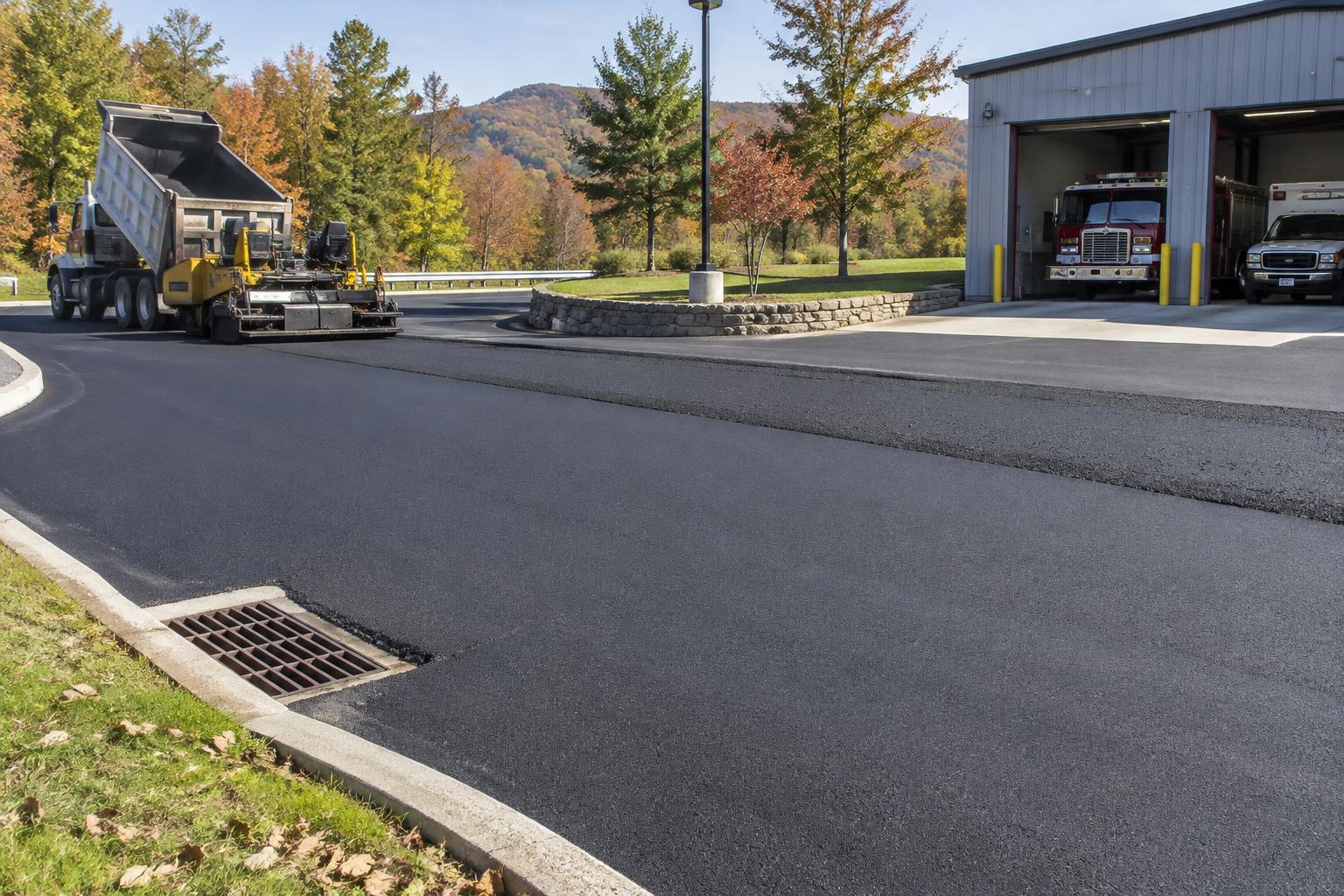
- Utility covers, drainage grates, and pavement steps that could obstruct passage after milling.
- Soft shoulders, steep cross slopes, or unpaved shortcuts proposed as temporary routes.
Inspect drainage during or after rainfall when practical. On Beekman's sloped sites, water may cross an access lane or collect at the bottom of an approach, weakening a temporary route that looked firm in dry weather. Photograph conditions and mark them on the same plan used for staging so pavement repairs and access decisions stay connected.
To understand the work behind these options, compare Avello’s municipal paving, milling and paving services.
Choose repairs that fit both pavement condition and access constraints
Localized patching fits isolated damaged areas when the surrounding pavement remains serviceable. Removing weak material and rebuilding those spots can prepare a response route before broader paving begins. It also lets a department address an urgent repair without opening a long stretch of road, provided the underlying cause is corrected.
An overlay adds asphalt over suitable existing pavement. It may fit a sound pavement structure with surface wear, but the added elevation must work at entrances, drains, curbs, and utility covers. An overlay is not a substitute for repairing unstable support, and raising a station approach can create an awkward transition.
Milling-and-paving removes a planned depth of old asphalt before placing new material. It can restore the surface while managing finished elevations, but the milled stage introduces roughness, pavement steps, and exposed structures. The scope should say whether traffic may use that surface, what temporary transitions are required, and who checks it before release.
Full-depth reconstruction fits areas where the asphalt and supporting layers need rebuilding. Because open excavation cannot function as a normal response route, this option usually requires tighter staging or a separately approved access path. Temporary crushed-stone access may be possible, but its support, drainage, grade, and maintenance need evaluation rather than assumption.
A Beekman project may combine these methods. Rebuild a weak entrance first, use that repaired approach for access, and then mill and pave adjoining areas. Select the sequence around actual pavement needs and vehicle movements, not simply the largest area a crew can open at once.
Phase milling and paving around a usable route at every step
Prepare a phase drawing that shows the work area and the usable route separately. Mark equipment storage, truck queues, pedestrian paths, and the location where traffic will be held. Confirm how public traffic will yield when a response vehicle approaches a one-lane section, including the far end of the work zone.
- Prepare the alternate lane or entrance first. Complete necessary spot repairs, transitions, signs, and drainage protection before shifting traffic.
- Walk the proposed route with the designated municipal representative. Confirm clearance, surface support, turning movements, and traffic-control staffing.
- Mill or excavate only the area allowed by the approved phase. Keep hauling, deliveries, and parked equipment outside the maintained route.
- Complete underlying repairs and paving within that phase. Coordinate driveway and intersection crossings individually rather than closing them incidentally.
- Release the finished area only after the responsible personnel confirm it is suitable for the expected vehicles. Move barriers and notify affected parties before starting the next phase.
For a facility with two entrances, one may remain usable while the other is rebuilt, but both approaches must connect to usable internal circulation. For a single-entry site, splitting the entrance may work only if the remaining section has adequate support and clearance. If it does not, redesign the sequence before construction.
Set an end-of-shift condition for every workday. It should identify the overnight route, secured excavations, signs and delineation, and a contact for access problems. Inspect again after heavy rain or any change that could affect temporary surfaces or barriers.
Build weather, slopes, and winter wear into the access plan
Hudson Valley freeze-thaw cycles can expose weaknesses that are less visible during dry summer weather. Water entering cracks or the pavement foundation can contribute to movement as it freezes and thaws. Spring thaw can also leave shoulders and underlying soil soft, making them poor substitutes for a paved travel lane.
April through November is a useful planning window for regional paving, not an assurance that every day within it is suitable. Actual placement depends on weather, surface conditions, asphalt mix, layer thickness, and project specifications. Build flexibility into the schedule so marginal conditions do not force a choice between paving quality and usable access.
Cold conditions shorten the time available to compact asphalt, while rain can interrupt surface preparation and placement. The contingency plan should describe how crews will leave the route if paving stops between milling and resurfacing. It should also explain who maintains temporary transitions during that interruption.
On sloped approaches, keep runoff from carrying loose material across the maintained lane or into an excavation. Temporary drainage measures must not divert water onto neighboring property or create another access problem. Confirm that milling and new pavement elevations will keep drainage structures working through each phase.
Plowing and salt exposure make sound edges, smooth transitions, and drainage important long after construction. Raised edges and loose temporary ramps can conflict with snow-removal operations. If unfinished work extends toward winter, the department needs a specific maintenance arrangement rather than a summer traffic setup left in place.
Write access responsibilities into the paving scope
A clear scope describes both the pavement being built and the access being maintained. Include mapped limits, removal depths, repair allowances, materials, compaction requirements, finished elevations, drainage work, and pavement markings. Identify how newly discovered weak areas will be documented and approved without unexpectedly closing the route.
For work in Beekman, confirm road ownership and the responsible approval authority early. Coordinate local permitting questions with the town's appropriate building or engineering office, and roadway work with the highway authority. County or state jurisdiction may require separate coordination; a local address does not establish who controls the pavement.
- Phase boundaries, usable routes, approved vehicle requirements, and any prohibited movements.
- The traffic-control plan, required signs and flagging, and applicable roadway standards.
- Responsibility for maintaining transitions, temporary surfaces, drainage, and overnight access.
- Contacts for public works, the contractor, dispatch, and responding agencies, with a backup communication method.
- Who can authorize a route change, stop work, and release a completed section for traffic.
- Weather interruption procedures and the response when a planned route becomes unusable.
Avoid vague phrases such as 'access maintained as needed.' Define what access means for this site and who verifies it. Likewise, distinguish uninterrupted vehicle passage from access that depends on a controlled pause; responding agencies must understand and accept the proposed arrangement before it becomes the construction plan.
Prepare municipal operations and keep communication current
The municipal owner or facility manager should identify all activities that depend on the work area. Include response vehicles, public visits, staff parking, refuse collection, deliveries, fleet fueling, and accessible pedestrian access. Moving these activities in advance reduces competition for the lane that must remain open.
Give the contractor relevant plans, known utility information, drainage concerns, and operating schedules. Arrange required utility location procedures before excavation, including investigation of privately owned services where applicable. Identify gates, keys, access controls, and parked vehicles that could interfere with an alternate entrance.
Use a preconstruction meeting to review vehicle movements, not just dates. Fire and ambulance representatives can explain approach directions and turning needs that may not be obvious from a drawing. Dispatch should receive route information in a usable format, with a clear process for updates when the work changes.
At the start of each shift, confirm the active phase, the open route, and the next planned change. Repeat that confirmation before moving barriers or switching entrances. A contact sheet helps, but it does not replace signs, trained traffic-control personnel, or a route that is physically ready.
Keep public instructions separate from operational details where helpful. Residents and visitors need clear directions about entrances and parking; responders need precise information about passage through the work. Assign one municipal coordinator to keep those messages consistent, while leaving traffic-control and construction responsibilities with the designated personnel.
Avoid access mistakes and use a short release checklist
Common mistakes include milling every entrance at once, storing equipment in a turning area, and assuming a shoulder can carry a loaded response vehicle. Another is opening fresh asphalt by the clock alone. Cooling and readiness vary, so the contractor and designated representative should evaluate conditions and the intended traffic before release.
Heavy steering movements and stationary loads can mark fresh pavement. Plan turns and waiting areas accordingly, without making essential access depend on restrictions the responding agencies cannot follow. If the proposed route requires an impractical maneuver, change the route or the construction phase.
Treat each phase change as a new access decision. Yesterday's clear route may be blocked by today's truck queue, raised utility cover, or shifted barrier. A brief field check is more useful than assuming the original drawing still matches conditions.
- Required vehicles can enter, pass, turn, and exit.
- The travel surface and transitions are suitable for expected loads.
- Excavations, structures, and pavement edges are protected.
- Equipment, deliveries, and parked vehicles are outside the route.
- Signs, flagging, pedestrian access, and drainage are in place.
- Dispatch and affected agencies have the current route information.
- Overnight conditions and backup contacts are confirmed.
For Beekman public works teams, the goal is steady coordination between pavement work and essential travel. We serve Dutchess County and the Hudson Valley from 141 Daley Road, Poughkeepsie, NY. To discuss municipal paving or milling-and-paving with an access plan, call Avello Asphalt & Construction at 845-454-3650 or request a free quote.
2027 Commercial Pavement Budget Planner
A contractor-built worksheet for budgeting parking lot and roadway work: cost ranges by scope, a condition-scoring sheet, phasing guidance, a bid-comparison checklist, and the questions to ask before you sign.
Common questions
Can fire trucks and ambulances travel over a milled road?+
Sometimes, but a milled surface is not automatically ready for traffic. Check pavement steps, loose material, exposed utility structures, drainage openings, and the condition of the remaining pavement. The contractor and responsible municipal representative should confirm whether the route is suitable for the expected vehicles. Provide appropriate transitions and traffic control, and inspect the route again if weather or construction changes its condition.
How do we maintain access on a dead-end road?+
Start by identifying whether any usable alternate connection exists and whether it can be approved for the required vehicles. Without one, the work may need shorter sections, partial-width construction, or another engineered staging arrangement. Include responding agencies in that decision before bidding or scheduling. If safe passage cannot coexist with a proposed operation, revise the operation rather than relying on moving equipment after a vehicle arrives.
How soon can heavy vehicles use the new asphalt?+
There is no single waiting period that fits every project. Asphalt temperature, weather, mix, pavement thickness, underlying support, and vehicle movements all influence readiness. Heavy turning or standing loads may need different consideration from straight-through travel. Establish release criteria before work and have the designated personnel check actual conditions. Keep the alternate route available until the new section has been accepted for its intended use.
Who should approve a change to the planned access route?+
Name the decision-makers in the written plan. Typically, the municipal representative and contractor coordinate construction changes with the roadway authority, while affected fire and ambulance agencies review operational access needs. Dispatch needs current routing information. The exact approval chain depends on jurisdiction and the project. A field crew should not independently substitute a shoulder, driveway, or other unreviewed route for the approved path.
What should a public works department ask a paving company about access?+
Ask the paving company to explain how each phase preserves vehicle passage, where equipment will wait, and what happens if rain interrupts work. Request a marked staging plan and clear responsibility for temporary transitions and overnight conditions. Also ask how hidden pavement damage will be handled without losing access. Useful answers describe specific movements and decision points, rather than simply saying the road will stay open.
Is night paving the best way to avoid access conflicts?+
Night work can reduce some conflicts, but it does not remove the need for a usable response route. Lighting, visibility, noise restrictions, staffing, material availability, and cooler temperatures all need review. Some facilities may operate more predictably with daytime work in smaller phases. Choose the schedule with the roadway authority and affected agencies, based on actual operating needs and construction conditions rather than traffic volume alone.
Avello provides free commercial pavement assessments across the Hudson Valley. No obligation — you keep the documentation either way.