Repair vs Resurfacing? Poughkeepsie Paving Contractor Weighs Cost & Timing
Avello's take
This item looks at how to choose between parking lot repair, resurfacing, and deeper reconstruction. We explain why the condition beneath the asphalt matters as much as the wear visible on top. Isolated damage over a sound base may suit targeted repair. Widespread surface wear on a stable foundation may suit resurfacing. Cracks or soft spots that return after patching can point to a deeper problem. The article also explains how these choices affect timing and disruption.
For Hudson Valley property owners, managers, boards, and public works teams, that distinction helps connect the proposed work to what the pavement actually needs. We see a sensible next step as understanding the base condition and reviewing a clear written scope. Details such as compacted asphalt thickness, milling depth, and repair quantities make bids easier to compare. Planning construction phases also matters when a parking lot needs to remain open during the work.
Key Takeaways
- Localized damage over a sound base usually calls for repair, while widespread surface wear on a stable foundation is a better fit for resurfacing
- Recurring cracks, soft spots, or patch failures in the same area often point to a failed base, which needs deeper reconstruction rather than another surface fix
- Modeled cost figures for a 20,000 sq ft lot show a wide gap between overlay, mill-and-overlay, and full-depth reconstruction, which makes comparing written scopes essential before signing
- A written scope should spell out compacted asphalt thickness, milling depth, and repair quantities so property managers can tell what a bid actually includes
- Phasing options exist to keep an occupied parking lot open during construction, a detail worth asking about before work begins
Keeping a commercial lot safe and presentable is a year-round job, and sooner or later every property manager faces the same question: does this pavement need a patch, a fresh surface, or a complete rebuild? The answer changes the price, the timeline, and how much disruption tenants or customers will notice. Avello Asphalt & Construction works with Hudson Valley property managers on this decision, and the guidance below walks through how to tell the difference before committing to a scope of work.
Which Fix Does Your Lot Need?
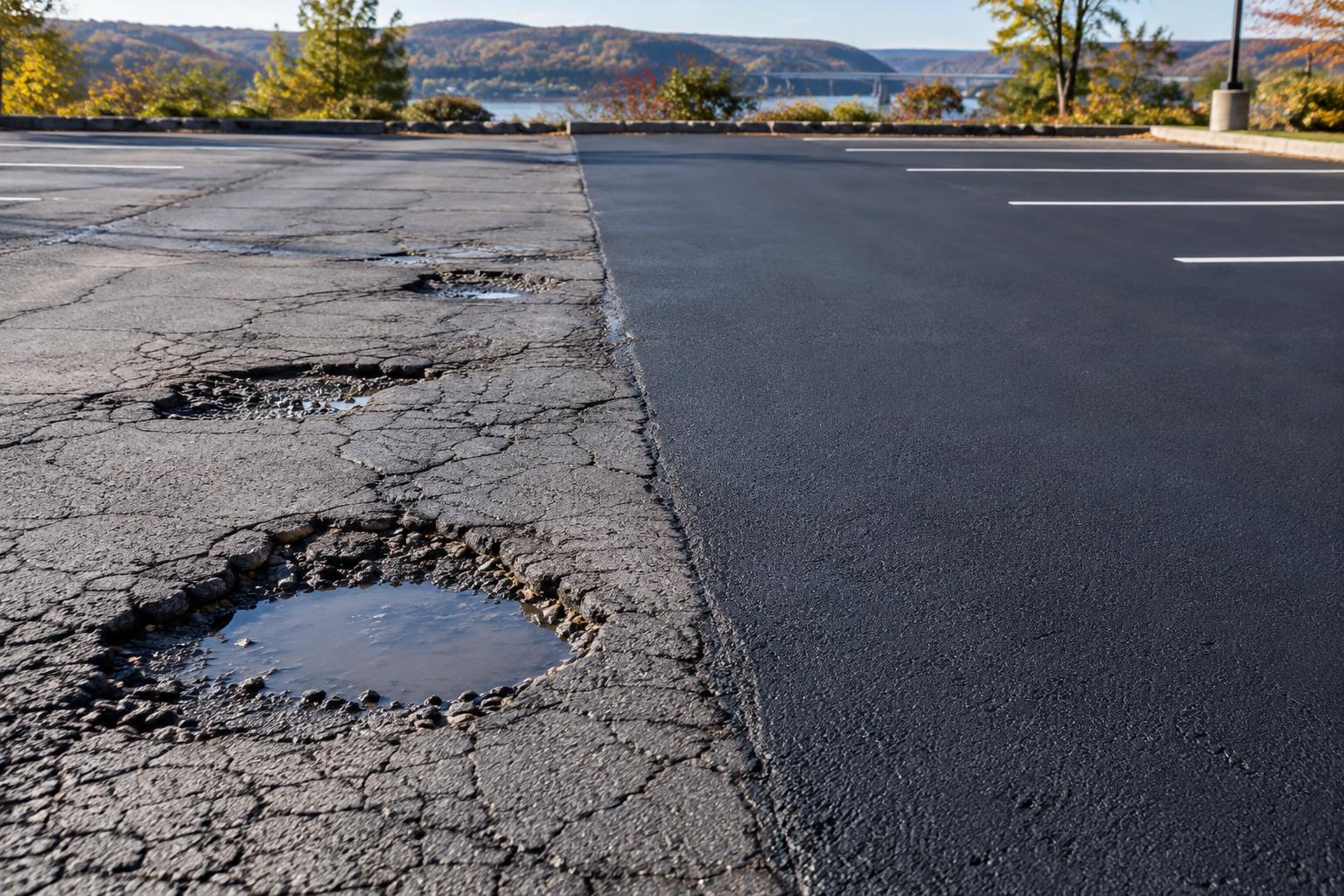
The starting point is simple: look at how much of the lot is affected and whether the ground underneath is still doing its job. A few isolated potholes or alligator-cracked patches in an otherwise solid lot point toward repair. Widespread fading, shallow cracking, or surface roughness spread across most of the pavement, sitting on a base that still holds its shape, points toward resurfacing. Cracks that keep coming back in the same spots, or soft, sinking areas that reappear after a patch, usually mean the problem lives below the surface, where new asphalt on top will not hold for long.
Getting this call right matters because each option carries a different price tag and timeline. Paying for a full resurfacing job over a base that is already failing wastes money on a fix that will crack again within a season or two. Tearing out and rebuilding a lot that only needs localized patching adds unnecessary expense and disruption for tenants, customers, or residents who rely on that parking.
Why Base Condition Decides Everything
Asphalt is only as strong as what sits beneath it. The visible surface can look rough or smooth, but the real question for any repair decision is whether the compacted base and subgrade are still carrying loads the way they were designed to. That single factor separates a quick patch from a project that requires milling, new material, or a full rebuild.
Localized Damage Over a Sound Base
When cracking, potholes, or minor settling show up in a small, contained area and the rest of the lot still drains and holds up under traffic, the base is likely intact. In these cases, targeted repair addresses the problem directly, often with full-depth patching that removes the damaged asphalt down to a stable base and replaces it in that spot. Standing water, sinking areas, and spreading cracks should be addressed at their cause rather than only at the surface, since a cosmetic fix over an unresolved drainage or base issue tends to fail again quickly.
Widespread Wear Still on Solid Ground
Some lots show their age everywhere at once: fine surface cracking, graying asphalt, and minor rutting spread across most of the paved area, but the base underneath remains structurally sound. This is the profile that makes resurfacing worthwhile. Because the foundation is not the problem, a new wearing layer restores a smooth, durable surface without the cost of rebuilding what is already working underground.
Recurring Failures Signal a Failed Base
A pattern worth watching closely is the patch that keeps failing. If the same pothole or soft spot reopens after repair, or if extensive alligator-style cracking spreads across large sections, the subgrade or base layer has likely lost its ability to support the pavement. Surface treatments placed over a failed base tend to crack again within a short time, which means the scope needs to shift toward full-depth reconstruction rather than another round of patching or an overlay.
What Repair, Resurfacing, and Reconstruction Involve
Each of these three paths involves different work, different materials, and different amounts of disruption. Understanding what actually happens on-site helps property managers evaluate whether a proposed scope matches the damage they are seeing.
Patching and Full-Depth Repair
Surface patching fills or covers a damaged area without necessarily removing all the compromised material beneath it, which works for shallow, cosmetic issues. Full-depth repair goes further: crews cut out the damaged asphalt down to the base, repair or replace the base material if needed, and rebuild the section in layers up to the original grade. Pothole repairs, in particular, are generally handled as full-depth patches rather than surface fills, since a shallow patch over a pothole tends to fail quickly under vehicle weight.
Overlay vs. Mill-and-Overlay
A basic overlay places a new layer of hot-mix asphalt directly over the existing surface after repairing any failed spots first. A mill-and-overlay instead removes the top layer, typically somewhere between 1.5 and 3 inches of deteriorated asphalt, before the base is inspected, failing areas are repaired, a bonding agent is applied, and new asphalt is placed. Milling matters most when the old surface has enough texture, rutting, or thickness that simply adding more asphalt on top would raise curb heights, interfere with drainage, or leave a rougher ride than starting with a clean, milled surface.
Comparing Cost Ranges By Scope
Cost comparisons help explain why getting the diagnosis right saves money. In one modeled example for a 20,000 sq ft lot that included 2 inches of new asphalt, base repair across a small portion of the area, two drainage castings, and striping for 60 parking stalls, the estimated cost worked out to $1.80 per square foot for a straightforward overlay, $2.25 per square foot for a mill-and-overlay, and $4.25 per sq ft for full-depth reconstruction. These figures come from a cost calculator's example scenario rather than an actual bid, but the spread between them shows how much the scope decision affects the bottom line.
Thickness alone can shift a budget significantly. In that same modeled lot, increasing the new asphalt layer from 1.5 inches to 3 inches added $19,032 to the estimate, a reminder that two overlay proposals quoting different thicknesses are not really comparable unless that detail is spelled out. Broader planning figures for 2026 put installed patching and localized repair work at $4.00 to $9.00 per square foot and overlay or resurfacing at $3.50 to $6.50 per square foot. A separate planning guide lists a basic overlay between $2.00 and $5.00 per square foot and mill-and-overlay between $4.00 and $9.00 per square foot. These ranges vary by region and base condition, which is exactly why a site-specific written scope matters more than any published number.
Reading a Scope Before You Sign
A proposal is only useful if it describes the work clearly enough to compare against another bid. Vague line items invite surprises once work begins, while a detailed scope lets a property manager see exactly what is being bought.
Thickness, Milling Limits, and Repair Quantities
A proposal comparison should state the compacted asphalt thickness being installed, the milling limits and depth if milling is part of the job, and the amount of full-depth repair included before overlay work starts. These three details alone can account for a large share of the price difference between two bids on the same lot, since a thin overlay over unrepaired base failures will cost less upfront and fail sooner. A written scope should explain what work is proposed, why it makes sense, and what the price includes, so every line item has a clear reason behind it.
Questions That Separate Comparable Bids
Before signing, it helps to ask a short list of direct questions:
- How many inches of compacted asphalt will be installed, and is that measured before or after compaction?
- If milling is included, how deep will it go, and will it reach sound material in every section of the lot?
- How much square footage of full-depth repair is included, and how was that quantity determined?
- What happens if more base failure is found once milling or excavation begins?
- How will utility covers, drainage castings, and accessible parking slopes be adjusted if the new pavement elevation changes?
Asking these questions upfront keeps two bids honest and comparable, since a lower number sometimes reflects less work rather than better pricing.
Phasing Work While the Lot Stays Open
For an occupied commercial lot, the schedule matters almost as much as the scope. On sites that cannot simply close for a week, phased work, repeated equipment mobilization, and traffic control can add cost to an overlay or reconstruction project, and anything that changes pavement elevation may require adjusting utility covers, curb reveal, or accessible parking slopes to stay usable and compliant. Scheduling the noisiest or most disruptive repair work during off-peak hours or overnight reduces interference with daily business, and most paving materials need at least 24 hours of curing time before they can handle traffic again, though manufacturer guidance can vary by product.
Phasing plans for HOAs, apartment communities, and parking lots are built around keeping residents and businesses able to access the property throughout construction, which often means splitting the lot into sections so part of it stays open while another section is being worked on. A property manager who raises this concern with a contractor early, before bids are finalized, tends to get a schedule that fits daily operations rather than one bolted on after the fact.
Choosing the Right Scope Protects Your Budget
The decision between repair, resurfacing, and reconstruction comes down to an honest look at where the damage sits and whether the base underneath is still sound. Matching the scope to the actual condition of the lot, rather than defaulting to the cheapest line item or the most dramatic-sounding fix, keeps a parking lot budget from being spent twice on the same problem. A clear, itemized scope that states thickness, milling depth, and repair quantities gives property managers the information needed to compare bids fairly and plan around an occupied site's daily traffic.
For a closer look at how these factors apply to a specific property, a free pavement action plan can walk through likely problems, repair options, and ways to keep a lot operating during construction.
Company: Avello Asphalt & Construction Corp City: Poughkeepsie Address: 141 Daley Road Website: https://www.avelloasphalt.com
Mentioned in this blog post: Poughkeepsie service area
Have a property like this?
Tell us what you're seeing. We'll walk the site, explain the options plainly, and give you a clear scope.
Related Avello guidance
More blog posts
- Speed Bumps at Housing Authorities: Placement & Plow Clearance - Poughkeepsie
- Does Restriping Fix ADA Bank Parking? - East Fishkill Paving Contractor Explains
- 10-Year Asphalt Pavement Plan for Office Parks - Poughkeepsie Paving Contractor
- Can a Medical Office Stay Open During Paving? Fishkill Contractor Explains