Cracks as Wheelchair Hazards? Hudson Valley Commercial Paving Contractor
Avello's take
This item looks at how cracks, uneven pavement, and potholes affect people who use wheelchairs, walkers, and other mobility aids. It explains why accessible parking and walkways depend on more than appearance. Surface openings, changes in level, and slopes all play a part in accessibility under the Americans with Disabilities Act. It also covers how ordinary wear can change pavement that originally met those requirements. We see this as a practical conversation about the surfaces visitors rely on to reach a building.
For Hudson Valley property owners and managers, that connection makes pavement maintenance part of keeping a property accessible and welcoming. A sensible next step is to review the route from accessible parking to the entrance, including cracks, uneven edges, and surface slopes. From there, repair decisions can reflect both ADA requirements and the needs of people using the property. We believe those everyday needs belong at the center of the paving conversation.
Key Takeaways
- Cracks and uneven pavement are not just eyesores — they're genuine physical hazards for wheelchair users, walkers, and anyone using a mobility aid.
- ADA standards set hard limits on surface openings (no wider than 0.5 inches) and vertical level changes (no more than 0.25 inches) that commercial property pavement must meet.
- Wear and tear can erode ADA compliance even on pavement that was originally built to code — ongoing maintenance is not optional.
- ADA federal Title III lawsuits have been filed at rates exceeding 10,000 in peak years, and courts have consistently rejected budget constraints as a legal defense.
- The right commercial paving approach — from crack sealing to slope grading — can restore full compliance and protect both visitors and property owners.
For commercial property managers and business owners across the Hudson Valley, pavement condition is rarely front of mind — until something goes wrong. A wheelchair gets stuck. A customer falls. A lawsuit gets filed. The connection between cracked asphalt and legal exposure is more direct than most people realize, and understanding it is the first step toward doing something about it.
Pavement Cracks Are a Wheelchair Hazard — And a Legal Liability
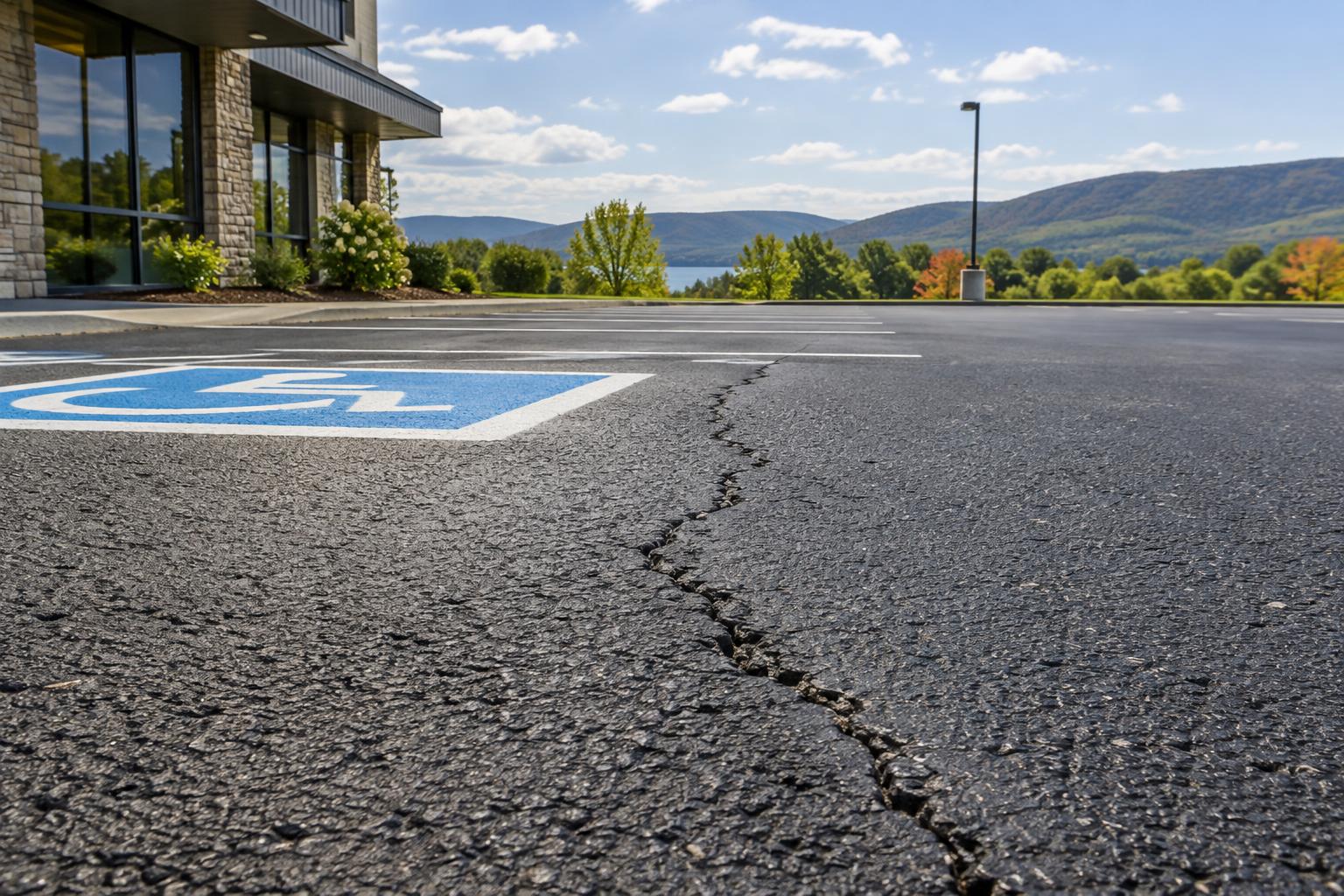
It's easy to look at a crack in a parking lot and see a cosmetic problem. But for someone navigating that surface in a wheelchair or on a mobility scooter, that same crack can mean a stuck wheel, a sudden jolt, or a dangerous fall. Uneven surfaces, cracks, and potholes make mobility significantly harder and more dangerous for individuals using wheelchairs, walkers, or even strollers — and that translates directly into liability for the property owner.
The Americans with Disabilities Act doesn't treat pavement as a minor detail. Accessible surfaces are a core part of what makes a commercial property legally compliant and genuinely welcoming. When that surface degrades, so does compliance — and the legal and human consequences can be serious. Avello Asphalt & Construction Corp, a Hudson Valley commercial paving contractor, works specifically with property owners facing these challenges, helping bring deteriorating pavement back into alignment with both ADA standards and the real-world needs of visitors who depend on accessible surfaces.
How Cracks Endanger Mobility Aid Users
The risks that cracked pavement creates for wheelchair users go well beyond inconvenience. They range from immediate physical danger to long-term health consequences — and in some cases, they push vulnerable people into genuinely life-threatening situations.
Stuck Wheels, Lost Control, and Fall Risk
When a wheelchair wheel catches in a crack or drops into a pothole, the result can be sudden and violent. Cracked and deteriorating pavement has been documented to cause wheelchair users to get stuck mid-route or lose steering control entirely, sometimes resulting in falls serious enough to cause broken shoulders and other significant injuries. Mobility scooter users face similar dangers — cracked surfaces can cause tipping, sudden jolting, and complete loss of steering control. These aren't rare edge cases. They're predictable outcomes of allowing pavement to deteriorate without repair.
Jolts and Vibrations That Cause Chronic Pain
Not every injury from bad pavement happens in a dramatic fall. Rough asphalt and repeated surface irregularities transmit vibrations directly through a wheelchair frame, and over time, those vibrations take a toll on the body. Wheelchair users already place heavy stress on the lower back, neck, shoulders, elbows, and wrists through everyday movement — and rough pavement compounds that strain. What looks like a minor surface issue can quietly contribute to long-term physical deterioration for people who depend on mobility aids daily.
When Bad Pavement Forces Wheelchair Users Into Traffic
Perhaps the most alarming consequence of poorly maintained pavement is what happens when the surface becomes completely impassable. Crumbling, cracked, or uneven sections of parking lot or walkway can force wheelchair users to abandon the accessible route entirely — sometimes moving into traffic lanes or driveways to find a passable path. That's a documented pattern that results directly from neglected commercial pavement, and it represents a profound failure of basic accessibility that no property manager should accept.
What ADA Standards Actually Require of Your Pavement
The ADA doesn't leave accessibility to interpretation. There are specific, measurable standards that commercial pavement must meet — and they apply whether a property was built last year or twenty years ago.
Surface Openings Must Not Exceed 0.5 Inches Wide — And Vertical Level Changes Are Capped at 0.25 Inches
ADA standards require that accessible surfaces be firm, stable, and slip-resistant. Surface openings — the kind created by cracks, gaps, or deteriorating seams — must not exceed 0.5 inches in width. That's a tight standard that ordinary pavement wear can violate quickly. Equally, vertical level changes between surfaces cannot exceed 0.25 inches without a beveled transition. Even a modest frost heave or settling edge can push pavement past that threshold, creating a barrier that's both dangerous and non-compliant.
Slope and Level Change Limits for Parking and Walkways
Accessible parking spaces and their access aisles must be essentially level. The ADA caps surface slopes at 1:48 — or 2.08% — in all directions. That means even gentle inclines in a parking area can disqualify a space from being counted as accessible. Over time, as pavement shifts, settles, or is resurfaced unevenly, slopes that were once compliant can drift out of tolerance without any obvious visual indication.
Accessible Routes: Width, Slope, and Surface Rules
The path from an accessible parking space to a building entrance must meet its own set of requirements. ADA-compliant accessible routes must be at least 36 inches wide, with a firm, stable, slip-resistant surface. For walking surfaces that are not ramps, the running slope cannot exceed 1:20 (5%); where a ramp is present, the running slope cannot exceed 1:12 (8.33%). No abrupt level changes greater than 1/4 inch are permitted anywhere along the route. Every crack, pothole, or uneven seam that crosses that path is a potential compliance violation — and a potential hazard for anyone using it.
Wear and Tear Can Strip Away Compliance Over Time
One of the most common misconceptions among commercial property owners is that ADA compliance is a one-time achievement. Build or pave it right the first time, and the job is done. In reality, pavement compliance is an ongoing status — not a permanent condition.
Why Original Construction Isn't Enough
Regular inspections and prompt repair of surface damage are required for maintaining ADA compliance, because wear and tear can create accessibility barriers even in pavement that originally met every standard. Freeze-thaw cycles in the Hudson Valley are particularly harsh on asphalt surfaces. Water infiltrates small surface cracks, freezes, expands, and forces those cracks wider — a process that accelerates surface deterioration and can take a compliant parking lot out of spec within a few seasons without routine attention.
Resurfacing Projects Trigger New ADA Requirements
There's an additional consideration when significant paving work is planned. Under federal ADA guidance, resurfacing projects that alter a roadway or parking area trigger requirements for accessible features — including curb ramps and accessible route upgrades — even if the work is framed as maintenance. That means a resurfacing project done without an accessibility lens can actually create new compliance obligations that weren't accounted for in the project budget. Working with a contractor who understands these requirements from the start avoids that trap entirely.
The Real Cost of Non-Compliance for Hudson Valley Businesses
The financial case for maintaining accessible pavement is straightforward — but the numbers behind it deserve serious attention.
ADA Lawsuits Are Prevalent and Costly — With Fines Up to $75,000
Federal Title III ADA lawsuits have been filed at rates exceeding 10,000 per year in peak years, with filings in the range of 8,600-8,800 annually in more recent years. First-time ADA violations can carry civil penalties of up to $75,000, with repeat violations reaching $150,000. Beyond the direct fines, there are legal fees, potential retrofitting costs under court order, and reputational damage that doesn't show up on a balance sheet. For a regional business or commercial property in the Hudson Valley, a single ADA lawsuit can be genuinely devastating — and cracked, deteriorating pavement is one of the more common triggers.
Budget Is Not a Defense — But Alteration Projects Have a 20% Cost Cap for Path-of-Travel Upgrades
Courts have made it increasingly clear that financial constraints are not an acceptable justification for inaccessible pavement. Judges have consistently declined to accept budget limitations as a defense for failing to maintain accessible surfaces. That said, the ADA does include some practical relief: when a commercial property undertakes an alteration project, the requirement to upgrade the path of travel to the altered area is capped at 20% of the total alteration cost. That cap doesn't eliminate the obligation, but it does make compliance planning more manageable when built into a larger project from the beginning.
How Commercial Paving Services Restore ADA Compliance
Deteriorating pavement is a fixable problem. Professional commercial paving services address accessibility failures systematically, bringing surfaces back into compliance while extending the overall life of the pavement.
1. Crack Sealing and Pothole Repair
The most immediate accessibility intervention is closing the gaps. Crack sealing fills surface openings before they exceed the 0.5-inch ADA threshold, stopping water infiltration that accelerates deterioration. Pothole repair eliminates the abrupt surface changes and voids that are most dangerous for wheelchair users. Done early and consistently, these targeted repairs preserve compliance and prevent more costly structural damage from spreading through the pavement base.
2. Resurfacing for Smooth, Level Access
When surface damage is too widespread for targeted repairs, resurfacing restores a consistent, compliant surface across the entire pavement area. A proper resurfacing job eliminates accumulated cracking, corrects surface irregularities, and creates the firm, stable, slip-resistant finish that ADA standards require. It also resets the compliance clock — giving a property owner a fresh surface to maintain rather than a deteriorated one to chase.
3. Proper Slope Grading and Accessible Parking Design
Resurfacing alone isn't enough if the underlying geometry is off. ADA-compliant parking requires precise slope control — surfaces must stay within that 2.08% maximum in all directions. Professional contractors measure and grade as part of the paving process, ensuring that accessible spaces and access aisles meet the standard rather than simply looking flat. This kind of precision matters especially in the Hudson Valley, where freeze-thaw movement can alter pavement grade subtly but significantly over time.
4. Sealcoating to Protect Compliance Long-Term
Sealcoating is the maintenance layer that protects everything underneath it. By sealing the surface against water infiltration, UV damage, and freeze-thaw penetration, sealcoating dramatically slows the rate at which a newly compliant surface degrades. Applied on a regular schedule, it's the most cost-effective way to preserve ADA-compliant pavement between major resurfacing cycles — far less expensive than the repairs, retrofitting, or legal costs that come from letting pavement deteriorate without protection.
Avello Asphalt Helps Hudson Valley Properties Stay Compliant and Accessible
Maintaining accessible pavement isn't a one-time project — it's an ongoing responsibility that sits at the intersection of property upkeep, legal compliance, and basic respect for every person who needs to access a commercial space. For Hudson Valley property managers and business owners, the stakes are clear: cracked pavement creates real danger for wheelchair users, real legal exposure for property owners, and real costs that grow the longer the problem is left unaddressed.
The path forward is straightforward. Regular inspections, timely crack sealing, and properly executed resurfacing or grading work can keep commercial pavement within ADA standards year after year — even through the Hudson Valley's demanding seasonal conditions. Understanding what those standards actually require, and why they exist, makes it easier to treat pavement maintenance as the priority it genuinely is rather than a deferred expense.
Avello Asphalt & Construction Corp brings technical knowledge and local experience to commercial paving projects throughout the Hudson Valley — visit AvelloAsphalt.com to learn how their commercial paving services can help keep your property safe, accessible, and compliant.
Company: Avello Asphalt & Construction Corp City: Poughkeepsie Address: 141 Daley Road Website: https://www.avelloasphalt.com
Mentioned in this blog post: Poughkeepsie service area
Have a property like this?
Tell us what you're seeing. We'll walk the site, explain the options plainly, and give you a clear scope.