How to Schedule Summer Medical Practice Lot Paving | Hudson Valley Experts
Avello's take
This item looks at parking lot upkeep and the concerns behind paving plans for commercial properties in the Hudson Valley. It covers how cracks let water beneath asphalt, how freeze-thaw cycles widen those cracks, and how uneven pavement and faded markings affect movement through a lot. It also discusses accessibility concerns, including signage and ramp slopes, alongside property owners’ maintenance responsibilities. We see these as connected parts of caring for the space visitors encounter before they reach a building.
For local property owners and managers, that connection matters when balancing building maintenance with outdoor needs. A parking lot deserves a place in that planning, too. We view a pavement inspection as a sensible starting point, with attention to cracks, drainage, markings, and pedestrian routes. Reviewing accessibility conditions belongs in that process as well. Together, those observations can help shape a maintenance calendar grounded in the lot’s condition and the Hudson Valley’s seasonal weather.
- 1 in 5 vehicle accidents happen in parking lots — making them one of the most overlooked safety hazards on commercial properties.
- Small cracks in asphalt don't stay small — Hudson Valley's freeze-thaw cycles can turn a hairline crack into a costly pothole in a single winter.
- ADA non-compliance penalties can reach $75,000 for a first violation, with inflation-adjusted federal figures exceeding $115,000 for a first offense and subsequent violations potentially surpassing $230,000 — and many property owners don't realize their lots are out of compliance until a lawsuit lands on their desk.
- Proactive maintenance follows a simple financial principle: every $1 spent early can prevent up to $7 in future repair costs — a ratio that makes routine upkeep hard to argue against.
- Several common ADA violations — from faded signage to incorrect ramp slopes — are hiding in plain sight on lots across the region, and the section below breaks down exactly what to look for.
A parking lot is usually the first thing a customer, tenant, or visitor encounters at a commercial property. Most property owners focus their maintenance budgets on the building itself — the roof, HVAC, interior finishes — while the asphalt outside quietly deteriorates. That's a costly oversight. What looks like a surface-level problem is often a compounding financial, legal, and safety risk hiding in plain sight.
1 in 5 Vehicle Accidents Happen in Parking Lots
Parking lots feel slow and low-stakes — but the numbers tell a different story. Roughly one in five vehicle accidents in the United States occurs in a parking lot or garage. These incidents injure more than 60,000 people and claim over 500 lives every year. That's not a minor footnote — it's a scale of harm that rivals many higher-profile road hazards.
A significant driver of those numbers is distracted behavior. Studies have found that two-thirds of drivers admit to distractions like texting, checking social media, or programming navigation systems while moving through parking lots — likely because the low-speed environment feels forgiving. It isn't. Add uneven pavement, poor lighting, faded lane markings, and unclear pedestrian routes, and a parking lot becomes a genuine accident waiting to happen.
For commercial property owners and facility managers, this isn't just a safety concern — it's a liability concern. The condition of a parking lot directly affects how safely people can move through it, and that responsibility falls squarely on the property owner. Avello Asphalt and Construction Corp, a Hudson Valley paving contractor at AvelloAsphalt.com, works with commercial property owners across the region who are managing exactly these risks — often after years of deferred maintenance have already taken a toll.
Cracked Asphalt Is More Than an Eyesore
A small crack in asphalt is easy to dismiss. It doesn't block traffic, nobody's complained, and there are bigger priorities. But ignoring pavement cracks is one of the most expensive decisions a property owner can make — not just financially, but legally and environmentally.
How Cracks Become Costly Potholes
Water is the primary enemy of asphalt. The moment a crack forms, it creates an open channel for rainwater to reach the sub-base beneath the pavement. Once there, water erodes the aggregate materials that give asphalt its structural support. Over time, the surface above that compromised base begins to flex, fragment, and eventually collapse inward — forming a pothole.
The cost curve here is steep. Crack filling is inexpensive. Pothole patching costs more. Full-depth asphalt reconstruction can run tens of thousands to six figures — all for a problem that started as a crack that could have been sealed for a fraction of the price. Early intervention isn't just smart maintenance; it's basic financial management.
Hudson Valley Freeze-Thaw Cycles Accelerate the Damage
The Hudson Valley's climate adds an aggressive multiplier to pavement deterioration. Through late fall, winter, and early spring, temperatures routinely swing above and below freezing — sometimes multiple times in a single week. When water trapped inside an asphalt crack freezes, it expands. When it thaws, it contracts. That repeated expansion and contraction forces the crack wider with each cycle.
What might take years to worsen in a milder climate can deteriorate significantly in a single Hudson Valley winter. This is why fall crack filling and spring pavement inspections aren't optional extras — they're essential parts of a maintenance calendar for any commercial property in the region. Many local municipalities across the Hudson Valley already require commercial property owners to keep driveways and parking areas in good repair, reinforcing what sound maintenance practice already demands.
Pollutants Seeping Into the Ground
The environmental consequences of cracked asphalt are less visible but equally serious. Parking lots collect oil drips, fuel residue, and heavy metals from vehicle traffic. On an intact surface, those contaminants can be managed through proper drainage systems. On a cracked surface, they seep directly into the soil beneath the pavement.
From there, pollutants migrate into storm drains and local groundwater, threatening soil quality and nearby ecosystems. In a region like the Hudson Valley — where environmental preservation is both a community value and a regulatory priority — this kind of contamination can attract attention from local agencies. A deteriorating parking lot isn't just an aesthetic problem; it's a potential environmental liability.
The Legal Exposure Hiding in Your Parking Lot
Property owners often don't think about their parking lot in legal terms — until something goes wrong. The reality is that commercial parking lots carry meaningful legal obligations, and failing to meet them creates exposure on multiple fronts.
Premises Liability: Your Duty to Maintain
Under premises liability law, commercial property owners and facility managers have a legal duty to keep their properties reasonably free from hazards. That duty extends to the parking lot — including potholes, uneven surfaces, poor lighting, inadequate signage, and unclear pedestrian paths.
When a visitor trips on a cracked surface, falls into a pothole, or is injured due to a condition the owner knew about (or should have known about), that owner can be held liable for the resulting damages. "Should have known" is the critical phrase — courts don't require proof that an owner was notified of a hazard. Regular inspections are part of what defines reasonable care, and skipping them is itself a form of negligence.
The financial consequences of a premises liability claim — legal defense costs, settlements, increased insurance premiums — can far exceed the cost of the maintenance that would have prevented the incident.
ADA Penalties, Lawsuits, and State-Level Costs
Beyond general liability, the Americans with Disabilities Act creates a specific and enforceable set of obligations for commercial parking lots. Federal civil penalties for a first-time ADA violation can reach $75,000, with inflation-adjusted figures exceeding $115,000 for a first offense. Subsequent violations can surpass $230,000 — and those figures don't include litigation costs or the reputational damage that often follows a public ADA complaint.
ADA lawsuits against commercial properties are more common than most owners realize, and they frequently originate from issues that could have been caught and corrected during a routine inspection. An accessible space without proper signage, a ramp with a non-compliant slope, access aisles too narrow for a wheelchair — each of these is a discrete, penalizable violation. The exposure adds up quickly on older or poorly maintained lots.
Common ADA Violations Property Owners Miss
The ADA Standards for Accessible Design are detailed and specific. Many of the most common violations aren't the result of deliberate neglect — they're the result of deferred maintenance on features that were once compliant but have since degraded. Here are four violations that regularly go unnoticed until they become a legal problem.
1. Too Few Accessible Spaces for Lot Size
The ADA establishes a clear formula for how many accessible spaces a lot must provide based on its total capacity:
- 1-25 total spaces: 1 accessible space required
- 26-50 spaces: 2 accessible spaces
- 51-75 spaces: 3 accessible spaces
- 76-100 spaces: 4 accessible spaces
- 101-500 spaces: 1 additional accessible space per additional 100 spaces
- 501-1,000 spaces: accessible spaces must equal 2% of the total
- 1,001 or more spaces: 20 accessible spaces, plus 1 for each 100 spaces (or fraction thereof) beyond 1,000
- At least 1 of those spaces must be van-accessible
Lots that have been reconfigured, expanded, or repainted without consulting the ADA ratios frequently fall short of these minimums. Larger facilities serving multiple buildings or entrances may also need accessible spaces distributed across different areas of the lot — not just clustered near one entrance.
2. Faded or Missing Signage
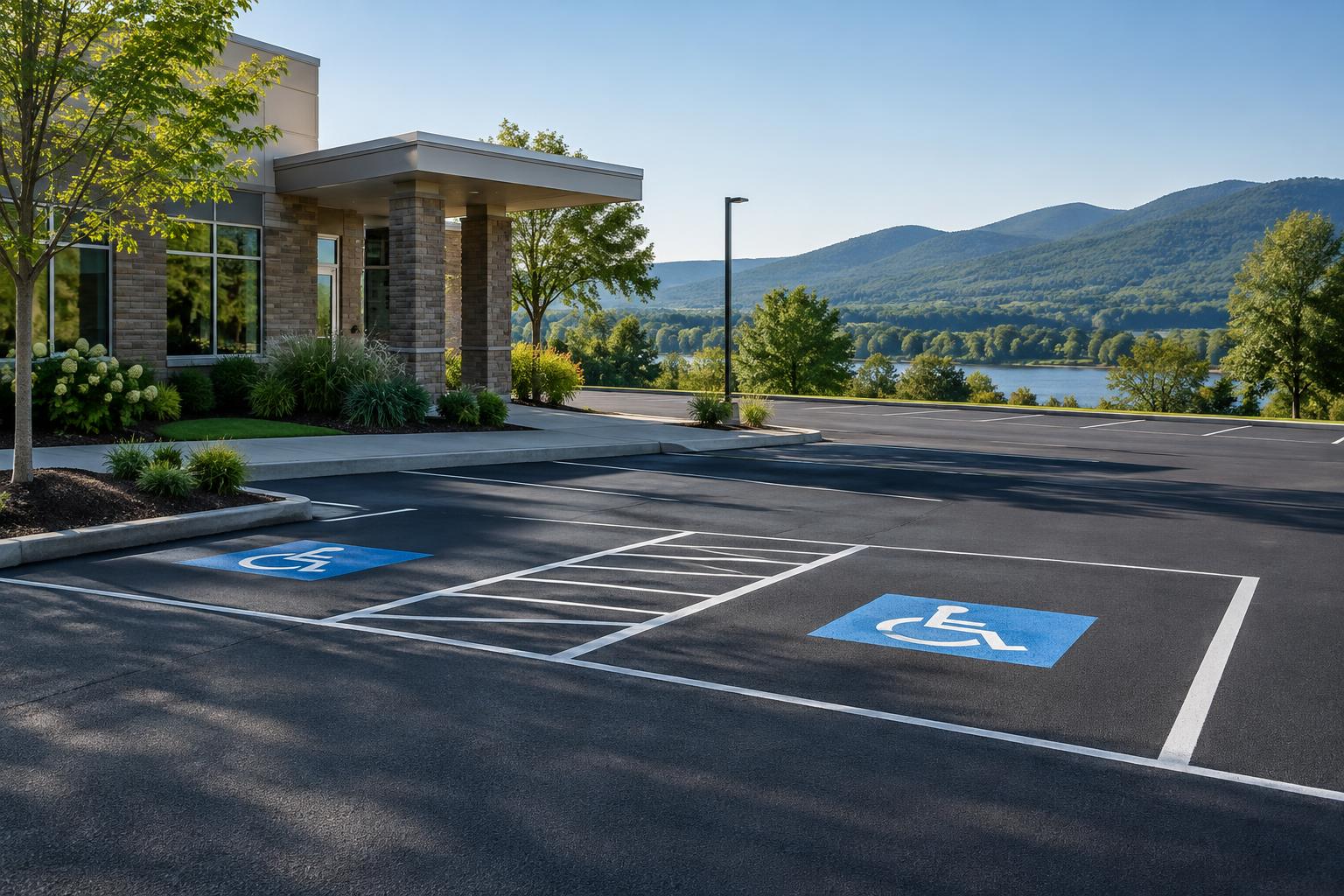
Every ADA-accessible parking stall must display the International Symbol of Accessibility, mounted so the bottom edge sits at least 60 inches above the ground. That height requirement ensures the sign remains visible even when vehicles are parked in adjacent stalls. Van-accessible spaces require an additional "Van Accessible" designation.
Signs fade. Poles get damaged. Snow removal equipment knocks them out of position. A sign that was installed correctly five years ago may no longer meet the visibility or placement standards today. When a sign becomes difficult to read or falls below the required mounting height, that space is no longer considered compliant — regardless of how the pavement is marked.
3. Incorrect Slopes and Non-Compliant Ramps
The ADA sets distinct slope limits for different parts of the accessible route. Ramps are capped at a maximum slope of 1:12 and must have smooth, slip-resistant surfaces with level landings at both ends. Accessible parking spaces and their access aisles are held to a stricter standard — slopes must not exceed 1:48 (approximately 2%) in any direction to ensure stability for mobility devices.
Pavement settles over time. Frost heave, erosion, and repeated freeze-thaw cycling can shift the grade of a surface that was once perfectly level. A ramp or accessible space that passes a slope measurement today may fail the same measurement after a hard winter. This is why periodic grade checks — not just visual inspections — matter for maintaining ADA compliance over the long term.
4. Undersized Stalls and Access Aisles
ADA dimension requirements are precise. Standard accessible car spaces must be at least 8 feet wide, paired with a 5-foot access aisle marked with diagonal striping. Van-accessible spaces require either an 11-foot-wide stall or an 8-foot stall with an 8-foot access aisle. Van routes and loading areas must also maintain a vertical clearance of at least 98 inches.
Restriping a lot without referencing the current ADA standards — or simply repainting over old lines without verifying dimensions — is a common way properties fall out of compliance. Access aisles that are too narrow don't just fail the legal standard; they prevent people using wheelchair lifts or ramps from safely exiting their vehicles.
Proactive Maintenance Pays for Itself
The financial case for regular parking lot maintenance is straightforward — and surprisingly compelling once the numbers are laid out.
The Rule of Seven: $1 Spent Saves $7 Later
The "Rule of Seven" is a well-established principle in pavement management: every dollar invested in preventive maintenance can prevent up to seven dollars in future repair costs. The logic is simple. Crack filling costs a fraction of pothole patching. Pothole patching costs a fraction of full-depth resurfacing. Resurfacing costs a fraction of complete lot reconstruction.
Each stage of deterioration is exponentially more expensive than the one before it — and each stage was avoidable with earlier action. For a commercial property owner managing a tight maintenance budget, this ratio reframes routine upkeep as an investment with a measurable return, not just an operating expense.
What a Maintenance Schedule Should Include
A well-structured parking lot maintenance plan isn't complicated, but it does need to be consistent. For Hudson Valley commercial properties, a practical schedule should include:
- Fall crack filling: Seal all visible cracks before winter to prevent water infiltration and freeze-thaw damage
- Spring inspection: Assess the full lot after the thaw season for new or worsened cracks, heaving, and drainage issues
- Annual ADA compliance review: Check signage condition and mounting height, verify stall and access aisle dimensions, and assess ramp slopes
- Restriping every 1-2 years: Repaint all markings — including accessible stalls, access aisles, and directional indicators — before they fade to the point of ambiguity
- Sealcoating on a 3-5 year cycle: Apply a protective seal coat to slow oxidation and water penetration across the full surface
- Pothole repair as needed: Address any failures promptly to prevent both injury liability and accelerated surrounding deterioration
Maintaining records of each inspection and repair is also worth the effort. Documented maintenance history demonstrates due diligence and can be a meaningful defense in a premises liability claim.
Don't Wait for a Lawsuit to Inspect Your Lot
The pattern is consistent: a property owner ignores gradual pavement deterioration, skips an ADA review, and then faces a premises liability claim or an ADA complaint that costs far more to resolve than any maintenance program would have. The risks outlined here — safety incidents, environmental contamination, legal penalties, and runaway repair costs — aren't hypothetical. They're the predictable outcomes of deferred maintenance on commercial asphalt.
The good news is that none of this is difficult to prevent. A structured inspection schedule, timely crack repair, proper restriping, and a periodic ADA compliance walkthrough are the core elements of a parking lot that protects visitors, satisfies regulators, and saves money over the long run. The question isn't whether a lot will deteriorate — all pavement does — but whether the deterioration will be managed proactively or reactively.
Reactive is always more expensive. Proactive is always more defensible. For commercial property owners and facility managers across the Hudson Valley, the time to inspect a parking lot is before there's a reason to regret not doing it sooner.
Commercial property owners looking to get ahead of pavement deterioration and ADA exposure can reach out toAvello Asphalt and Construction Corp, a Hudson Valley paving contractor specializing in commercial lot maintenance, repair, and compliance assessments.
Company: Avello Asphalt & Construction Corp City: Poughkeepsie Address: 141 Daley Road Website: https://www.avelloasphalt.com
Mentioned in this blog post: Poughkeepsie service area
Have a property like this?
Tell us what you're seeing. We'll walk the site, explain the options plainly, and give you a clear scope.