Gas Station Asphalt Paving: Poughkeepsie Contractor's Complete Guide
Avello's take
Gas station paving has to account for more than everyday car traffic. This guide looks at how fuel spills, frequent vehicle movement, and heavy tanker deliveries affect asphalt. It also covers the planning behind a workable lot, from entries and exits to pump spacing, delivery access, and drainage. We explain why materials and layout need to suit the conditions at a fueling site, rather than follow the same approach used for every commercial parking lot.
For Hudson Valley property owners and managers, these details matter when planning paving work at a gas station. Vehicle access, pavement wear, and spill containment are connected decisions. We see a sensible starting point as a review of how the site handles customer traffic, tanker deliveries, and runoff. That review can help shape the material choices, layout, and maintenance planning described in the guide.
Key Takeaways
- Gas station pavement faces a unique combination of heavy tanker truck loads, constant vehicle turnover, and fuel spills that standard asphalt simply isn't built to survive long-term.
- Fuel-resistant sealers and thermoplastic striping aren't optional upgrades — they're baseline requirements for any gas station lot that needs to last.
- Smart traffic flow design (entries, exits, pump lane spacing, and angled stalls) directly reduces accidents and keeps customers moving efficiently.
- Poughkeepsie gas station owners must navigate both city and town permit requirements, plus EPA and ADA rules — choosing the wrong path adds serious delays and costs.
- Proactive maintenance — sweeping, crack sealing, scheduled sealcoating, and restriping — can extend pavement life by decades rather than years.
Gas station lots don't get the same consideration as a shopping center or office park. The traffic is relentless, the chemical exposure is constant, and the regulatory obligations run deeper than most property owners expect. Getting the pavement right from the start — and keeping it right — is one of the highest-return decisions a station owner or manager can make. This guide breaks down exactly what that looks like in Poughkeepsie, from initial design through long-term maintenance.
Gas Stations Destroy Ordinary Asphalt — Here's Why
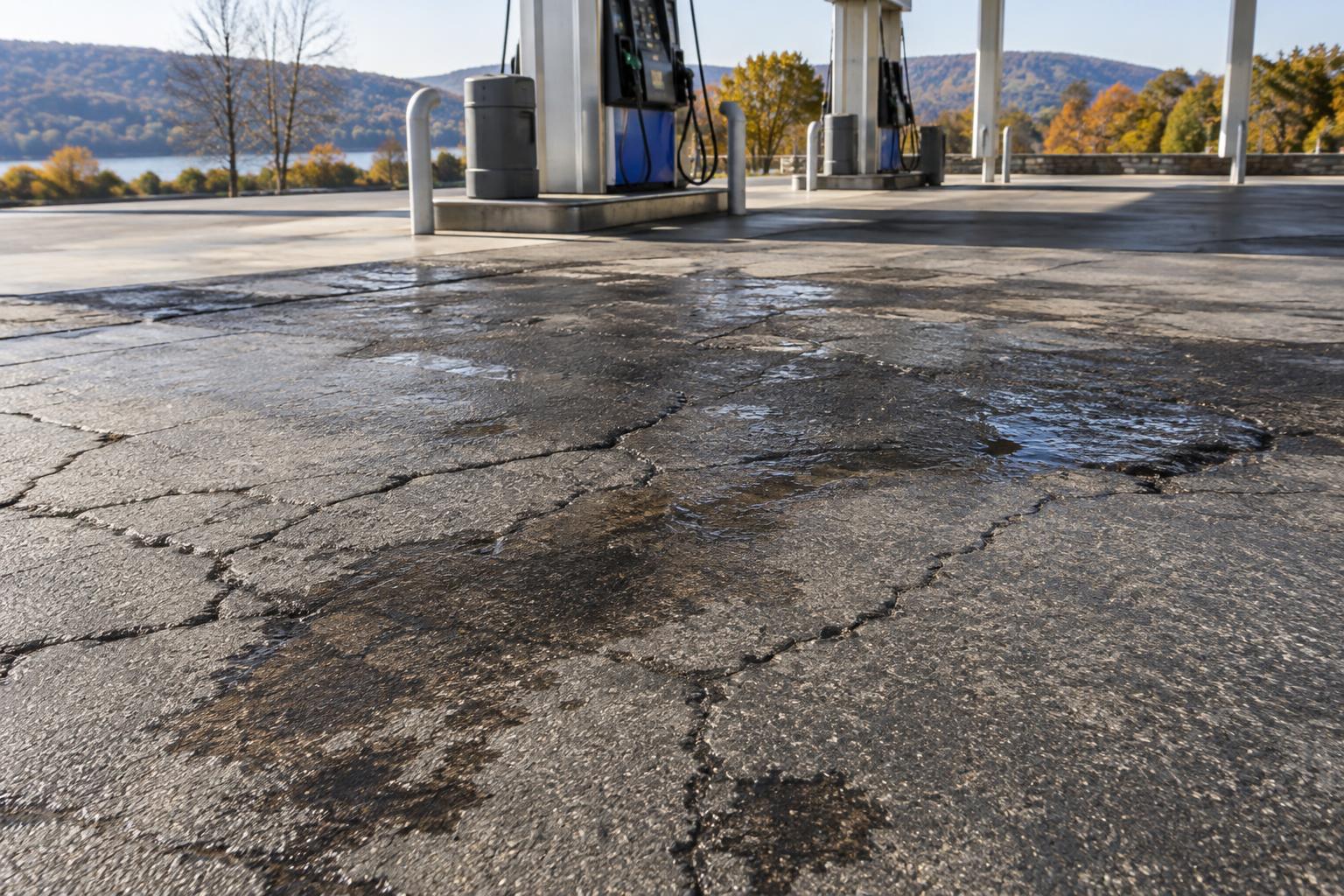
Standard commercial asphalt is engineered for wheel loads, weather cycles, and time. Gas stations introduce a fourth variable that most pavement simply isn't designed for: constant chemical exposure. Gasoline, diesel, motor oil, and hydraulic fluid are all petroleum-based solvents. When they soak into unprotected asphalt, they dissolve the binder that holds the aggregate together. The surface softens, loses structural integrity, and begins to ravel and crack — often within a fraction of the lifespan you'd expect from a normal lot.
On top of that, gas stations absorb an unusual load profile. Passenger cars cycle in and out all day, but fuel tanker trucks — sometimes topping 80,000 lbs gross vehicle weight — make regular deliveries. That combination of high-frequency light loads and periodic extreme heavy loads accelerates rutting and base failure, particularly in the pump island aprons and tanker delivery zones. A modified binder asphalt mix, sometimes called a polymer-modified asphalt, is one field-tested response to this; these formulations are specifically engineered to resist both deformation under heavy loads and chemical breakdown from fuel contact.
Standard asphalt is generally impervious, but its surface can be degraded by fuel spills over time, allowing petroleum-based solvents to penetrate and reach the sub-base — and eventually soil and groundwater. That's not just a pavement problem; it becomes an environmental liability. Specialized hybrid sealers, such as products meeting ASTM D-2939 testing standards, are engineered to seal the asphalt surface against fuel and chemical intrusion. Avello Asphalt and Construction Corp works specifically with commercial clients in the Poughkeepsie area who face exactly these conditions, applying the right materials for the right application rather than a one-size-fits-all approach.
Design That Moves Vehicles and Protects the Site
Good paving at a gas station starts before the first ton of mix is laid. The layout of the lot — where traffic enters, how it moves around pumps, where it exits, and how stormwater leaves the site — determines everything from customer throughput to long-term pavement wear. Poor design doesn't just frustrate customers; it creates conflict points that increase accident risk and concentrates wear in the wrong spots.
Traffic Flow: Entries, Exits, and Pump Lane Spacing
The entry and exit design of a gas station lot is one of the most consequential decisions in the entire project. Wide, clearly delineated entry aprons reduce hesitation and congestion at the curb cut. Separate entry and exit points — where site geometry allows — eliminate the dangerous head-on conflict that happens when customers try to exit through an active entry point during peak hours.
Pump lane spacing needs to accommodate more than just a typical sedan. Pickup trucks, SUVs with extended wheelbases, and the occasional work truck all need enough clearance to pull in, fuel up, and pull through without backing. Adequate face-to-face spacing between parallel pump islands — generally enough for vehicles on both sides to maneuver independently — is a standard design consideration. Tanker truck access is a separate design requirement entirely — the delivery area needs its own apron with adequate turning radius and a reinforced base course rated for the load.
Angled Stalls and One-Way Lanes Reduce Conflict
For the convenience store parking area adjacent to the fueling canopy, angled stalls outperform perpendicular ones in most gas station configurations. At 45 or 60 degrees, stalls are easier to pull into without precise steering, require narrower drive aisles, and naturally push traffic in a single direction. That one-way flow is what makes the difference between a lot that feels chaotic and one that customers navigate intuitively.
One-way lanes also extend pavement life by distributing wear more evenly. When every vehicle enters and exits from the same side of a stall, wheel loads concentrate in predictable locations — which means maintenance and repairs can be targeted precisely where they're needed rather than spread across the entire parking field.
Drainage, Spill Containment, and Stormwater Compliance
Water management at a gas station is layered. The fueling island canopy area needs to be graded and curbed so that any spilled fuel or wash-down water is directed toward a containment system — not toward the street or storm drain. Oil-water separators are commonly required to treat runoff before it enters the municipal stormwater system, and the pavement grade in fueling zones must direct flow toward these collection points, not away from them.
Beyond the canopy, the broader lot needs positive drainage — typically a 1.5% to 2% cross-slope — to move rainwater efficiently to catch basins without pooling. Standing water accelerates asphalt oxidation, works into cracks, and in freeze-thaw climates like Poughkeepsie's, causes dramatic sub-base damage over the winter months. Drainage design isn't a detail; it's the structural backbone of a long-lived lot.
Why Asphalt Wins for Gas Station Lots
Both asphalt and concrete are viable base materials for gas station pavement, but in most Poughkeepsie-area projects, asphalt is the practical choice. The reasons come down to upfront cost, construction speed, and how each material responds to the inevitable need for repairs.
Lower Cost and Faster Installation vs. Concrete
Asphalt consistently comes in at a lower initial cost per square foot than concrete for commercial lots. It's also ready for traffic significantly faster — asphalt can typically be opened within 24 to 48 hours of placement, while concrete requires a curing window of several days to a week before it can handle full vehicle loads. For an operating gas station doing a full-lot replacement or major resurfacing, that difference in downtime translates directly to lost revenue.
Repairs also favor asphalt. When a concrete panel cracks or settles, the repair is complex and often visible — matching the original color and texture is difficult, and full panel replacements are expensive. Asphalt patches, when done properly with the right mix and compaction, are structurally sound and far less disruptive to the surrounding pavement. Properly maintained asphalt lots can last 20 to 30 years, making the lifecycle cost very competitive with concrete.
Fuel-Resistant Sealers: The Non-Negotiable Add-On
Here's where the asphalt-versus-concrete discussion gets important nuance: standard asphalt has less inherent chemical resistance than concrete. That gap is closed by applying a fuel-resistant sealer — but not just any sealer. Standard asphalt emulsion sealers generally offer limited protection against gasoline or diesel; coal-tar based products vary widely in their fuel resistance depending on formulation. Products specifically engineered to pass ASTM D-2939 testing and FAA P-625 specifications — like the BIG A Pro-Hybrid class of hybrid sealers — are formulated to create a true chemical barrier.
These hybrid sealers work by filling the surface voids in the asphalt matrix, preventing fuel molecules from penetrating to the binder layer where the real damage starts. They also make the surface much easier to clean — fuel residue sits on top rather than soaking in, so routine pressure washing removes it before it has a chance to accumulate. In high-risk zones like directly under the pump dispensers and along the tanker fill-port area, a second application coat is often warranted. Thermoplastic line markings complement this approach well — thermoplastic is virtually impervious to gas, diesel, and oil, meaning stripes stay crisp and visible even in the most active fueling zones.
Poughkeepsie Permits and Regulations You Can't Skip
Permit requirements for commercial paving in the Poughkeepsie area are not uniform — they depend on where exactly the property sits and which roads it touches. Skipping the right permit isn't just a paperwork risk; it can result in stop-work orders, required demolition of completed work, and significant fines.
City Building Department vs. Town Highway Department: Which Applies to You
This is the first question that needs an answer before any plans are drawn. Properties within the City of Poughkeepsie generally fall under the jurisdiction of the City Building Department. Paving projects that affect or access city streets typically require street opening permits and right-of-way permits, coordinated through the relevant city departments including the Department of Public Works (DPW). Contractors and owners should confirm current requirements directly with the City of Poughkeepsie before work begins, as departmental processes and standards documents can change.
Properties in the Town of Poughkeepsie or adjacent municipalities operate under different rules — the Town Highway Department generally has jurisdiction over town roads, and Dutchess County oversees county roads, though owners should verify current jurisdictional boundaries and requirements directly with those agencies. If a gas station driveway apron intersects a state route — Route 9 and Route 44 are common examples in the area — a New York State DOT highway work permit is typically required; confirm specifics with NYSDOT before proceeding. Sorting out which entities need to sign off before work starts is a critical early step — an experienced local contractor who has already navigated these channels repeatedly is a real advantage here.
EPA and ADA Requirements That Apply to Your Lot
Federal compliance obligations layer on top of local permits. The EPA's Resource Conservation and Recovery Act (RCRA) governs underground storage tanks (USTs), and any paving work near fill ports or vent lines has to be coordinated carefully to avoid disturbing UST infrastructure or compromising secondary containment integrity. The Clean Air Act's requirements around volatile organic compounds (VOCs) also apply at fueling facilities, particularly if canopy drainage or surface runoff could mobilize VOCs toward storm drains.
ADA compliance is non-negotiable. Any lot resurfacing or reconstruction project triggers a requirement to bring accessible parking spaces, access aisles, and pedestrian routes into current ADA standards — including proper slope tolerances (no more than 2% cross-slope in accessible spaces), clearly marked accessible routes from parking to the store entrance, and van-accessible space dimensions where required. These aren't optional upgrades to budget later; they're baseline legal obligations that apply at project completion.
Maintenance That Doubles Pavement Lifespan
The difference between a gas station lot that lasts 12 years and one that lasts 25 years is almost never the original installation. It's what happens after. Proactive maintenance — executed on the right schedule with the right materials — is the single highest-ROI investment a station owner can make in their pavement. Each of the following steps addresses a specific failure mechanism.
1. Sweep and Pressure Wash Regularly
Debris accumulation isn't just cosmetic. Small rocks, sand, and gravel work their way into surface cracks and act as wedges — the natural flex of the pavement under traffic loads drives them deeper, widening cracks that would otherwise stay stable. Busy stations benefit from frequent sweeping to remove this material before it causes structural harm; the right interval depends on traffic volume and site conditions.
Pressure washing targets what sweeping misses: oil residue, fuel staining, and the black sludge film that builds up in high-traffic areas. These deposits accelerate oxidation of the asphalt surface and make fuel-resistant coatings less effective over time. Use the lowest effective pressure setting — excessive pressure can displace surface aggregate and damage the sealer coat. Avoid harsh chemical solvents that can themselves attack the asphalt binder.
2. Seal Cracks Before Fuel Turns Them Into Potholes
Cracks are the entry point for every major pavement failure that follows. Water infiltrates, freezes, and expands in Poughkeepsie winters — each freeze-thaw cycle widens the crack and degrades the sub-base beneath it. At a gas station, cracks also channel fuel spills directly into the pavement structure, bypassing the protective sealer coat entirely.
Crack sealing should happen as soon as cracks are spotted — not at the next scheduled maintenance visit, not next season. Hot-applied rubberized crack sealant is the industry standard for commercial applications; it bonds to both crack faces, remains flexible through temperature swings, and forms a waterproof barrier. A crack sealed at 1/4 inch costs a fraction of what it costs once it's propagated into a pothole requiring full-depth patching.
3. Sealcoat on a Schedule Matched to Your Traffic Level
Sealcoating is the protective layer that sits between the asphalt surface and everything that attacks it — UV radiation, water, and most importantly at a gas station, fuel and oil. For many commercial lots, a 2-to-3-year sealcoat cycle is common. High-volume gas stations, particularly those with heavy tanker traffic or extended operating hours, may require more frequent applications — sometimes annually or every one to two years — in the most heavily used zones.
The key is using the right product. A fuel-resistant hybrid sealer (not a standard emulsion sealer) is appropriate for the fueling island and pump approach areas. These zones should be prioritized in any sealcoat program. Sealcoating also refreshes the appearance of the lot — a clean, dark, well-maintained surface signals to customers that the business itself is well-run, which matters in a competitive fueling market.
4. Restripe with Thermoplastic for Long-Lasting, High-Visibility Markings
Line striping at a gas station does more than designate parking spaces — it manages traffic flow, identifies pedestrian paths, marks accessible spaces, and directs pump-lane circulation. When markings fade, customers improvise, and improvised traffic patterns create conflict points and near-misses.
Thermoplastic striping material is the right choice for gas stations specifically because it's chemically inert to fuel and oil. Standard traffic paint fades and dissolves in areas with chronic fuel contact; thermoplastic holds its color and bond even in the most active fueling areas. It's also more durable under tire scrubbing — a constant stress in a lot where vehicles are frequently stopping, turning, and pulling away from a dead stop. Restripe whenever markings become difficult to read; don't wait for a scheduled sealcoat cycle to address visibility issues.
What to Demand From Your Paving Contractor
The quality gap between paving contractors in the commercial space is significant. A contractor who primarily does residential driveways is not equipped — in experience, equipment, or materials knowledge — to handle the design complexity and regulatory requirements of a gas station lot. Here's what to look for before signing a contract.
Proven Commercial and Gas Station Project Experience
Ask directly: has this contractor paved active gas stations before? Not just commercial parking lots — gas stations specifically. The combination of spill containment design, tanker load reinforcement, fuel-resistant material specifications, and ADA and EPA compliance is a specialized knowledge set. A contractor who has done this work can describe exactly what mix design they'd specify for the pump island apron, what sealer product they'd use, and how they'd coordinate the work around the station's operating hours. Vague answers to specific questions are a red flag.
References from comparable commercial projects — ideally within Dutchess County or the Hudson Valley region — are a reasonable ask. Local experience matters because it means familiarity with Poughkeepsie's permitting process, the regional climate's effect on asphalt performance, and the material suppliers who serve this market.
Material Transparency and Workmanship Warranties
A credible contractor will tell you exactly what mix they're installing — the binder grade, aggregate size, and target compaction density — not just call it hot mix asphalt. They'll specify the sealer product by name and cite its relevant test standards. If a contractor is unwilling to put materials specifications in writing before the project starts, that's a problem worth walking away from.
Workmanship warranties should cover both the installed asphalt and any applied coatings for a defined period. Ask specifically what the warranty covers — delamination of the sealer, premature rutting, drainage failures — and what it excludes. A contractor who stands behind their work structurally has no reason to avoid putting that commitment in writing.
Avello Asphalt Knows Poughkeepsie Gas Station Paving — Get a Quote
Gas station paving isn't a commodity service. The combination of load engineering, chemical-resistant materials, site drainage, regulatory compliance, and long-term maintenance planning requires a contractor who has worked through these variables on real projects — not one learning on the job at a client's expense. Every element covered in this guide, from fuel-resistant sealer selection to ADA-compliant accessible routes to permit coordination with the City of Poughkeepsie DPW, is a real decision point with real consequences for how long a lot lasts and how well it performs.
The right contractor brings all of this to the table before the first machine rolls onto the site. That means a site assessment that accounts for traffic flow and drainage together, materials specs that match the actual conditions of a working gas station, and a maintenance plan that protects the initial investment over the full life of the pavement — not just through the warranty period.
For gas station owners and managers in the Poughkeepsie area ready to move forward with a paving project or a long-overdue maintenance program, Avello Asphalt and Construction Corp offers the local knowledge and commercial paving experience to get it done right.
Company: Avello Asphalt & Construction Corp City: Poughkeepsie Address: 141 Daley Road Website: https://www.avelloasphalt.com
Mentioned in this blog post: Town of Poughkeepsie service area, City of Poughkeepsie service area, Poughkeepsie service area
Have a property like this?
Tell us what you're seeing. We'll walk the site, explain the options plainly, and give you a clear scope.