72,000-Pound Proof Roll Testing: Poughkeepsie Contractor Reveals Method
Avello's take
We’re sharing this item to explain proof roll testing in plain terms. A heavily loaded vehicle moves across the prepared ground beneath future pavement while observers watch how the surface responds. The process helps reveal soft spots and areas that need more compaction. The item also explains how this broader check complements density tests, which measure conditions at individual locations, and why truck traffic makes foundation preparation especially important.
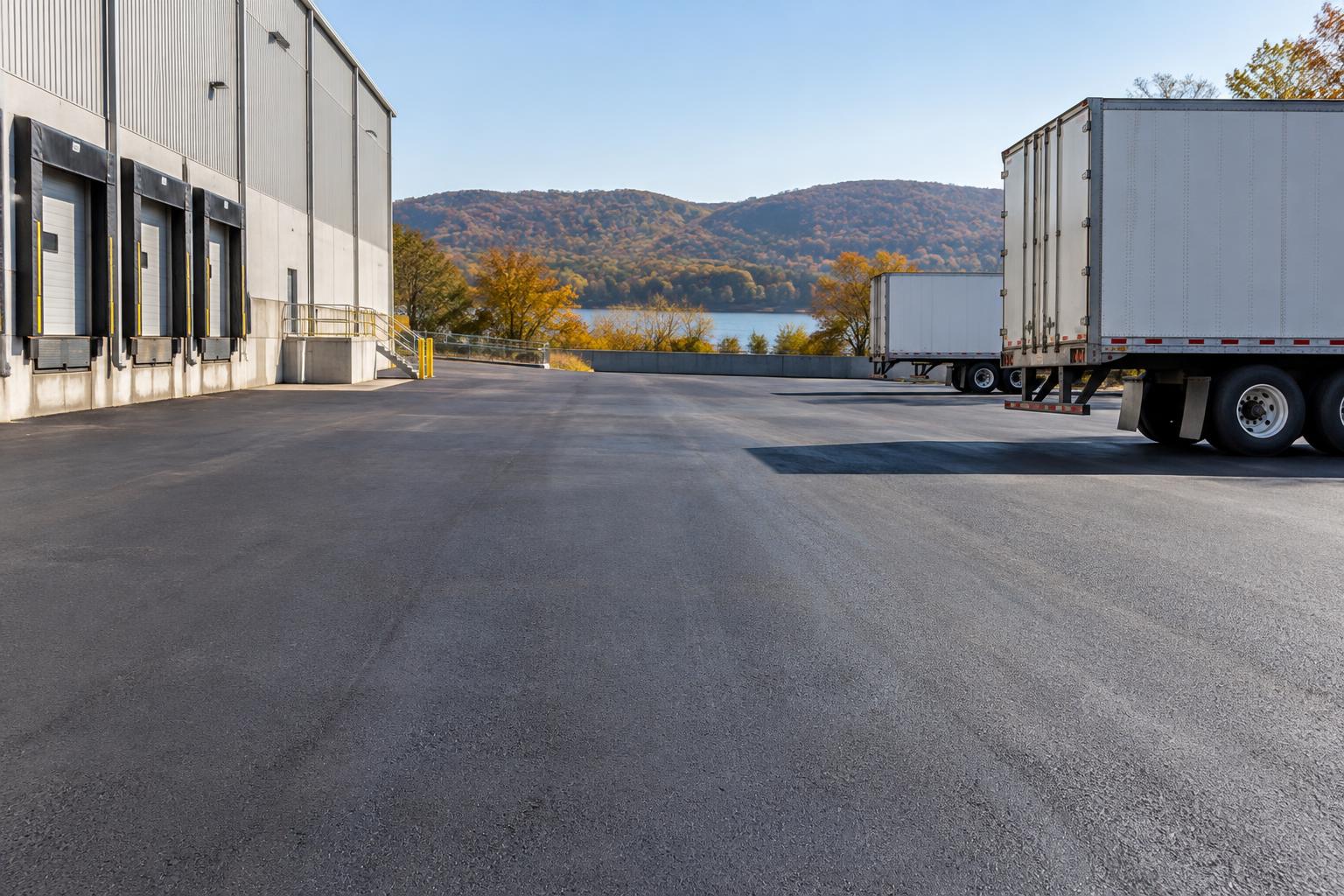
For Hudson Valley property owners and managers, the useful takeaway is that pavement planning starts below the asphalt. Loading docks, warehouse yards, and truck lanes place repeated demands on the ground beneath them. We see this as a practical planning topic. A sensible next step is to review expected vehicle loads and the proposed testing approach before paving, with attention to documenting ground movement and addressing weak areas during preparation.
Key Takeaways
- 72,000-pound proof roll testing identifies weak spots in subgrades by monitoring surface deflection, preventing costly pavement failures before they occur
- Industrial properties with heavy truck traffic require thorough subbase testing beyond standard spot-checking methods to ensure long-term durability
- The one-inch deflection criterion serves as the critical threshold for determining whether subgrade repairs are necessary during proof roll testing
- Row-by-row coverage with heavy equipment reveals foundation issues that traditional density testing can miss, potentially saving thousands in future repairs
- Local Poughkeepsie contractors are using advanced testing methods to meet the demanding requirements of Hudson Valley industrial facilities
When semi-trucks loaded with 80,000 pounds repeatedly traverse loading docks and warehouse yards, the hidden foundation beneath the asphalt determines whether that surface will last five years or twenty. Industrial property owners across the Hudson Valley are finding that traditional subgrade testing methods leave critical gaps in foundation assessment—gaps that lead to expensive pavement failures just when operations depend on them most.
What 72,000-Pound Proof Roll Testing Actually Reveals
Proof roll testing represents a qualitative assessment method that reveals what density testing alone cannot detect. While standard compaction tests provide spot measurements at specific locations, proof rolling evaluates the stiffness, uniformity, and stability of the entire subgrade surface. The process involves systematically driving a heavily loaded vehicle across the prepared subgrade to observe how the ground responds under realistic load conditions.
The 72,000-pound specification isn't arbitrary—it simulates the concentrated loading that industrial pavements will experience throughout their service life. Industry professionals use this testing approach to identify localized soft spots and insufficiently compacted areas that would otherwise remain undetected until pavement failure occurs.
Traditional density testing checks individual points across a subgrade, typically covering less than 5% of the total area. Proof rolling, by contrast, evaluates 100% of the surface, ensuring that every square foot can support the intended loads. This thorough approach reveals foundation problems early in the construction process, when repairs cost significantly less than post-paving reconstruction.
Why Industrial Properties Need Heavy-Duty Subbase Testing
Semi-Truck Traffic and Loading Dock Demands
Distribution centers and manufacturing facilities face loading conditions that far exceed typical commercial parking lot requirements. Semi-trucks with gross weights reaching 80,000 pounds concentrate massive forces through relatively small tire contact patches. Loading dock areas experience repetitive positioning maneuvers, creating concentrated stress points that can quickly compromise inadequately prepared subgrades.
The dynamic loading from turning movements, braking, and acceleration creates additional stresses beyond static weight considerations. Forklifts operating in outdoor storage areas add another layer of concentrated loading, often exceeding 20,000 pounds per axle. These operational realities demand subgrade preparation that accounts for both load magnitude and repetitive application patterns.
Overlooked Subbase Issues Leading to Costly Foundation Problems
Subgrade failures in industrial environments typically manifest as progressive deterioration rather than sudden collapse. Initial signs include minor rutting in truck lanes, slight depressions near loading dock approaches, and hairline cracks that expand with each loading cycle. Property managers often dismiss these early indicators as normal wear patterns, not recognizing them as symptoms of foundational inadequacy.
The financial consequences of subgrade failure extend beyond pavement replacement costs. Operations disruption during emergency repairs can halt production schedules, compromise delivery timelines, and strain customer relationships. Emergency excavation and reconstruction in active industrial areas requires complex logistics coordination and often costs three to five times more than prevention-focused testing during initial construction.
The Proof Roll Testing Process Explained
1. Equipment Requirements and Weight Specifications
Effective proof roll testing requires precise equipment selection based on intended pavement loading conditions. The industry standard calls for tandem-axle dump trucks loaded to a minimum gross weight of 40,000 pounds, while heavy-duty applications benefit from quad-axle configurations reaching 72,000 pounds or chariot-style rollers loaded to 80,000 pounds.
Equipment selection must account for axle configuration and tire pressure to properly simulate field loading conditions. Single-axle configurations concentrate loads differently than multi-axle arrangements, potentially missing subgrade weaknesses that would manifest under distributed loading patterns. Tire inflation pressure also affects contact patch size and pressure distribution, influencing test sensitivity.
2. The One-Inch Deflection Criterion for Proof Roll Testing
The one-inch deflection threshold serves as the critical decision point for subgrade acceptance or remediation. When the subgrade surface deflects more than one inch under proof roll loading, it indicates insufficient bearing capacity to support long-term pavement performance. This criterion has been established through decades of field performance correlation and represents the practical limit for acceptable subgrade flexibility.
Deflection measurement requires careful observation and documentation throughout the testing process. Experienced operators can detect excessive deflection through visual observation and equipment response, but precise measurement often requires laser-guided systems or string line references. Areas exceeding the one-inch criterion require immediate attention before pavement installation proceeds.
3. Row-by-Row Coverage Method
Systematic proof rolling involves complete coverage of the prepared subgrade surface using overlapping passes in a methodical pattern. Row-by-row progression ensures that no areas escape evaluation while maintaining consistent loading conditions across the entire surface. Pass spacing must account for the zone of influence created by the loaded equipment, typically requiring 50% overlap to guarantee complete coverage.
Documentation of the proof rolling process includes mapping areas of concern, measuring deflection magnitudes, and recording equipment specifications and environmental conditions. This documentation serves as quality assurance verification and provides baseline data for future pavement performance analysis. Photographic documentation of testing procedures and identified problem areas supports long-term maintenance planning.
When Soft Spots Are Found: Repair Methods That Work
Undercutting for Deep Foundation Problems
Undercutting represents the most thorough approach to subgrade remediation when proof rolling reveals significant soft areas. This process involves excavating the compromised material to a depth of 2-3 feet below the intended subgrade elevation and replacing it with properly graded and compacted aggregate material. The replacement material must meet specific gradation requirements and achieve density standards of at least 100% of AASHTO T99 compaction levels.
Undercutting depths depend on the extent of weak material encountered and the bearing capacity requirements of the intended pavement structure. Deeper excavations may be necessary when weak clay layers extend below the initial excavation depth. Proper drainage installation during undercutting prevents future moisture-related weakening of the repaired areas.
Geo-Grid Solutions for Cost-Effective Reinforcement
Geo-grid installation offers an economical alternative to extensive undercutting while providing effective subgrade reinforcement. This method involves excavating only 16 inches below the subgrade surface and installing high-strength geosynthetic grid materials to bridge weak areas and distribute loads across stronger supporting soils. The grid creates a composite structure that significantly improves bearing capacity while reducing excavation and material costs.
Geo-grid selection requires careful consideration of material strength, aperture size, and installation requirements. Proper installation includes adequate overlap at grid joints, secure anchoring at edges, and appropriate aggregate placement and compaction above the reinforcement. When properly designed and installed, geo-grid solutions can provide equivalent performance to undercutting at 50-70% of the cost.
Industry Standards vs. Real-World Applications
AASHTO Compaction Requirements
The American Association of State Highway and Transportation Officials (AASHTO) establishes compaction standards that serve as the foundation for subgrade preparation specifications. AASHTO T99 density requirements call for subgrade material to be compacted to a depth of 200mm below the finished surface to achieve densities equal to at least 100% of laboratory maximum density.
For heavy-duty pavement applications, achieving densities of at least 95% of AASHTO T99 becomes vital for preventing detrimental consolidation under repeated loading. These standards provide the baseline for acceptable compaction, but proof rolling verification ensures that theoretical density achievements translate into practical bearing capacity across the entire subgrade surface.
Why 100% Coverage Beats Spot Testing
Traditional density testing using nuclear gauge or sand cone methods typically evaluates 3-5 locations per acre, leaving the vast majority of the subgrade surface unverified. This spot-checking approach assumes uniform conditions across the site, an assumption that rarely holds true in real-world construction environments. Localized soft spots, inadequate compaction areas, and material inconsistencies often fall between test locations, remaining undetected until pavement failure occurs.
Proof rolling provides 100% coverage verification, identifying every weak area within the subgrade surface. This thorough assessment eliminates the statistical gaps inherent in spot testing and provides confidence that the entire pavement structure rests on adequate foundation support. The combination of density testing for quantitative verification and proof rolling for qualitative confirmation creates a robust quality assurance program that significantly reduces the risk of premature pavement failure.
Avello Asphalt Delivers Proven Subbase Integrity for Hudson Valley Industrial Properties
Industrial property owners throughout the Hudson Valley region face unique challenges in maintaining pavement systems that support heavy manufacturing operations, distribution activities, and logistics functions. The combination of harsh winter conditions, heavy loading requirements, and operational demands requires pavement systems built on foundations that can withstand decades of intensive use.
Proper subgrade preparation through thorough proof roll testing represents the most critical investment in long-term pavement performance. The upfront costs of thorough testing and remediation pale in comparison to the expenses associated with premature pavement failure, operational disruption, and emergency reconstruction in active industrial environments.
For Hudson Valley industrial property owners seeking proven subbase integrity solutions, proper expertise and testing capabilities are necessary to ensure lasting pavement performance. Avello Asphalt & Construction Corp serves the region with specialized knowledge in heavy-duty pavement construction.
Company: Avello Asphalt & Construction Corp City: Poughkeepsie Address: 141 Daley Road Website: https://www.avelloasphalt.com
Mentioned in this blog post: Poughkeepsie service area
Have a property like this?
Tell us what you're seeing. We'll walk the site, explain the options plainly, and give you a clear scope.