Alligator cracking is a connected pattern of small cracks that usually signals pavement fatigue under repeated traffic. At a Millbrook office park, it raises questions about the asphalt thickness, stone base, underlying soil, and water movement, but it does not prove the entire base needs replacement. A useful evaluation maps the damage, checks movement and drainage, and opens representative areas when needed. This report explains how to distinguish localized distress from broader structural problems, select repairs, phase work around tenants, and write a scope that addresses the cause rather than covering the pattern.
Alligator cracking at office parks in Millbrook: what it says about the base
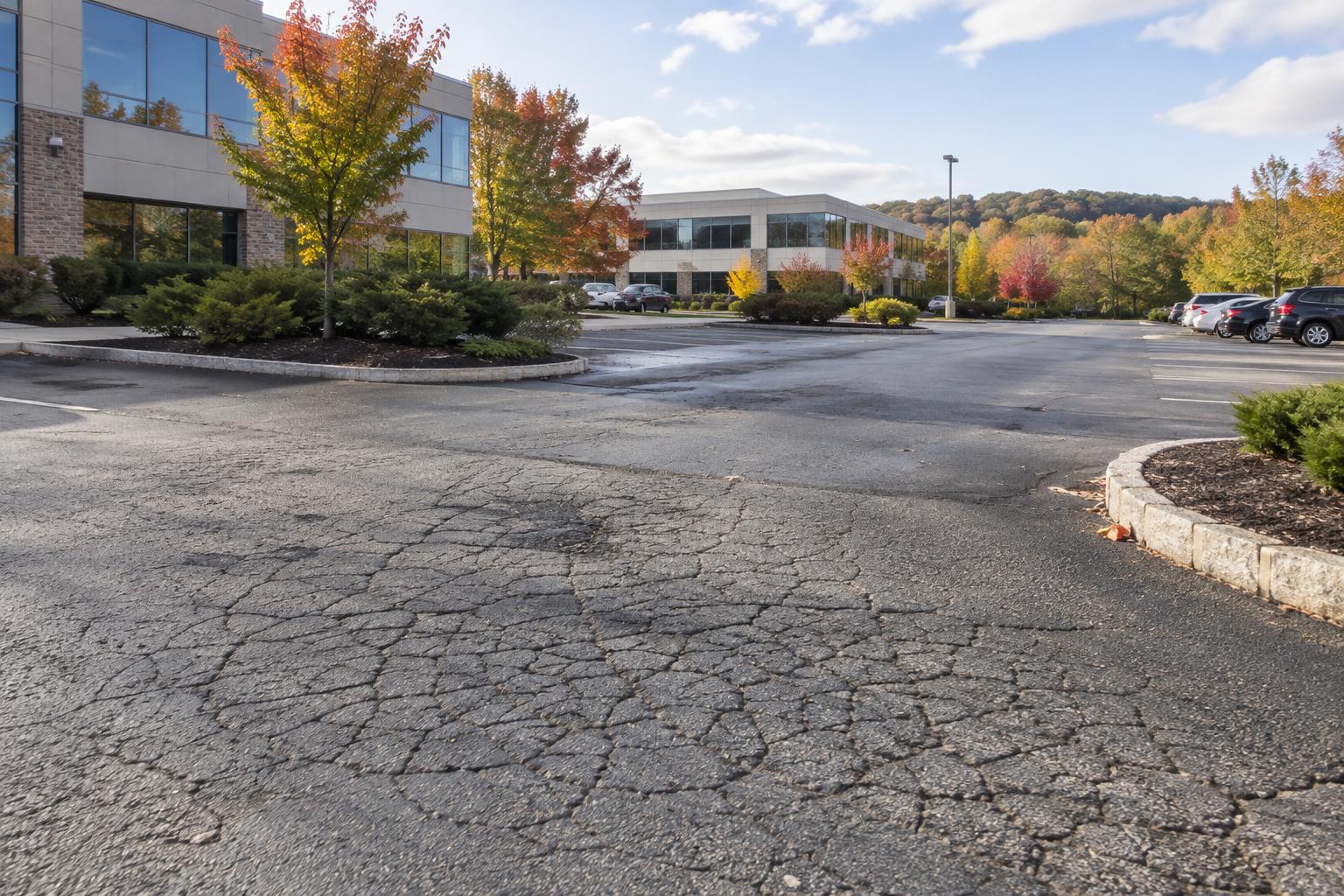
Alligator cracking usually means the pavement structure is no longer spreading repeated vehicle loads effectively in that area. The small, connected cracks resemble scales and often develop in wheel paths, turning areas, or regularly occupied parking spaces. At an office park in Millbrook, that pattern deserves a look below the surface, not simply a cosmetic treatment.
The base is the compacted stone layer beneath the asphalt. Below that is the subgrade, meaning the soil that supports the whole pavement structure. If either layer becomes wet, settles, or lacks adequate support, the asphalt bends repeatedly under vehicles until interconnected cracks develop.
However, the pattern alone does not prove the stone base is defective. Asphalt that is too thin for actual traffic, poorly bonded pavement layers, or aged material can also contribute to fatigue cracking. The correct question is whether the weakness is in the asphalt, the supporting layers, or a combination of both.
Location helps narrow the investigation. Cracking confined to a delivery turn suggests a different loading history than cracking across lightly used stalls. A depressed patch beside a drainage structure points toward a different investigation than a flat wheel path with tight cracks and no visible movement.
The practical conclusion is straightforward: treat alligator cracking as evidence of structural distress, but determine its extent before choosing excavation limits. Some office parks need isolated full-depth repairs. Others need more extensive support correction before milling and paving can provide a sound finished surface.
Read the crack pattern, surface movement, and surrounding pavement together
A useful condition survey starts with a marked site plan. Separate interconnected cracking from isolated straight cracks, utility-cut settlement, surface wear, and large rectangular crack patterns. These conditions can occur together, but they do not necessarily share a cause or require the same treatment.
Large blocks of cracking outside regular wheel paths may relate more to asphalt aging and temperature movement than repeated loading. Smaller interconnected pieces concentrated under tires are more characteristic of fatigue. Appearance is only the starting point; the survey should also record depressions, rutting, loose material, and nearby water.
- Pattern and extent: isolated wheel paths, individual parking spaces, or connected areas across a drive aisle.
- Surface shape: flat pavement, shallow depressions, ruts, or displaced crack edges.
- Material condition: tight cracks, loose pieces, missing asphalt, or repeated patches.
- Water clues: damp edges, sediment, staining, blocked outlets, or water emerging under normal vehicle loading.
- Traffic use: employee parking, delivery access, refuse collection, or frequent turning.
Cracked pieces that rock or shift under ordinary traffic indicate a more disrupted structure than tight cracks in a stable surface. Water or fine soil moving upward through cracks is another important clue. It suggests that loading is moving moisture and material within the pavement system.
Photos after rainfall and during spring thaw can reveal conditions that a dry summer visit misses. Property staff can document observations from safe locations without standing in active lanes. We use the relationship between the cracking and its surroundings to identify where further investigation will be most useful.
To understand the work behind these options, compare Avello’s parking lot repair, milling and paving services.
Confirm which layer is weak before setting repair depths
A surface inspection cannot establish the condition of every buried layer. Where repair choices depend on that information, representative pavement cores or test openings can help. A core is a cylindrical sample of the asphalt; a test opening exposes a larger area and can extend into the supporting material.
Cores can show asphalt thickness, cracking through the pavement, and separation between layers. Test openings can reveal stone condition, soil contamination, moisture, and soft underlying ground. Sampling both distressed and apparently sound pavement helps avoid treating one unusual spot as representative of the entire lot.
The evaluation should connect those findings to the site's history. A settled utility trench may need a focused repair even when adjacent base material is sound. Conversely, widespread wet support beneath multiple cracked areas may justify broader investigation and drainage correction before the repair footprint is finalized.
For extensive or unexplained distress, a pavement or geotechnical professional may be appropriate. During construction, controlled evaluation of the exposed support can help identify areas that move under load. That assessment needs suitable equipment and judgment so the inspection itself does not damage saturated material or buried infrastructure.
The result should be a repair map with known conditions, proposed depths, and a process for handling uncertainty. No one can see every buried soft pocket before excavation. A written field-review procedure allows the owner to authorize additional work based on documented conditions rather than an unexplained change in scope.
Why Millbrook weather and sloped sites change the diagnosis
Hudson Valley freeze-thaw cycles can expose weaknesses that remain less noticeable in dry weather. Water in susceptible soil can freeze and lift the pavement. As that ground thaws, support can temporarily soften, especially where moisture cannot escape readily.
Spring thaw is therefore a useful observation period, but not automatically the right time to place permanent pavement. A repair built over wet, unstable support starts with a problem beneath it. The contractor should evaluate actual ground conditions rather than assuming the surface is ready because the snow has disappeared.
Plowing and salt also affect how distress develops and appears. A plow blade can catch raised edges or dislodge already loose asphalt pieces, while snow storage can keep nearby areas wet during melting. Salt use alone does not establish the cause of alligator cracking; the important questions remain water exposure, material condition, and structural support.
On a sloped Millbrook property, water may arrive from uphill landscaping or move through the stone beneath apparently dry pavement. A depression is not the only place worth checking. The assessment should follow water from its source to a suitable outlet and determine whether the proposed repair would block an existing subsurface flow path.
The Hudson Valley paving season generally runs from April through November, but that is a planning window, not a promise of suitable conditions every day. Temperature, rain, daylight, and the condition of exposed support affect scheduling. Structural repairs need room in the plan for excavation, drying or stabilization when appropriate, and paving under suitable placement conditions.
Match the repair to the support problem, not just the visible cracks
The right repair depends on how much sound pavement remains and which layers need correction. Filling interconnected fatigue cracks does not restore the pavement's ability to carry loads. Likewise, placing new asphalt over loose, moving pieces leaves the underlying structural problem in place.
- Documented monitoring: appropriate for tight, limited cracking without loose material or measurable movement when an evaluation supports deferring reconstruction. It does not restore structural capacity.
- Temporary localized patching: useful for smoothing a broken area while permanent work is being planned or weather conditions are unsuitable. Its limits should be stated clearly.
- Full-depth asphalt patching: appropriate where fatigue damage is localized. Remove the affected asphalt, inspect the exposed support, and repair the base or soil wherever the findings require it.
- Localized structural repairs followed by milling and paving: appropriate when the broader lot remains serviceable but distressed pockets need rebuilding and the surrounding pavement needs renewal.
- Broader reconstruction: appropriate when weak support, inadequate pavement structure, or widespread structural distress makes isolated patches an incomplete solution.
Milling removes an established depth of asphalt to make room for replacement pavement and preserve elevations at curbs, walks, and drainage structures. It does not, by itself, repair a soft base. If cracking extends below the planned milling depth, the scope needs additional removal or another structural treatment.
Patch boundaries should reach sound material rather than follow every visible crack edge. Once exposed, acceptable base can remain; replacement should follow observed condition and the pavement design. Where unsuitable soil is present, the plan may require deeper removal, stabilization, or separation materials selected for the actual ground conditions.
At Avello, we approach parking-lot repair and milling-and-paving as related tools, not interchangeable answers. The objective is to correct the weak areas and retain sound pavement where practical. A new surface makes sense only when the structure beneath it is suitable for the expected use.
Phase structural repairs around office access and daily services
Office parks have overlapping access needs: employees arrive, visitors look for entrances, deliveries continue, and service vehicles need room to turn. Structural repairs create open excavations as well as paving closures. The phasing plan must account for both, rather than treating the work as a single surface operation.
- Confirm repair limits, utility information, site access requirements, and any applicable approvals before mobilization.
- Set up the first work zone with barriers, parking restrictions, tenant notices, and a continuous accessible route to occupied buildings.
- Remove distressed pavement and inspect the exposed base and soil before covering them.
- Complete authorized support and drainage corrections, then place and compact the replacement pavement layers.
- Reopen completed areas when the contractor determines they are ready for traffic, and shift operations to the next zone.
- Complete any broader milling and paving, restore markings, and review transitions and drainage before final handover.
Phase boundaries should leave usable circulation, not isolated rows of parking behind equipment. Keep refuse pickup, loading areas, fire access, and accessible parking in the plan. Temporary routes must be genuinely usable; a sign pointing toward a curb or rough excavation edge is not an adequate substitute.
Some sites can maintain access by working in separate parking courts or alternating drive aisles. Others may need a coordinated short closure because the entrance geometry leaves no workable bypass. The owner and contractor should settle that question early and communicate the approved arrangement to every tenant.
Do not rely on a universal reopening time. Asphalt cooling, weather, mix characteristics, and expected turning loads affect readiness. Each phase should have a clear handoff, with barriers removed only when the work area can support its intended use.
Put base-repair decisions and acceptance checks in the written scope
A clear scope describes what will happen below the surface, not merely how much new asphalt will appear. It should identify repair areas on a drawing or marked photographs and distinguish full-depth repairs from milling areas. Vague language such as 'repair as needed' leaves too much unresolved.
- Removal limits and depths, including how boundaries will be extended to sound pavement when necessary.
- Base and subgrade evaluation, proposed materials, compaction requirements, and any specified testing.
- Who reviews concealed conditions, what documentation is required, and how additional excavation is authorized and priced.
- Asphalt mix, compacted layer thicknesses, placement sequence, joint treatment, and connections to existing pavement.
- Drainage corrections and finished elevations at inlets, curbs, walks, doors, and accessible routes.
- Traffic control, tenant access, work-zone protection, weather interruptions, cleanup, and pavement markings.
- Final inspection, correction of identified deficiencies, and delivery of relevant work records.
Require a review point after excavation and before the support is covered. Photos and field notes can show what was removed, what remained, and why an adjustment was needed. For owners managing several buildings, that record is more useful than an invoice that simply says 'additional base work.'
The scope should also assign responsibility for checking local requirements. A Millbrook mailing address does not by itself establish the governing municipality; a property may be within the Village of Millbrook or the surrounding Town of Washington. Confirm applicable requirements with the relevant building or engineering department, especially when changing drainage, entrances, or site layout.
Final acceptance should include the finished transitions and water path as well as the repaired pavement. Accessibility-related work should be checked against applicable requirements, not judged by appearance. Where design or testing services are needed, identify who provides them before construction begins.
Prepare the property and avoid repairs that only hide the pattern
Owners can improve the evaluation by assembling information that a visiting paving crew cannot know. Prior repair locations, utility work, seasonal wet spots, delivery routes, and tenant complaints all help explain the crack pattern. Even dated photographs can show whether an area is changing or has remained stable.
A common mistake is assuming every cracked area needs the same excavation depth. Another is specifying a uniform overlay before investigating movement beneath it. Both approaches separate the proposed work from the actual condition of the pavement.
Other avoidable mistakes include leaving a water source untreated, patching only the visibly broken center, and routing heavy service vehicles across newly completed work without coordination. Replacing all base material without evidence can also add unnecessary work. The better approach is selective removal supported by clear field observations and agreed decision rules.
- Gather pavement plans, repair records, utility information, and photos of wet-weather conditions.
- Mark recurring soft spots and identify delivery, refuse, and snow-storage areas.
- Confirm tenant hours, visitor access, accessible routes, and available alternate parking.
- Choose one owner representative who can review exposed conditions and authorize documented changes.
- Agree on notices, vehicle relocation, work-zone boundaries, and weather-related schedule updates.
- Keep the completed repair map and field records for future pavement evaluations.
For Millbrook office parks, alligator cracking is best understood as a question about load support, not simply a surface defect. Map the pattern, verify the layers where necessary, and match the repair to the evidence. That gives the owner a practical basis for choosing between targeted parking-lot repair and a broader milling-and-paving program.
To discuss your office park's pavement, call Avello Asphalt & Construction at 845-454-3650 or request a free quote.
2026 Commercial Pavement Budget Planner
A contractor-built worksheet for budgeting parking lot and roadway work: cost ranges by scope, a condition-scoring sheet, phasing guidance, a bid-comparison checklist, and the questions to ask before you sign.
Common questions
Does alligator cracking always mean the stone base must be replaced?+
No. It indicates pavement fatigue, but it does not identify the weak layer by itself. The asphalt may be too thin for the traffic, the layers may not be working together, or the base or soil may have lost support. Representative openings help distinguish those conditions. Sound base can often remain when the investigation supports that decision; wet, contaminated, or unstable material needs a specific corrective plan.
Can we pave over the cracked areas while keeping the rest of the office park open?+
Access can often be maintained through phased work, but paving directly over structurally distressed areas is not a substitute for repairing them. The cracked pavement should be evaluated and the affected layers corrected first. Separate parking courts or aisles may allow sequential closures. A narrow shared entrance may require a different arrangement, including a coordinated closure, so the access plan should be settled before work starts.
Why does the cracking look worse after winter?+
Winter can make existing structural weaknesses more visible. Moisture in susceptible soil can freeze and lift pavement, while thawing can leave the support temporarily soft. Plowing may dislodge pieces that were already loose, and melting snow can keep certain areas wet. These observations do not prove one cause, but they help identify where to inspect drainage, pavement thickness, and the condition of the supporting layers.
What asphalt parking lot maintenance guidelines apply once alligator cracks appear?+
Start with documentation and condition assessment rather than treating the pattern like an isolated crack. Map the area, photograph it, and note loose pieces, depressions, water, and traffic use. Keep drainage structures clear through the property's normal maintenance process. Have structurally distressed areas evaluated for repair, and maintain safe pedestrian routes. Surface maintenance alone cannot restore support lost beneath a connected fatigue-crack pattern.
Do parking lot drainage problems have to be corrected before paving?+
Any drainage condition contributing to the distress should be addressed as part of the repair sequence. That might mean correcting surface elevations, repairing a drainage structure, or managing water entering the pavement from uphill ground. Not every cracked area needs a new drain. The important step is identifying the water source and a suitable outlet, then coordinating the correction before the affected area receives its final pavement.
How should we compare proposals with different base-repair allowances?+
Compare what each proposal assumes and how concealed conditions will be handled. Ask whether the price includes defined excavation depths, specified replacement materials, compaction, disposal, and inspection of exposed support. Check the authorization process and pricing basis for additional work. A proposal with a modest initial allowance is not directly comparable to one including broader excavation unless those differences are made explicit in writing.
Avello provides free commercial pavement assessments across the Hudson Valley. No obligation — you keep the documentation either way.