Utility Trench Restoration built around how warehouses actually operate
Avello Asphalt & Construction scopes, prices, and phases utility trench restoration for warehouses across the Hudson Valley — with a written scope and a budget range you can hand straight to ownership.
- Licensed & Fully Insured in New York
- Owner Accountability
- Free, No-Obligation Conversation
Get a free Pavement Risk Snapshot
Share a few details and get a practical starting point for the conversation.
Free · 2 minFree Pavement Risk SnapshotWarehouses have their own access, traffic, scheduling, and communication needs. Avello Asphalt & Construction plans utility trench restoration for warehouses in the Hudson Valley around the way the property is actually used. We usually work with Facility Manager, Director of Operations and warehouse Manager, but the first conversation is useful whether you are ready to move forward or simply gathering information. Pavement planned around the traffic your property actually handles.
How utility trench restoration fits warehouses
Utility-cut and trench restoration in commercial and municipal pavement — saw-cut, flowable fill or compacted backfill, infrared or hot-mix surface, and a patch that won't settle. Avello approaches utility trench restoration as damage control with a deadline: stop the water, remove the failed material rather than covering it, and restore a compacted, sealed edge that will not unravel on the next freeze-thaw cycle. Every repair is documented with location, dimensions, and depth so the work becomes evidence in a liability file and a data point in next year's capital plan. On warehouses, the conditions we are commonly asked to look at include Rutting and shoving at dock approaches, Failed concrete aprons at dock faces, Forklift punch-through at yard storage, Cracking along trailer turning paths, Drainage failure at the dock pit and trench restoration failures. We will look at the property, explain what we see, and separate what makes sense now from what can reasonably be planned for later.
A straightforward first conversation
Tell us what you are seeing, how the property operates, and what you are trying to accomplish. We will ask a few practical questions and explain the options in plain English. There is no pressure to decide on the first call.
How Avello scopes utility trench restoration on warehouses
Every project runs the same sequence so nothing is guessed at. Typical timeline: 1–3 days per trench depending on length and depth..
- Coordinate with the utility contractor on backfill spec
- Saw-cut a clean perimeter 6"–12" outside the trench edge
- Verify backfill compaction or use flowable fill
- Place hot-mix in compacted lifts to full depth
- Infrared the perimeter to fuse the patch into surrounding pavement
- Compact and finish flush to surrounding grade
- Written scope with quantities, materials, and a realistic budget range you can hand to ownership, a board, or a finance director
- Pre-construction notice package with dates, affected areas, and access maps so tenants, staff, or residents are never surprised
What you receive in writing
Documentation you can put in a board packet, a bid file, or a budget request — not a one-line verbal number.
- Saw-cut perimeter with clean edges
- Hot-mix or infrared restoration (no cold patch)
- Infrared-fused perimeter — no cold joint
- Quantities and locations documented
- Workmanship warranty
- Photo-documented before-and-after record for your maintenance and liability file
- A prioritized follow-up plan showing what should be scheduled next season and roughly what it will cost
Access, phasing, and keeping the property open
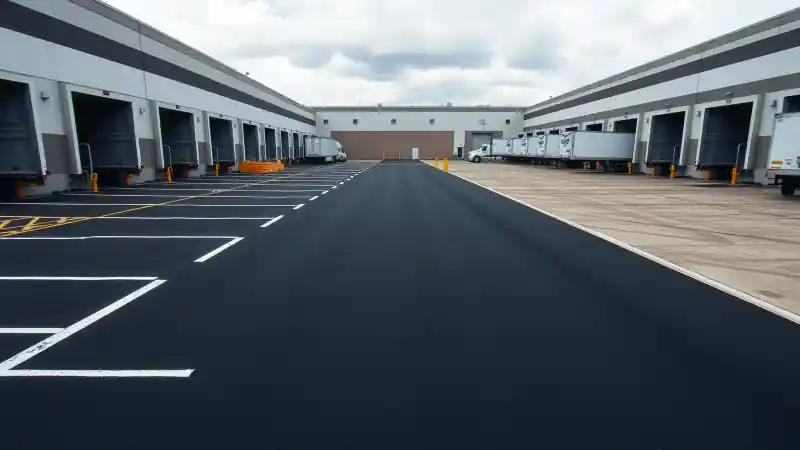
Industrial phasing is built around your dock schedule, not ours. Avello sequences a Warehouses lot so that a working share of docks, trailer stalls, and the truck route stay live through every stage — frequently by taking half the yard at a time, working nights or weekend shutdown windows, and using accelerated mixes at critical crossings. Cure and load-return times are stated in writing before work starts so dispatch can plan around them. Typical site size for this property type: Varies by site - Avello scopes on the walk.
Budget reality
Projects of this type usually land in the $15K - $250K typical, project-dependent range, depending on square footage, base condition, drainage work, and phasing requirements. You get a written range before anyone asks for a signature, so you can compare bids fairly and defend the number internally.
Compliance and liability
For warehouses, the documentation that matters most is ADA Title III parking ratios, NY State accessibility code, Local site-plan and DOT permits and aDA-compliant stall count, access aisles, running slope, and cross slope verified against the finished grade — not just repainted where the old lines were. Those requirements go into the scope up front instead of surfacing mid-project.
Objections we hear — and straight answers
"Cannot stop receiving" That is exactly why we lead with a written scope, a phasing plan, and a range instead of pressure. "Corporate procurement" That is exactly why we lead with a written scope, a phasing plan, and a range instead of pressure. "Coordinate with multiple tenants in multi-tenant warehouses" That is exactly why we lead with a written scope, a phasing plan, and a range instead of pressure. If the honest answer is that the pavement can be monitored for another season, we will put that in writing too.
Who this is a fit for
Avello brings municipal-scale planning and accountability to commercial, community, institutional, industrial, private-road, estate, and smaller-property paving work.
- Water, sewer, gas, electric, and telecom contractors
- Municipalities requiring proper trench restoration
- Property owners after utility work
- Sites with prior trench failures and settlement
- Owners and managers who need a written, defensible scope rather than a one-line verbal number
Let’s talk about your project.
FAQ
Will the work shut down my property?+
Not necessarily. Every project is different. We will look at how your property operates and plan the work around access, traffic, residents, customers, employees, or other daily activity whenever the project allows.
How is your pricing different from a lower bid?+
The number at the bottom of a proposal does not always tell the whole story. Scope, preparation, materials, quantities, scheduling, and site conditions can all affect the final result. We will explain exactly what we are proposing so you can compare bids based on what is actually included.
Do you work directly with HOA boards and property managers?+
Yes. We can communicate directly with boards, property managers, and other decision-makers involved in the project and provide the information needed to evaluate the work.
What happens if weather delays the project?+
Weather can affect paving schedules. If conditions are not appropriate for the work, we will communicate with you and coordinate the schedule around suitable conditions.
Can you provide documentation for insurance or compliance records?+
We will discuss the documentation your project requires and provide the applicable project information and records available for the work being performed.