
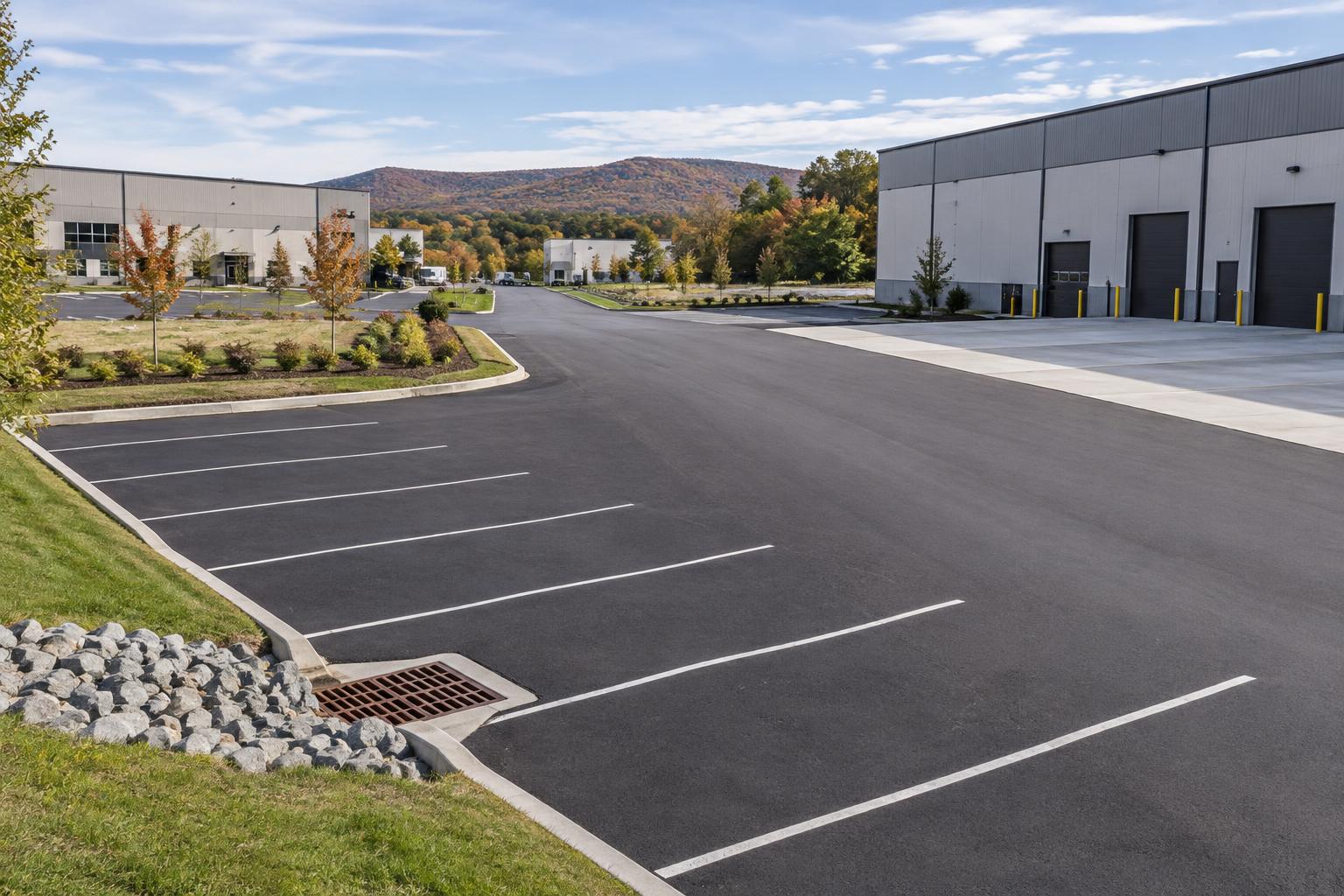
A pavement condition assessment gives an industrial park a documented picture of surface wear, drainage concerns, and possible structural weakness. For LaGrange properties, it should distinguish cosmetic aging from conditions that affect truck access, tenant operations, and repair planning. The most useful report maps each area, explains what the observations mean, identifies where testing is needed, and connects findings to practical work packages. It also sets out access requirements and unanswered questions. Owners can then compare scopes on the same basis rather than choosing treatments from appearance alone.
What a pavement condition assessment tells industrial parks in LaGrange
A pavement condition assessment tells an industrial park where its asphalt is sound, where it is worn, what may be causing that wear, and which areas need closer investigation before work is specified. It should connect those findings to usable recommendations, not simply label the whole property good or poor. In LaGrange, that means looking at shared access roads, employee parking, tenant entrances, service areas, and drainage as connected parts of one property.
The key distinction is between surface deterioration and weakness deeper in the pavement structure. Surface deterioration affects the exposed asphalt; deeper weakness can involve the asphalt layers, the stone base, or the soil beneath them. A walk-through can identify warning signs, but it cannot reliably establish every layer's thickness or strength.
A useful assessment therefore separates observed facts from suspected causes. For example, a depressed area with standing water is an observation. Whether it resulted from settlement, insufficient support, or an old utility excavation may require records, measurements, or testing.
- Which areas can remain in service with monitoring or limited maintenance?
- Which areas need localized repairs, and what should those repairs address?
- Where could resurfacing work, and where is deeper reconstruction more appropriate?
- What information and access arrangements are needed before a dependable scope can be written?
At Avello, we view the assessment as the starting point for those decisions. The goal is a property-specific explanation that an owner, tenant representative, and contractor can all understand.
Read pavement condition by zone, not by overall appearance
An industrial park should be divided into mapped zones with recognizable boundaries. A shared entrance may deserve its own designation, as may a parking row, truck turning area, or drive alongside a building. Record each zone's use, visible condition, and relationship to adjoining pavement.
Dark color does not prove strength, and faded asphalt does not automatically need replacement. The assessment should consider the type, extent, and severity of distress together. A few isolated cracks in otherwise stable pavement present a different problem from widespread cracking accompanied by movement or depressions.
- Cracks: their pattern, width, location, and whether adjoining edges have moved.
- Raveling: surface stones becoming loose as the material holding them together deteriorates.
- Ruts or depressions: low areas that affect travel, collect water, or suggest movement below the surface.
- Patches: their condition, edge separation, and whether repeated repairs occupy the same location.
- Edges and transitions: crumbling shoulders, uneven connections, and changes beside curbs or structures.
- Drainage evidence: ponding, sediment trails, water staining, and blocked flow paths.
Photographs should carry location references so a manager can find the same condition later. Measurements and estimated quantities should use consistent boundaries. A rating is useful only if the report explains what the rating means and applies it consistently across the site.
The report should also note limitations. Pavement hidden by trailers, stored materials, snow, or standing water has not received the same inspection as an open, dry area. Marking those gaps is more useful than treating unseen pavement as sound.
To understand the work behind these options, compare Avello’s pavement condition assessment services.
Account for LaGrange weather, slope, and what lies below
Hudson Valley freeze-thaw cycles make water management central to pavement assessment. Water entering cracks or collecting in supporting materials can contribute to movement as conditions change. During spring thaw, some areas may be softer than they appear during a dry summer inspection.
That seasonal difference matters when interpreting distress. Ask whether a low spot stays wet year-round, appears after snowmelt, or develops only during heavy rain. Maintenance notes and photographs from different seasons can reveal a pattern that a single visit would miss.
Plowing can catch raised edges and disturb already loose material. Salt use and snow storage also belong in the discussion because they help explain winter operating conditions and where meltwater travels. The assessment should distinguish mechanical damage from broader deterioration rather than attributing every rough area to winter maintenance.
On sloped sites in LaGrange, inspect where water starts, which routes it follows, and where it leaves the paved area. A slope can shed water effectively while still concentrating runoff across a drive or toward a building. Check curb lines, drainage inlets, shoulders, and transitions together; correcting one low point without considering the outlet can move the problem elsewhere.
Where structural questions affect the recommendation, additional investigation may include cores, test pits, or surveyed elevations. A core is a small cylindrical sample used to examine pavement layers; a test pit exposes supporting materials. These checks should answer a defined question, such as whether an overlay has adequate support or whether drainage elevations need redesign, rather than being added without a clear purpose.
Match each finding to a realistic treatment option
A condition assessment should explain why a treatment fits a particular zone. It should also identify prerequisites, such as correcting drainage or investigating movement. The same property may reasonably need monitoring in one area, localized repairs in another, and broader rehabilitation elsewhere.
- Monitoring: appropriate where wear is limited, the pavement remains serviceable, and changes can be checked at defined intervals.
- Crack treatment: useful for suitable isolated cracks in otherwise stable pavement, but not a substitute for restoring weakened support.
- Localized patching: suited to defined damaged areas where the surrounding pavement remains useful. Repair depth should match the actual problem.
- Milling and resurfacing: appropriate where deteriorated upper material needs removal and the remaining structure can support a new asphalt surface.
- Reconstruction: appropriate where investigation shows that the asphalt and supporting layers need rebuilding to suit site conditions and use.
- Drainage or edge improvements: needed where water movement or unsupported boundaries would otherwise undermine pavement work.
Asphalt pavement milling removes a controlled depth of existing asphalt with specialized equipment. It can help maintain elevations at entrances, curbs, and drainage structures when new asphalt is placed. Milling is not, by itself, a correction for weak soil or a saturated base.
Raveling also needs interpretation before treatment is selected. Loose surface aggregate may be confined to the upper layer, or it may accompany more extensive deterioration. The assessment should describe how widespread and deep the loss appears, and whether sampling is needed.
Where loading or operations have changed, the recommendation should account for present use rather than simply duplicate the old pavement. Any structural design should be supported by appropriate investigation and qualified design input when needed.
Turn the condition map into priorities and operating phases
Condition alone does not determine work order. A moderately worn shared entrance may deserve earlier attention than a more deteriorated area that sees little use. Priorities should combine pavement condition, drainage effects, access importance, and the consequences of taking each zone out of service.
The assessment should identify practical work packages before detailed scheduling begins. Grouping adjacent repairs can reduce repeated closures, but an oversized work area may interrupt several tenants at once. Management needs to see both the construction logic and the operational tradeoffs.
- Confirm the findings, complete necessary testing, and resolve drainage or design questions.
- Coordinate any utility work so new pavement is not opened shortly afterward.
- Identify temporary routes, protected walking paths, delivery arrangements, and tenant notification responsibilities.
- Complete drainage corrections and deeper repairs before placing the final surface.
- Mill and pave defined zones while keeping agreed access routes available.
- Restore markings and transitions, inspect the work, and reopen each area when conditions permit its intended use.
The usual Hudson Valley paving season runs roughly April through November, but those months are not a promise of suitable conditions. Temperature, precipitation, ground conditions, the specified asphalt work, and available daylight all affect scheduling. Spring work may require particular attention to wet support layers.
Reopening should follow the contractor's direction for the actual materials, weather, and expected loading. An alternate route also needs review before trucks are redirected onto it. The condition assessment can flag that route for closer inspection rather than assuming any open pavement can carry the same traffic.
Require a written scope that connects recommendations to locations
An assessment and a construction scope serve different purposes. The assessment records conditions and supports recommendations; the scope defines the work to be priced and performed. A clear handoff between them prevents a useful report from becoming a vague request to repair the parking lot.
Each work item should point to a mapped location and state its limits. Where depth or supporting conditions remain uncertain, the scope should identify that uncertainty and explain how additional work would be measured, documented, and authorized. Concealed conditions should not disappear behind broad language.
- The site plan, zone references, measured areas, and boundaries of included work.
- Removal methods and depths, including where milling differs from full-depth excavation.
- Base preparation, materials, pavement layers, and compaction requirements appropriate to the design.
- Drainage corrections and required elevations at buildings, curbs, inlets, and adjoining surfaces.
- Treatment of edges, joints, utility covers, and connections to retained pavement.
- Phasing, access responsibilities, temporary traffic controls, and tenant communication arrangements.
- Marking restoration, accessible-route considerations, cleanup, and completion review.
- Exclusions, testing responsibilities, permit responsibilities, and the process for approved changes.
For a LaGrange property, confirm applicable review requirements with the Town of LaGrange building or engineering department. The need for review depends on the proposed work, particularly where drainage, grading, access, or site layout changes. Connections to county or state roads may involve a different road authority.
The scope should name who will make those inquiries and obtain required approvals. It should also distinguish pavement maintenance from alterations that may require broader design or accessibility review.
Prepare records, tenant input, and access before the inspection
Owners do not need perfect records to start an assessment. They do need to share what is known and identify what is uncertain. Even an old site plan with handwritten repair notes can help connect visible conditions to past work.
Useful background includes pavement installation dates where available, previous repair limits, utility excavations, drainage complaints, and photographs taken after rain or snowmelt. Let the assessor know about recurring patch locations and areas where tenants report rough travel. Those observations help direct investigation without substituting for it.
Operational information is equally important. Describe vehicle types, delivery windows, employee shift changes, waste collection, and routes that cannot be closed together. Include anticipated tenant changes that could bring heavier vehicles or different circulation patterns.
- Gather available site plans, repair records, and seasonal photographs.
- Mark recurring puddles, rough areas, and known utility cuts.
- Identify tenant contacts and one property-level decision-maker.
- Provide delivery schedules and access restrictions.
- Arrange safe access to inspect areas normally covered by vehicles or materials.
- List planned utility, building, drainage, or landscape work.
Discuss inspection timing before moving equipment or changing tenant routines. Some observations are easiest on dry pavement, while drainage behavior may require a separate wet-weather visit. If areas cannot be cleared, agree on how they will be recorded and whether a follow-up inspection is needed.
Finally, state the decision the assessment must support. Preparing next season's repair package, evaluating a property acquisition, and investigating recurring settlement may require different levels of documentation and testing.
Avoid shortcuts that weaken the assessment's value
One common mistake is asking for a single condition score without a map or explanation. That score can conceal substantial differences between zones. Management needs to understand both the overall picture and the individual locations driving the recommendation.
Another mistake is treating every crack as the same problem. Crack pattern, movement, moisture, and surrounding surface condition all matter. A treatment chosen from a photograph alone may miss the reason the pavement changed.
It is also easy to specify a new surface before checking drainage elevations. Additional asphalt can change relationships at doors, curbs, and inlets. The assessment should flag those constraints before the project reaches construction pricing.
Avoid requesting several proposals against different assumptions. If one contractor includes base repairs and another assumes sound support, the totals describe different projects. Resolve major unknowns where practical, or have each proposal clearly state the same allowances and change procedures.
Finally, do not file the report away as a permanent description of the property. Pavement changes with weather, loading, utility work, and maintenance. Keep the map current, record completed work, and revisit areas that the assessment specifically identifies for monitoring.
The best result is not the longest report. It is a clear explanation of what is known, what remains uncertain, and how each recommendation supports the industrial park's daily use. That gives LaGrange owners a practical basis for decisions without treating every worn area as a full replacement project.
To discuss a pavement condition assessment for your industrial park, call Avello at 845-454-3650 or request a free quote.
2027 Commercial Pavement Budget Planner
A contractor-built worksheet for budgeting parking lot and roadway work: cost ranges by scope, a condition-scoring sheet, phasing guidance, a bid-comparison checklist, and the questions to ask before you sign.
Common questions
Can a visual inspection tell us whether the pavement base is sound?+
A visual inspection can identify clues, including movement, recurring patches, depressions, and cracking patterns. It cannot confirm the condition of every concealed layer. If the proposed treatment depends on the base being sound, cores, test pits, or other investigation may be appropriate. The report should distinguish visible evidence from conclusions that still require testing, and explain how that uncertainty affects the recommendation.
When should a LaGrange industrial park schedule an assessment?+
Choose a time when pavement is visible and inspection can be performed safely. Spring can reveal thaw-related softness and drainage concerns, while dry conditions help document surface distress. A second visit after rain may be useful. Schedule the assessment far enough ahead of intended construction to allow investigation, scope development, tenant coordination, and any necessary approvals rather than treating it as a final step before paving.
Does asphalt pavement raveling mean we need to replace the whole area?+
Not necessarily. Raveling means aggregate is loosening from the asphalt surface, but its extent and depth vary. An assessment should determine whether the loss is shallow and isolated or accompanies broader deterioration. It should also check drainage and surrounding pavement condition. Replacement of an entire zone should follow the findings, not the presence of loose stones alone.
Is pavement milling always needed before resurfacing?+
No. Milling is one way to remove deteriorated material and manage the finished elevation of new asphalt. It is particularly relevant where curbs, entrances, or drainage structures limit how much the surface can rise. Whether it is needed depends on existing condition and the proposed design. Milling does not eliminate the need to repair weak areas beneath the planned surface.
Can we assess and repair only the areas covered by this year's budget?+
You can limit construction to selected areas, but assessing the connected pavement and drainage system often improves those choices. A problem outside the current work boundary may affect a planned repair, and an alternate access route may need attention before it carries redirected traffic. Ask for clearly separated work packages so current work remains compatible with later improvements without committing to them immediately.
What should we receive besides a paving estimate?+
For a defined assessment assignment, agree on deliverables before the inspection. Useful items include a zone map, referenced photographs, condition descriptions, observed drainage concerns, treatment recommendations, and a list of unresolved questions. The report should identify limitations and any recommended testing. A construction estimate can follow, but pricing alone does not explain why a treatment is appropriate or what assumptions support it.
Avello provides free commercial pavement assessments across the Hudson Valley. No obligation — you keep the documentation either way.