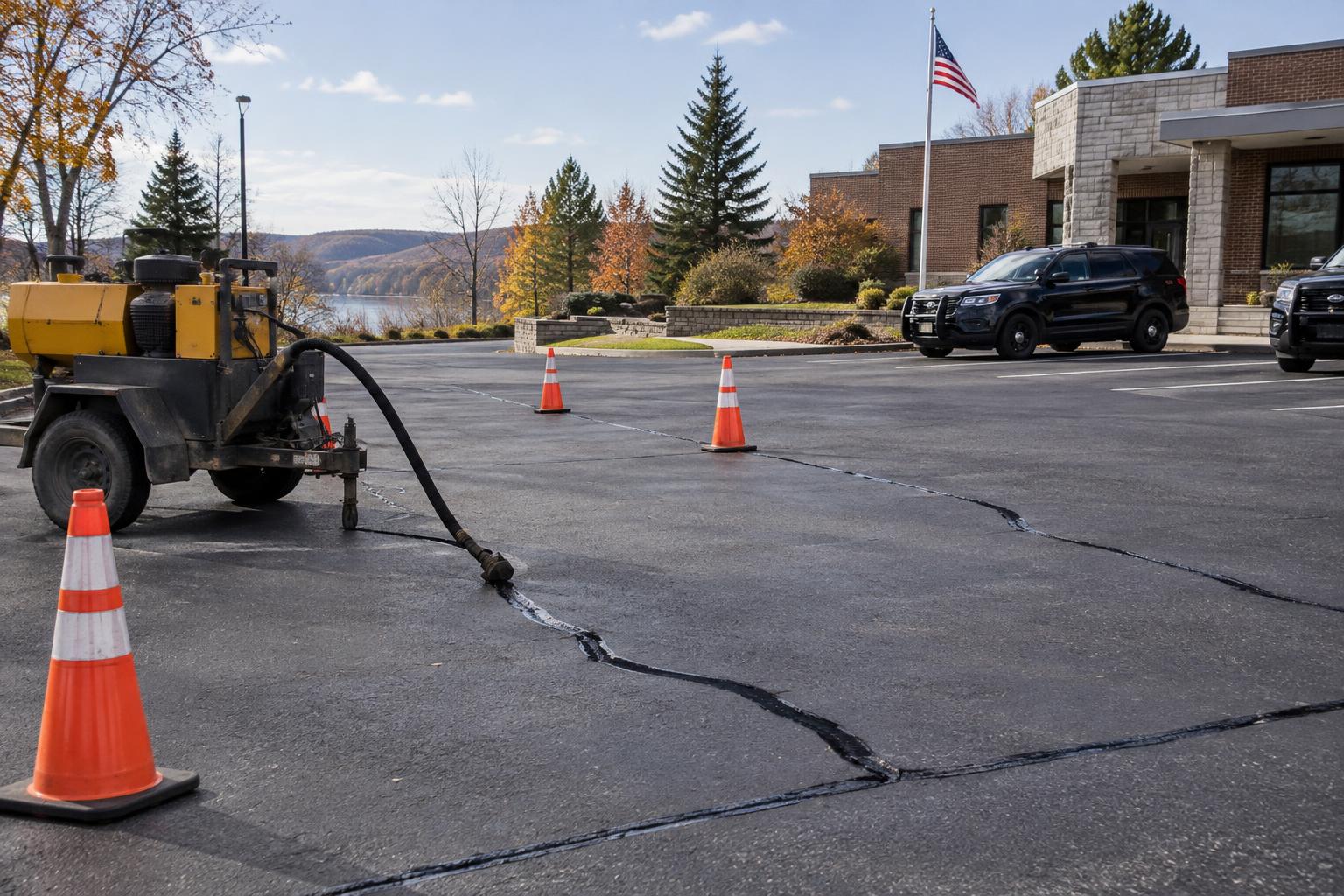
Prewinter crack filling can help protect sound asphalt at a Wappingers Falls police station by limiting water entry before freeze-thaw weather. It works best on individual cracks with stable edges, not broken pavement, soft areas, or drainage defects. A useful plan starts with a condition survey, separates crack treatment from patching, and schedules small work zones around police operations and public access. This guide explains treatment choices, weather requirements, written scope details, and winter follow-up so municipal managers can make a practical maintenance decision without treating every pavement defect the same way.
Crack filling public pavement before winter in Wappingers Falls
Yes—crack filling before winter is a sensible maintenance step for public asphalt at a Wappingers Falls police station when the surrounding pavement remains sound. The immediate goal is to limit water entering open cracks before repeated freezing and thawing. Start with an inspection, repair broken areas separately, and schedule crack treatment during a dry weather window that meets the selected material’s requirements.
The calendar alone cannot tell you whether the work belongs on this fall’s list. Individual cracks with firm edges may be good candidates, while a depression filled with connected cracks needs a different assessment. Filling the openings will not restore support beneath the asphalt or change where runoff collects.
For police stations, the planning question is also operational: which pavement can be taken out of service briefly without disrupting dispatch-related vehicle movements, staff arrivals, or public visits? The answer usually involves small treatment zones rather than closing the entire lot. Each zone needs a clear boundary and an agreed reopening check.
We approach crack-filling as targeted maintenance, not a promise that worn asphalt will behave like new pavement. In Dutchess County, a useful prewinter plan separates work that protects serviceable pavement from repairs that require excavation, drainage correction, or later paving. That distinction keeps the municipality’s maintenance record honest and gives the next crew a clear starting point.
A station manager should finish the planning process with three concrete answers: which cracks will be treated, which defects need separate repair, and how every work area will reopen. Those answers matter more than a broad instruction to fill everything visible.
Inspect the pavement by crack condition, not just crack count
Walk the pavement in daylight and mark observations on a simple site plan. Separate patrol parking, visitor spaces, staff parking, garage approaches, and connections to public streets. Photographs should include both close views of defects and wider views showing their location.
Look at the asphalt on both sides of each crack. Firm, level edges suggest a different repair need from edges that crumble, rock under traffic, or sit at different heights. Loose aggregate, recurring patch damage, and connected cracking around a depression are reasons to investigate beyond the visible opening.
- Individual cracks with stable edges: assess for cleaning and compatible crack treatment.
- Cracks with old material still bonded in place: inspect for gaps or separation rather than automatically covering everything again.
- Open joints along patches or pavement edges: check support and drainage before choosing a treatment.
- Broken, displaced, or depressed areas: assess for patching or deeper repair.
- Wet cracks, stained runoff paths, or persistent puddles: identify the water source before scheduling treatment.
If practical, inspect once after rain and again when the surface is dry. The wet-weather visit shows flow paths; the dry visit makes edge condition and debris easier to see. Do not enter active vehicle paths without coordinating with station personnel.
Ask maintenance staff which areas reopen each winter and where plows have caught raised edges. A single inspection cannot show seasonal movement or recurring water problems. Staff observations help distinguish an isolated opening from a symptom of a continuing condition, without assuming that every old crack needs reconstruction.
To understand the work behind these options, compare Avello’s crack filling, municipal roadway maintenance services.
Choose between crack filling, flexible sealing, and separate pavement repair
People often use crack filling and cracksealing to mean the same thing. In technical practice, filling generally addresses cracks with relatively little movement, while sealing uses a flexible material and preparation intended to accommodate movement. Because contractor terminology varies, the written scope should name the product and preparation method rather than rely on the service label alone.
Flexible hot-applied material can be appropriate for working cracks—openings that change as pavement expands and contracts. Some treatments include routing, which cuts a controlled recess along the crack to hold the material. Routing is not automatically suitable for every crack, especially where the surrounding asphalt is weak or badly weathered.
- Clean and treat suitable cracks when the surrounding asphalt is stable and the selected material fits the expected movement.
- Use routed treatment where the crack condition, pavement strength, and specified system support creating a recess.
- Patch localized broken pavement where crack material cannot provide the missing structural support.
- Investigate drainage or base conditions where cracks accompany settlement, recurring wetness, or repeated patch deterioration.
- Monitor very fine openings when they cannot be prepared and treated effectively under the chosen product instructions.
Cold-applied products also exist, but their curing requirements and intended uses vary. They should not be substituted simply because a cold day makes another method inconvenient. Compatibility, weather limits, traffic exposure, and expected crack movement still govern the choice.
Where larger pavement repairs are needed, coordinate their sequence before treating nearby cracks. Excavation and patching can remove or damage freshly placed material. A focused crack-treatment program should protect the asphalt worth maintaining while clearly identifying areas outside its purpose.
Use Hudson Valley weather and drainage to set the work window
Hudson Valley freeze-thaw cycles make water control especially relevant before winter. Water entering cracks can contribute to deterioration as conditions repeatedly freeze and thaw. Crack treatment reduces one entry path, but it cannot stop water arriving through an uncorrected pavement edge, leaking structure, or saturated underlying layer.
The regional paving season generally runs from April through November, weather permitting. That is a planning window, not approval to place any material on any day within it. Crack treatments have their own air-temperature, pavement-temperature, moisture, and preparation requirements, which belong in the work plan.
A dry-looking surface does not prove that the crack itself is dry. Overnight dew, shaded pavement, frost, and recent rain can leave moisture where adhesion is needed. Require the crew to verify acceptable conditions and postpone affected work when the product requirements cannot be met.
On sloped sites in Wappingers Falls, follow runoff from the upper side of the property to its outlet. Water may cross a garage approach, follow a pavement joint, or collect at the bottom of a ramp. Clearing an obstructed drain may help, but a low spot or unsuitable grade needs separate evaluation rather than extra crack material.
Winter plowing and salt use should inform the finished profile and follow-up inspection. Raised ridges can be exposed to plow contact, while salt and meltwater make winter drainage patterns worth recording. During spring thaw, inspect treated cracks along with nearby settlement or softness; weakened support beneath wet pavement is not something surface treatment can correct.
Phase crack treatment around police-station access and daily movements
Before scheduling, meet with the station’s designated facilities or operations contact. Identify shift-change periods, public counter hours, deliveries, secure entrances, and vehicle movements that cannot be diverted casually. Keep sensitive operational details within the coordination group rather than placing them on public work notices.
- Confirm the day’s weather, treatment limits, station contact, and alternate travel paths before unloading equipment.
- Set up a small work zone with barriers and clear directions for drivers and pedestrians.
- Complete any scheduled supporting repairs, then prepare selected cracks by removing debris, loose material, and incompatible residue as specified.
- Verify that cracks meet the product’s dryness and preparation requirements, then place material using the specified equipment and method.
- Keep traffic off the treated area until the material meets the reopening requirements and will not track onto tires or shoes.
- Inspect the completed zone with the designated contact before moving barriers and starting the next area.
Work-zone size should reflect the actual amount of pavement that can be prepared, treated, and reopened under the day’s conditions. Do not base reopening solely on a promised number of minutes. Material behavior changes with weather, placement conditions, and the selected system.
Keep a continuous usable pedestrian route to the public entrance, including an accessible route. Visitors should not have to step through fresh material or cross an unmarked equipment area. Coordinate any temporary change to accessible parking or access with the municipality before the crew arrives.
If work extends into a public street, shoulder, or sidewalk, confirm jurisdiction and traffic-control requirements first. A parking-lot maintenance plan does not automatically authorize occupying a public right-of-way.
Put treatment limits, preparation, and weather rules in the written scope
A clear scope lets the municipality understand what it is buying and lets the field crew recognize the same boundaries. Attach a marked plan or photographs showing included areas. State whether quantities are measured in advance, estimated, or reconciled during the work, and explain how changes receive approval.
- The pavement areas included, crack-selection criteria, and defects excluded for separate repair.
- The specified material or approved performance requirements, plus the process for approving substitutions.
- Cleaning, drying, old-material removal, and routing requirements where applicable.
- Manufacturer-based weather limits, application requirements, and the intended finished surface profile.
- Protection of drains, building edges, markings, pedestrian routes, and nearby vehicles.
- Work-zone phasing, operating contacts, traffic control, and reopening criteria.
- Handling of unsuitable conditions, added work, weather postponements, cleanup, and completion records.
Avoid vague language such as “repair all cracks” without defining what qualifies. Some cracks may be too fine for the specified method, while others sit in pavement that needs patching. The scope should explain who makes those field decisions and how exceptions are documented.
For Wappingers Falls work, confirm whether the pavement is village-owned, town-owned, county-controlled, or under another authority. The relevant municipal building or engineering department can help establish whether review is needed; the highway or road authority should confirm right-of-way requirements. Do not assume ordinary lot maintenance and work affecting a public road follow the same process.
For municipal purchasing, align the scope with the owner’s procurement procedures and any applicable public-work requirements. We recommend resolving those administrative details before field scheduling so the crew receives one approved set of instructions.
Prepare the station and avoid common prewinter treatment mistakes
The owner’s preparation is mostly coordination, not pavement work. Provide a current contact who can authorize vehicle moves and answer access questions. Share known drainage issues, prior repair records, and restrictions around secure areas so the crew does not have to discover them after setting up.
- Approve the treatment map and identify areas needing separate repair.
- Arrange vehicle relocation for each planned phase.
- Confirm staff, visitor, and accessible routes during work.
- Notify affected shifts and building users of temporary access changes.
- Keep scheduled irrigation or washing away from the treatment area.
- Confirm permits or approvals where required and assign a field contact.
- Arrange a completion walk-through and save the work record.
One common mistake is washing pavement shortly before the crew arrives without allowing sufficient drying. Another is assuming the contractor can work around parked vehicles and still reach every selected crack. Coordinate cleaning and parking restrictions with the actual preparation method rather than setting them independently.
Applying material over dirt, vegetation, or loose old filler creates an unreliable bond. Adding a thick ridge does not make up for poor preparation and can leave an undesirable surface profile. The right amount and shape come from the specified treatment system, not from making the repair look more substantial.
Finally, avoid treating the whole property as one undifferentiated task. A quiet visitor row and a heavily used garage approach may need different work windows. If suitable weather does not develop, document the untreated locations and revise the plan rather than placing material under conditions the manufacturer does not support.
Inspect the finished work and carry the record through spring thaw
At completion, compare the treated pavement with the approved map. Look for missed qualifying cracks, visible separation at the edges, material tracking, spills, and excessive buildup. Record any areas intentionally omitted because of moisture, weak pavement, or another condition outside the scope.
The finished material should match the specified profile, whether that is recessed, flush, or a controlled surface band. There is no single appearance suitable for every treatment system. Assess the work against the approved product and method rather than expecting every crack to look identical.
Save the work date, material information, treated locations, photographs, and unresolved observations in the station’s maintenance file. This is a useful foundation for asphalt parking lot maintenance guidelines: inspect, classify, treat suitable defects, and compare conditions over time. A dated record is more helpful than a general note that the lot was repaired.
After winter, revisit the site during spring thaw and again when conditions allow a reliable assessment. Check for reopened cracks, plow contact, loose edges, new depressions, and persistent runoff paths. Distinguish an isolated treatment issue from movement in the pavement around it before selecting the next repair.
We provide crack-filling and municipal-roadway-maintenance services for Hudson Valley properties, with Dutchess County first. Avello Asphalt & Construction is based at 141 Daley Road in Poughkeepsie, NY. Our approach is to connect the visible condition, the appropriate treatment, and a workable site plan without overstating what crack maintenance can accomplish.
To discuss prewinter pavement maintenance for your Wappingers Falls police station, call Avello at 845-454-3650 or request a free quote.
2027 Commercial Pavement Budget Planner
A contractor-built worksheet for budgeting parking lot and roadway work: cost ranges by scope, a condition-scoring sheet, phasing guidance, a bid-comparison checklist, and the questions to ask before you sign.
Common questions
How late in the fall can a police station schedule crack filling?+
There is no reliable calendar cutoff that applies to every material and site. The selected product’s air-temperature, pavement-temperature, and moisture requirements control whether work can proceed. Shaded areas may remain damp or cold after open pavement becomes workable. Plan a weather-dependent schedule with room for postponement, and require the contractor to document locations that cannot be treated under acceptable conditions.
Can patrol vehicles use the lot while crack filling is underway?+
Usually, work can be divided into small areas while other parts of the lot remain available, provided the layout supports that arrangement. The station and contractor should agree on travel paths, vehicle relocation, pedestrian access, and a contact for operational changes. Vehicles must stay off fresh treatment until it meets reopening requirements. A narrow entrance or single garage approach may require a separate, closely coordinated work window.
Does crack filling fix puddles or uneven pavement?+
No. Crack material treats an opening; it does not restore a depressed surface or rebuild support beneath the asphalt. A puddle may result from an obstructed drain, settlement, or the pavement’s slope. Inspect the water path and surrounding condition before deciding on repairs. Crack treatment may still belong elsewhere on the property, but the ponding area needs its own assessment and scope.
Should existing crack material be removed before new material is placed?+
Not always. Sound, well-bonded material may remain if the selected repair system allows it. Loose, separated, contaminated, or incompatible material may need removal so the new treatment can bond properly. Simply covering every old repair can create unnecessary buildup without closing the actual water-entry path. The scope should state how existing material will be evaluated and what preparation is required.
Will snowplowing damage newly treated cracks?+
Plow contact can affect exposed material, particularly where treatment forms a raised ridge or the pavement is uneven. Proper placement and a suitable finished profile help reduce that exposure, but they cannot eliminate every winter maintenance impact. Share existing raised areas with the snow-removal crew, avoid unnecessary buildup during treatment, and inspect the pavement after winter to distinguish surface contact from underlying movement.
Do we need municipal approval for crack filling at a public police facility?+
Requirements depend on ownership, jurisdiction, procurement rules, and whether the work affects a public right-of-way. Confirm the process with the municipality’s facilities or engineering staff before scheduling. For work extending into a street, shoulder, or sidewalk, consult the responsible road authority about permits and traffic control. Routine parking-area maintenance should not be assumed to carry the same requirements as work affecting public travel.
Avello provides free commercial pavement assessments across the Hudson Valley. No obligation — you keep the documentation either way.