Drainage Correction built around how police stations actually operate
Avello Asphalt & Construction scopes, prices, and phases drainage correction for police stations across the Hudson Valley — with a written scope and a budget range you can hand straight to ownership.
- Licensed & Fully Insured in New York
- Owner Accountability
- Free, No-Obligation Conversation
Get a free Pavement Risk Snapshot
Share a few details and get a practical starting point for the conversation.
Free · 2 minFree Pavement Risk SnapshotPolice Stations have their own access, traffic, scheduling, and communication needs. Avello Asphalt & Construction plans drainage correction for police stations in the Hudson Valley around the way the property is actually used. We usually work with Police Chief, Town Supervisor and town Highway Superintendent, but the first conversation is useful whether you are ready to move forward or simply gathering information. Experience built for public infrastructure.
How drainage correction fits police stations
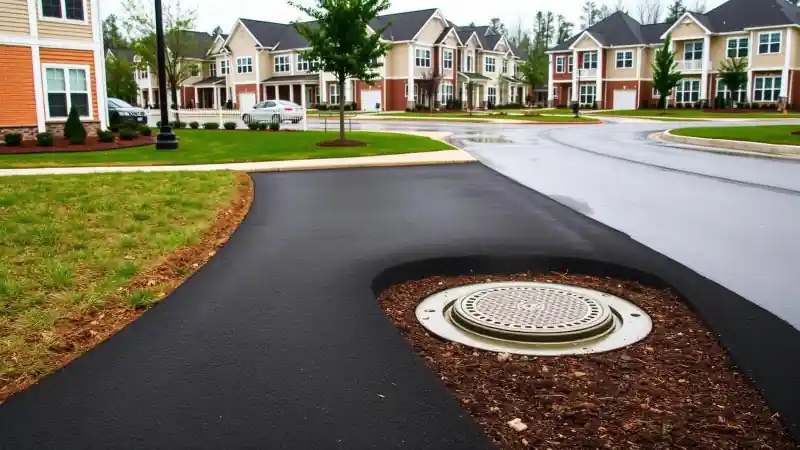
Re-grading, catch-basin work, trench drains, and surface-drainage corrections that stop ponding, undermining, and the freeze-thaw damage that follows. Avello uses drainage correction to turn a vague pavement worry into a defensible plan. You get a documented condition picture, a priority order that separates true safety exposure from cosmetic wear, and a multi-year spending outline you can hand to an owner, a board, or a finance director without further translation. On police stations, the conditions we are commonly asked to look at include Wear at cruiser-bay approaches, Failed pavement at sally port and evidence dock, Settled pavement around utility cuts, Faded striping in cruiser lineup areas, Drainage at the prisoner-transfer area and salt damage from heavy winter operations. We will look at the property, explain what we see, and separate what makes sense now from what can reasonably be planned for later.
A straightforward first conversation
Tell us what you are seeing, how the property operates, and what you are trying to accomplish. We will ask a few practical questions and explain the options in plain English. There is no pressure to decide on the first call.
How Avello scopes drainage correction on police stations
Every project runs the same sequence so nothing is guessed at. Typical timeline: 2–10 days depending on basin work and concrete cure time..
- Map water flow with a wet-weather walk or hose test
- Shoot grades to identify low spots and reverse slopes
- Engineer corrections: regrade, add basins, or install trench drains
- Excavate failed pavement and saturated base
- Install or rebuild structures; tie into existing storm system
- Re-base, pave, and re-establish positive slope (1.5% minimum)
- Wet-test the corrected area before closeout
- Written scope with quantities, materials, and a realistic budget range you can hand to ownership, a board, or a finance director
What you receive in writing
Documentation you can put in a board packet, a bid file, or a budget request — not a one-line verbal number.
- Drainage diagnosis with grade shots and photos
- Corrected grades verified after paving
- New or rebuilt catch basins and trench drains as scoped
- Tied-in connections to existing storm system
- Wet-test verification photos
- Workmanship warranty
- Photo-documented before-and-after record for your maintenance and liability file
- A prioritized follow-up plan showing what should be scheduled next season and roughly what it will cost
Access, phasing, and keeping the property open
Public facilities get phased around the calendar that actually governs them: school breaks, court and meeting schedules, election days, and emergency-response access. Avello typically splits a Police Stations site into halves or quadrants, keeps at least one entrance and a compliant accessible route open at all times, and holds a written contingency for apparatus or emergency vehicle access. Paving is scheduled when hot-mix plants are producing reliably, and striping follows only after the mat has cured enough to hold paint. Typical site size for this property type: Varies by site - Avello scopes on the walk.
Budget reality
Projects of this type usually land in the $15K - $250K typical, project-dependent range, depending on square footage, base condition, drainage work, and phasing requirements. You get a written range before anyone asks for a signature, so you can compare bids fairly and defend the number internally.
Compliance and liability
For police stations, the documentation that matters most is ADA Title III parking ratios, NY State accessibility code, Local site-plan and DOT permits and aDA-compliant stall count, access aisles, running slope, and cross slope verified against the finished grade — not just repainted where the old lines were. Those requirements go into the scope up front instead of surfacing mid-project.
Objections we hear — and straight answers
"Cannot close patrol bays" That is exactly why we lead with a written scope, a phasing plan, and a range instead of pressure. "Prevailing wage" That is exactly why we lead with a written scope, a phasing plan, and a range instead of pressure. "Sensitive security access" That is exactly why we lead with a written scope, a phasing plan, and a range instead of pressure. If the honest answer is that the pavement can be monitored for another season, we will put that in writing too.
Who this is a fit for
Avello brings municipal-scale planning and accountability to commercial, community, institutional, industrial, private-road, estate, and smaller-property paving work.
- Lots with persistent puddles after every rain
- Properties with ice patches forming in winter
- Buildings with water migrating toward foundations
- Loading docks pooling at the apron
- Municipal roads with edge erosion from poor drainage
Let’s talk about your project.
FAQ
Will the work shut down my property?+
Not necessarily. Every project is different. We will look at how your property operates and plan the work around access, traffic, residents, customers, employees, or other daily activity whenever the project allows.
How is your pricing different from a lower bid?+
The number at the bottom of a proposal does not always tell the whole story. Scope, preparation, materials, quantities, scheduling, and site conditions can all affect the final result. We will explain exactly what we are proposing so you can compare bids based on what is actually included.
Do you work directly with HOA boards and property managers?+
Yes. We can communicate directly with boards, property managers, and other decision-makers involved in the project and provide the information needed to evaluate the work.
What happens if weather delays the project?+
Weather can affect paving schedules. If conditions are not appropriate for the work, we will communicate with you and coordinate the schedule around suitable conditions.
Can you provide documentation for insurance or compliance records?+
We will discuss the documentation your project requires and provide the applicable project information and records available for the work being performed.