The lowest paving bid is only the lowest cost when it covers the right repair, adequate preparation, and a workable plan for keeping the property open. For Rhinebeck property managers, the useful comparison is not simply one contractor’s total against another’s. It is the cost of equivalent work, plus disruption, likely follow-up repairs, and unresolved site conditions. This guide explains how to assess pavement, compare realistic options, review exclusions, and plan construction around tenants and deliveries. It also includes a practical bid checklist and questions to resolve before signing.
Why the lowest paving bid isn't always the lowest cost for property managers in Rhinebeck
The lowest paving bid is not always the lowest cost because the bid price may cover less work, leave underlying problems untouched, or shift operating expenses back to the property. A lower number can be a good choice when the scope is complete and appropriate. The problem is choosing that number before checking what it actually buys.
For a Rhinebeck property manager, paving costs extend beyond asphalt and labor. Tenant access, delivery arrangements, temporary parking, restriping, and repeated visits all affect the project’s practical cost. Some expenses appear on the contractor’s invoice; others land in the management budget or take staff time.
Consider two proposals for the same parking area. One includes removal of damaged material, localized base repairs, adjustments at pavement transitions, and replacement markings. The other lists only an asphalt overlay. The second may be lower because it offers a different project, not because it delivers the same result more efficiently.
A useful comparison has three parts: the contracted work, the owner’s additional responsibilities, and the likely consequences of conditions left unresolved. You do not need to predict an exact service life to compare those parts. You do need each contractor to identify assumptions, exclusions, and the limits of the proposed repair.
At Avello, we approach commercial paving as a property decision, not just a surface purchase. The central question is whether the proposed work fits the pavement’s condition and the way the site operates. That keeps the conversation focused on value rather than the lowest opening number.
Read the pavement condition before comparing the proposals
Start with a joint site walk and a marked plan or aerial image. Identify the exact work limits, then separate surface wear from signs of movement below the asphalt. Faded pavement alone does not establish the need for replacement, and a smooth-looking area does not prove that the supporting layers are sound.
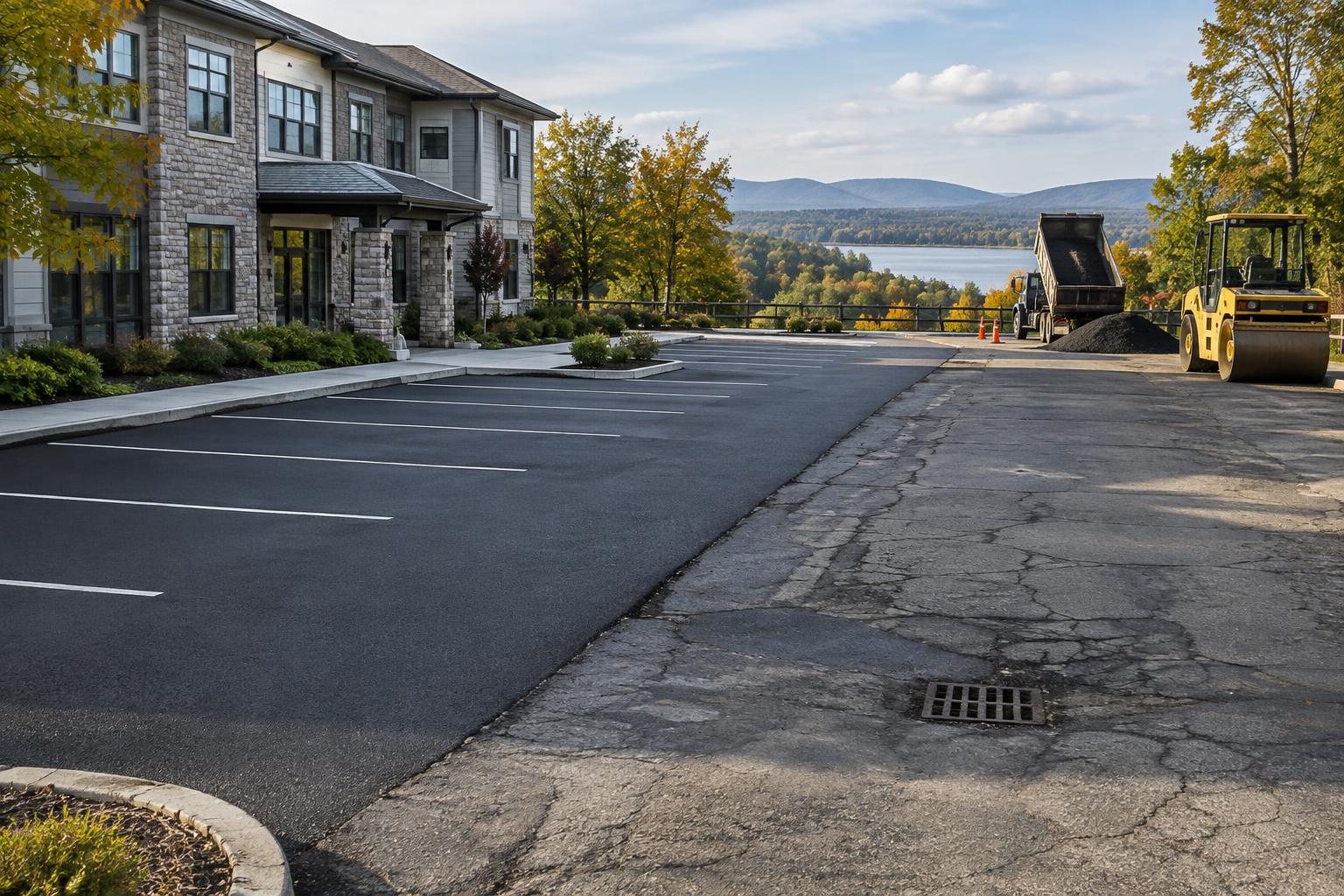
Look for loose aggregate, isolated cracks, potholes, wheel-path depressions, settled patches, and broken edges. Closely connected cracks that resemble a web can indicate that the pavement structure is struggling under loads. Record where those conditions occur rather than assigning one condition rating to the entire property.
- Whether distress is isolated or repeated across broad areas.
- Whether delivery routes and dumpster approaches look worse than parking stalls.
- Whether old patches have settled, cracked, or remained stable.
- Where water remains after rain and where runoff enters from uphill areas.
- Whether pavement edges have support or crumble into adjoining soil.
- How entrances, walkways, drains, and accessible parking connect to the pavement.
A visual review has limits. Cores—small samples cut through the pavement—can help establish existing asphalt thickness and layering. Test openings may be appropriate where the condition of the aggregate base, the stone layer beneath the asphalt, is uncertain. Ask what question each investigation will answer before authorizing it.
Share repair records, recurring puddle locations, and photographs from wet weather. A dry-day visit can miss seasonal movement or a runoff pattern familiar to maintenance staff. Giving each bidder the same information makes differences in their recommendations easier to understand.
Match the repair option to the problem, not the available budget alone
The least extensive appropriate repair often provides good value. Spending more does not automatically produce a better result, just as spending less does not automatically produce a poor one. The repair must address the actual defect, and the proposal should explain what it will leave in place.
- Crack treatment can help limit water entry through suitable individual cracks. It does not restore a weak base or correct settlement.
- Localized full-depth patching removes damaged asphalt in defined areas and addresses unsuitable supporting material where necessary. It fits isolated structural damage within otherwise serviceable pavement.
- An overlay adds a new asphalt layer over pavement that remains suitable to support it. Needed repairs and elevation checks should come first.
- Milling and resurfacing remove an upper layer before new asphalt is placed. Milling can preserve useful elevations at curbs, drains, and entrances, but it does not independently repair deeper weakness.
- Reconstruction removes and rebuilds the pavement structure where widespread damage or unsuitable support makes surface work a poor fit.
Mixed-condition properties may need a mixed scope. A delivery lane might require deeper repairs while parking stalls need only surface work. Pricing everything as reconstruction can overspend; pricing everything as an overlay can leave the heavily used area inadequately addressed.
A limited repair can also be a reasonable interim decision when redevelopment or utility work is planned. The distinction should be explicit: this work supports current use for an interim period rather than renewing the whole lot. Ask the contractor to describe its limitations without attaching an unsupported lifespan.
When contractors recommend different options, request the reasoning before comparing totals. The useful question is, “What condition makes this treatment appropriate here?” A clear answer connects the recommendation to observed pavement, traffic, elevations, and supporting layers.
Account for Rhinebeck weather and slopes in the base price
Hudson Valley freeze-thaw cycles make water management part of the paving decision. Water entering cracks or collecting in supporting materials can contribute to movement as temperatures change. A bid that renews the surface without considering that water may leave an important source of pavement distress untouched.
Spring thaw deserves particular attention when assessing soft spots and scheduling work. Support conditions can change as frozen ground thaws and moisture remains in the soil. If the assessment occurs during that period, ask whether further observation or testing is needed before finalizing repair depths.
April through November is the general paving season in the Hudson Valley, not a promise that every day within it is suitable. Air and surface temperatures, rain, ground conditions, mix requirements, and the thickness being placed affect scheduling. A sensible proposal allows weather-based adjustments instead of treating the calendar as the only acceptance test.
On a sloped Rhinebeck site, trace water from its uphill source to an appropriate outlet. Raising pavement in one place can change flow at a doorway, walkway, or neighboring boundary. The scope should identify necessary elevation checks and drainage adjustments, rather than relying on a general statement that the contractor will improve the grade.
Plowing and salt use also belong in the discussion. Raised transitions, unsupported edges, and projecting structures can be vulnerable to plow contact; snow-storage areas introduce concentrated meltwater. Salt use should be considered alongside freeze-thaw exposure and the care of nearby concrete and metal components, not treated as proof that asphalt replacement alone solves winter maintenance concerns.
Require a written scope that makes bids genuinely comparable
A useful scope lets an owner identify what will be built, where it will be built, and how additional work will be authorized. “Pave parking lot” is not enough. The drawing, written description, quantities, and exclusions should tell the same story.
- Measured work areas and boundaries, including entrances, repair zones, and excluded pavement.
- Removal or milling limits, handling of removed material, and disposal responsibilities.
- Base preparation, compaction, and the process for addressing unsuitable material uncovered during work.
- Asphalt mix, specified compacted thickness, and planned layers rather than an ambiguous loose-placement thickness.
- Surface preparation and bonding between layers, including tack coat where appropriate.
- Transitions at curbs, walkways, structures, and adjoining pavement.
- Drainage adjustments, pavement markings, accessible spaces and routes, and any related design responsibilities.
- Phasing, traffic controls, cleanup, reopening procedures, payment terms, and written change authorization.
Concealed conditions require a fair process, not a vague allowance for anything the crew encounters. Ask how additional excavation will be measured and priced, who approves it, and what documentation will accompany the request. Defined unit prices can help when quantities are uncertain, provided the included depth and material are clear.
Check permit responsibility before treating a proposal as complete. Depending on the property and scope, confirm requirements with the appropriate Town or Village of Rhinebeck building department and engineering staff where applicable. Work affecting a public-road entrance may also involve the agency responsible for that road.
Accessibility deserves its own review when pavement elevations or markings change. Repainting an existing layout does not establish that spaces, access aisles, and routes meet applicable requirements. Identify who checks the layout and grades, and whether professional design assistance belongs in the project budget.
Price the construction sequence and the cost of staying open
Two bids can describe similar pavement work but assume very different access conditions. One may assume an empty lot and a continuous operation. Another may include several work zones, protected pedestrian routes, and repeated equipment moves. Those differences should be visible before award.
- Confirm work limits, layout, required utility locating, access routes, and staging areas.
- Notify occupants and establish barriers, signs, temporary parking, and protected walking routes.
- Complete removal, drainage-related work, and base repairs within the designated phase.
- Inspect prepared areas and resolve documented additional work before covering them.
- Place and compact asphalt, finish transitions, and keep traffic off until the contractor approves reopening.
- Complete markings, review access and drainage, and move to the next phase or final closeout.
For a property near Route 9 or another busy Rhinebeck approach, staging should not assume that trucks can wait on the public roadway. Discuss on-site delivery movements and any traffic-control requirements with the responsible parties. Keep customer entry arrangements understandable from the approach, not just from inside the lot.
Smaller phases can preserve parking but may add mobilizations, joints, and management effort. A larger closure may simplify construction while requiring temporary parking or tenant coordination. Neither approach is automatically cheaper once the owner’s operating needs are included.
Confirm reopening by phase and vehicle type rather than assuming all traffic returns together. Conditions, the work performed, and contractor instructions govern the timing. Delivery trucks and turning movements at loading areas may need different arrangements from ordinary passenger parking.
Prepare the property and avoid common purchasing mistakes
Before requesting final bids, assemble one shared information package. Include a site plan, known repair history, utility work plans, operating hours, delivery schedules, and any lease restrictions affecting closures. Identify who can approve field decisions so crews are not waiting for an unavailable owner.
Prepare the site responsibilities as carefully as the contractor’s scope. Decide who moves vehicles, dumpsters, trailers, and other obstructions. Confirm access to private utility information and whether additional locating is needed beyond the applicable public utility notification process.
One common mistake is negotiating the total before resolving scope differences. Another is accepting a lower price after needed preparation disappears from the revision. Ask for a revised written scope whenever the price changes so the final agreement does not quietly become a different repair.
Equipment is another easy distraction. Commercial asphalt repair equipment matters when it suits the repair size, access, and compaction needs. A long equipment list is not a substitute for explaining how confined patches, edges, and larger paving areas will be prepared and compacted.
Finally, avoid comparing only the first invoice or assuming the most expensive proposal is automatically strongest. Check relevant commercial experience, insurance documentation, communication, and the completeness of the proposed method. A defensible purchasing decision combines price with evidence that the contractor understands this property.
Use a short bid checklist and document the final choice
Create a side-by-side comparison using the same categories for every bidder. Mark missing information as unresolved rather than assuming it is included. Ask contractors to clarify those gaps in writing, then compare the revised proposals.
- The repair recommendation matches documented pavement conditions.
- All proposals cover the same measured areas and required preparation.
- Thicknesses, materials, transitions, and drainage responsibilities are explicit.
- Access, phasing, markings, and owner responsibilities are priced or identified.
- Permits and accessibility review have assigned responsibility.
- Unforeseen work has a written pricing and approval process.
- The owner’s additional expenses are included in the comparison.
Your award recommendation can be brief: describe the selected treatment, explain material differences between bids, and identify remaining uncertainties. Record why the choice best fits the property’s operating needs. This gives ownership a clearer basis for approval than a statement that one contractor was cheapest.
The lowest complete, suitable bid may still be the right selection. The purpose of this process is not to justify spending more; it is to avoid purchasing less than the property needs without realizing it. Clear scope turns price competition into a useful comparison.
For commercial paving in Rhinebeck and Dutchess County, call Avello Asphalt & Construction at 845-454-3650 or request a free quote.
2026 Commercial Pavement Budget Planner
A contractor-built worksheet for budgeting parking lot and roadway work: cost ranges by scope, a condition-scoring sheet, phasing guidance, a bid-comparison checklist, and the questions to ask before you sign.
Common questions
How can I tell whether a paving bid is unusually low or simply competitive?+
Compare the work before judging the price. Check measured areas, preparation, compacted asphalt thickness, base repairs, transitions, markings, and traffic arrangements. Ask the lower bidder to explain exclusions and assumptions in writing. A competitive price can reflect efficient scheduling or a simpler construction approach. It becomes difficult to evaluate when essential items are missing or described too broadly to verify.
Should every contractor recommend the same repair for our parking lot?+
Not necessarily. Contractors may interpret visible conditions differently or propose different levels of intervention. Ask each to connect the recommendation to specific observations and explain what remains unresolved. If one recommends an overlay and another recommends reconstruction, further investigation may help establish whether the supporting layers are suitable. Compare alternatives only after understanding the condition assumptions behind them.
Can we keep a Rhinebeck commercial property open during paving?+
Often, some operations can continue through planned phases, but the layout determines what is practical. A single entrance or limited pedestrian access can constrain the plan. Discuss deliveries, accessible routes, customer parking, and service access before pricing is finalized. Ask for a phase drawing and reopening instructions. Keeping every stall available is generally not a realistic assumption during work.
What should happen if the crew uncovers soft material beneath the asphalt?+
The contract should establish a process before excavation begins. The contractor should document the condition, explain the proposed correction, and obtain authorization from the designated owner representative before additional work proceeds, subject to agreed site-protection arrangements. Pricing may use defined unit rates or a written change proposal. Ask how quantities are measured and how completed repairs will be documented.
Is an autumn paving bid a better value than a spring bid?+
The season alone does not establish value. Spring conditions may require attention to thawing ground, while autumn work must account for shorter suitable weather windows. Compare the actual scope, site readiness, access arrangements, and weather provisions. A lower seasonal price is useful only if the project can be completed under appropriate placement and compaction conditions without omitting needed preparation.
What should I ask a paving company about commercial asphalt services in Dutchess County?+
Ask how the company evaluates pavement condition, develops repair limits, coordinates occupied properties, and handles changes. Request a written description of materials, preparation, phasing, and exclusions. Discuss experience with comparable commercial access and traffic needs, without relying solely on equipment size or a low total. Also confirm who handles permit coordination, accessibility review, markings, and final project documentation.
Avello provides free commercial pavement assessments across the Hudson Valley. No obligation — you keep the documentation either way.