Loading dock aprons take concentrated punishment from slow-turning trucks, repeated braking, trailer landing gear, and water near depressed docks. In LaGrange, freeze-thaw cycles and spring-softened ground can make those stresses worse. A durable rebuild starts by separating surface wear from movement in the pavement’s supporting layers, then checking drainage and trailer geometry. This guide explains repair choices, asphalt and concrete considerations, dock-by-dock construction phasing, and the written details that help distribution center managers compare proposals and keep receiving and shipping organized.
Loading dock aprons at distribution centers in LaGrange: why they wear first and how to rebuild them
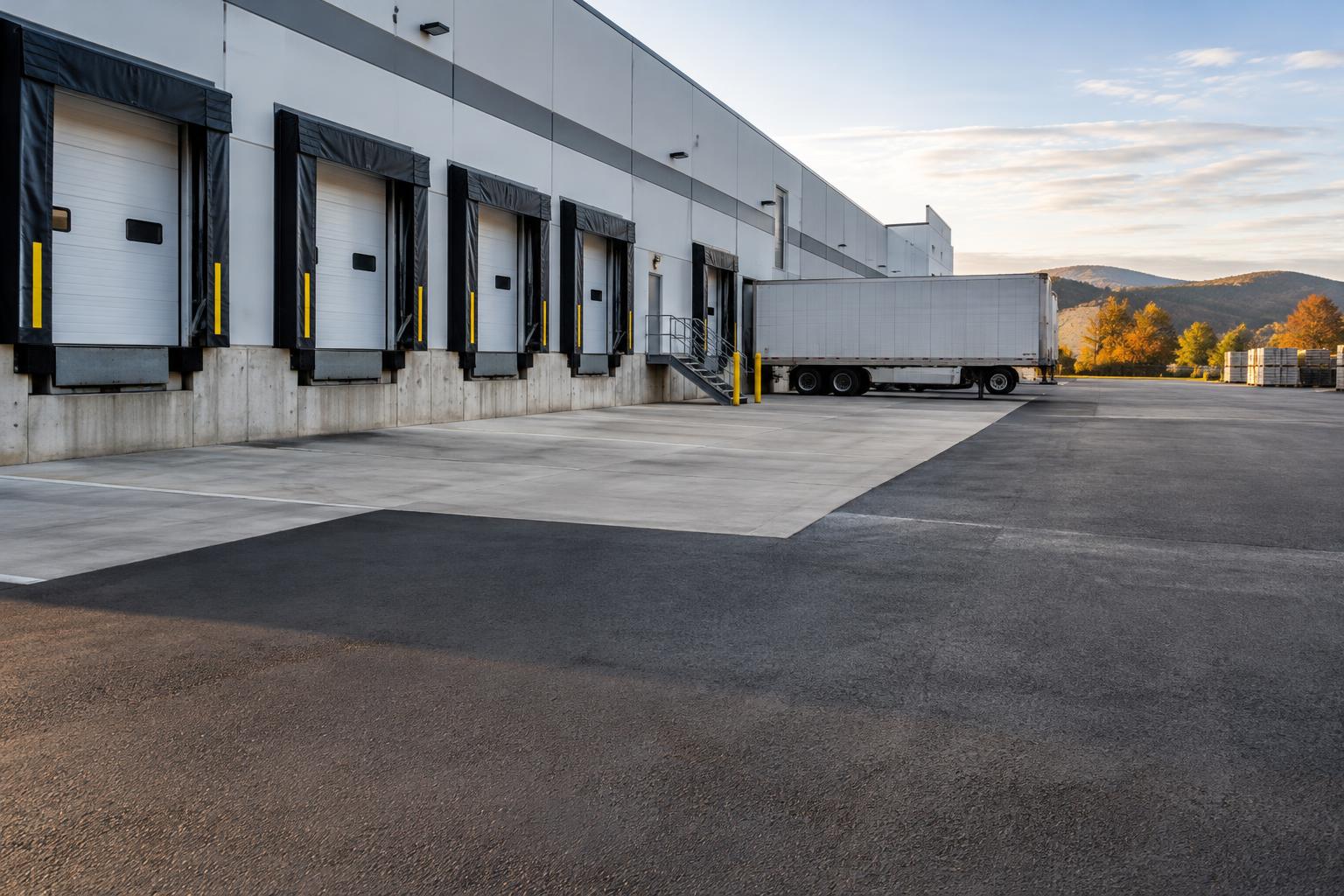
Loading dock aprons wear first because heavy loads repeatedly stop, turn, and stand in the same small area. Unlike a travel lane, an apron carries slow, twisting tire movements and concentrated pressure from parked equipment. Rebuilding it successfully means correcting the support and water conditions beneath those loads, not simply replacing the visible surface.
A tractor backing toward a door often follows nearly the same wheel path every time. Braking and steering push sideways against the asphalt, while trailer landing gear concentrates weight onto much smaller contact areas. When trailers are dropped, shallow indentations beneath those supports can become pockets that hold water.
Dock approaches also have constraints that ordinary yard pavement does not. Their elevations must work with dock levelers, trailer floors, drainage structures, and the slope needed for trucks to enter and leave. An apparently simple overlay can change those relationships enough to affect clearance or loading operations.
For a LaGrange distribution center, the practical starting point is a dock-by-dock assessment tied to actual operations. Identify where tractors turn, where trailers stand, which doors receive the heaviest use, and where water collects. From there, choose a localized repair, surface rehabilitation, or structural rebuild, with concrete considered where concentrated standing loads justify it.
Read the damage by wheel path, landing-gear position, and dock door
Inspect the apron when it is clear of trailers, then compare observations with photographs taken during normal use. Look after rainfall as well as in dry weather. Mark damage by door number so the investigation connects to dispatch records and maintenance history rather than becoming a general description of a rough truck yard.
- Shallow surface raveling: loose aggregate and a rough texture may indicate deterioration near the top, but do not establish that the base is sound.
- Ruts or shoved ridges: depressions and raised edges along tire paths suggest movement under repeated loads and turning.
- Landing-gear indentations: isolated depressions beneath trailer supports point to concentrated standing pressure.
- Interconnected cracks and settlement: a broken pattern with vertical movement can indicate insufficient support beneath the surface.
- Water or fine material coming through cracks: this can indicate water moving within the pavement structure under truck loading.
Condition assessment should go beyond appearance when movement is present. Pavement cores can show existing asphalt thickness and whether layers have separated. Test pits can expose the aggregate base and soil below it; the investigation should also check wet areas, drain connections, and buried utilities before excavation is planned.
A pavement professional may recommend checking exposed support under a controlled load to see whether it deflects. That observation helps identify unstable areas but does not replace engineering where ground conditions or loading warrant it. At Avello, we distinguish observed conditions from assumptions so the repair recommendation has a clear basis.
Match the repair to the depth of damage and the way trailers are handled
Localized full-depth patching fits isolated damaged areas surrounded by sound pavement. The work removes the affected pavement, corrects weak support where needed, and rebuilds the section. Patch limits should reach stable material rather than follow only the visible crack edges.
Milling and replacement can fit an apron with surface distortion or worn upper asphalt over reliable support. Milling removes a controlled depth before new asphalt is placed, helping preserve critical dock elevations. It is not a cure for saturated base material, continuing settlement, or deep movement under landing gear.
An overlay is appropriate only when the existing structure and elevations can accommodate it. At dock doors, added height deserves particular scrutiny because it changes the trailer approach. Where damage extends into the base or subgrade—the soil beneath the pavement—a full-depth rebuild is the more complete option.
Concrete may suit landing-gear support zones or heavily worked dock areas because it distributes concentrated loads through a rigid slab. It still needs adequate support, deliberate joint placement, and an appropriate structural design. Reinforcement, load transfer between slabs, curing, and reopening requirements belong in the design rather than being treated as interchangeable extras.
An asphalt yard with a concrete dock apron or support strip can also make sense. The transition between materials must account for movement, drainage, and tire traffic. Neither material eliminates the need to match the pavement section to truck movements, trailer storage practices, and site conditions.
Set apron grades around trailers, dock equipment, and Hudson Valley weather
Before selecting final elevations, survey the dock thresholds, existing approach, drain rims, and nearby yard pavement. Check the operating range of dock levelers and the trailer types using each door. The design must allow practical backing and loading without creating abrupt grade changes that compromise equipment clearance.
On a sloped LaGrange site, runoff may arrive from well beyond the apron. A sound plan follows that water from the upper yard to its intended discharge point. Depressed docks need particular attention because their low position can collect water near the building unless drains and connecting pipes work properly.
Hudson Valley freeze-thaw cycles amplify problems where water enters cracks or remains in susceptible supporting soils. Spring thaw can leave the support temporarily softer even when the surface looks dry. Investigations and construction plans should account for that seasonal difference rather than assume a summer inspection represents every condition.
Plow blades can catch raised joints, patch edges, and uneven drain frames. Salt exposure also matters when specifying concrete and protecting adjacent metal components. Snow storage should not block drainage or send meltwater back toward dock doors.
April through November is the usual paving planning window in the Hudson Valley, not a promise that every day is suitable. Rain, ground conditions, air and surface temperatures, and asphalt supply affect scheduling. Concrete work has its own temperature, curing, and protection requirements, especially near the ends of that window.
Rebuild in dock groups while protecting truck access and shipping capacity
Phasing begins with the operation, not the paving equipment. Determine how many doors the facility needs during each shift and which doors serve specialized functions. Refrigerated receiving, outbound staging, waste handling, and trailer storage may each limit which dock groups can close together.
- Assign alternate doors and trailer staging areas before closing the first work zone. Confirm that the revised route accommodates full truck turning movements.
- Install barriers and signs, establish pedestrian separation, and preserve required emergency access. Keep backing trucks away from workers and excavation edges.
- Sawcut or mill the defined limits, remove pavement, and inspect the exposed base. Document unexpected wet or unstable areas before proceeding.
- Repair support and drainage, establish grades, and compact the aggregate base. Verify elevations before covering work that will no longer be visible.
- Place the specified asphalt layers or concrete section. Complete joints, transitions, drain adjustments, and other details within that phase.
- Inspect and release the completed dock group under the agreed reopening criteria before shifting traffic and beginning the next group.
Some adjacent doors may need to close together because their backing paths overlap. A barrier that leaves a door physically reachable does not necessarily leave enough room to use it safely. Test the proposed routing with the transportation team before accepting the phase layout.
Build weather and unexpected excavation conditions into the operating plan. Have a defined holding location for arriving trailers and a clear dispatch contact for route changes. Keeping the property operating may mean reduced capacity for a period, not uninterrupted access to every door.
Seeing this on your property?
Avello walks the lot, scores the pavement, and gives you written findings — free, no obligation.
Put measurable construction details and decision points in the written scope
A useful proposal describes what will be built and what happens if concealed conditions differ from expectations. A single line for dock paving leaves too much unresolved. Managers should be able to compare bids against the same repair boundaries, materials, elevations, and operating constraints.
- A marked plan showing door numbers, repair limits, construction joints, transitions, drain work, and each closure phase.
- Removal depths and the proposed pavement section, including compacted asphalt thicknesses, aggregate requirements, or concrete design details as applicable.
- Procedures for evaluating exposed support, documenting unsuitable material, authorizing additional excavation, and measuring that work.
- Survey controls and finished elevations tied to dock equipment, drainage structures, existing pavement, and building interfaces.
- Placement, compaction, curing, inspection, and testing requirements appropriate to the chosen pavement system.
- Responsibility for utility coordination, permits, barriers, temporary routing, debris removal, markings, and final cleanup.
- Reopening criteria, weather contingencies, change authorization, and closeout documentation.
Avoid accepting a pavement thickness merely because it appears in another facility’s proposal. The suitable section depends on support conditions, truck use, standing loads, and the selected materials. Where engineering is needed, identify who provides it and which design documents govern construction.
For work in LaGrange, confirm applicable approvals with the Town of LaGrange building or engineering department, as appropriate. Drainage changes, work near buildings, or connections beyond the property may require additional coordination. The scope should name the party handling those questions instead of assuming all pavement work is exempt.
Prepare operations records, equipment access, and a short owner checklist
The owner’s most useful contribution is an accurate picture of how the docks operate. Provide typical trailer types, loaded versus empty storage practices, landing-gear locations, and busy receiving windows. Include expected operational changes, such as more dropped trailers or a shift toward heavier loads.
Collect available pavement records, utility drawings, drainage information, and previous repair photographs. Identify private services that may not be covered by a standard public utility markout. Report buried electrical feeds, dock equipment connections, and any known drains or pipes beneath the apron.
Coordinate dock equipment maintenance before setting the paving schedule. A leveler adjustment or drain repair discovered afterward can require reopening completed work. Also identify who can approve concealed-condition changes promptly, so excavation does not remain open while responsibility is sorted out.
- Assign one facilities contact and one dispatch contact.
- Clear trailers, stored materials, and movable equipment from each phase.
- Confirm alternate doors and off-apron trailer holding areas.
- Share utility records and arrange access for investigation.
- Notify carriers, yard drivers, maintenance staff, and affected tenants.
- Agree on inspection, change approval, and reopening procedures.
Before mobilization, walk the proposed traffic route with the contractor and yard team. Check backing space, pedestrian crossings, trailer swing, and access to fire protection equipment. A route that works on a marked plan can still conflict with a parked trailer or a normal staging habit.
Avoid repair shortcuts that leave the dock’s original problem in place
One common mistake is treating every depression as a surface defect. If the support moves under trucks, placing new asphalt over it does not resolve that movement. Another is choosing a patch boundary for convenience while leaving cracked or softened material immediately beside the repair.
Raising the apron without checking dock geometry can create a different operational problem. The new surface may change trailer pitch, interfere with clearances, or leave a drain too high to collect water. Finished elevations deserve the same attention as material selection.
Concrete support strips are sometimes located around where one trailer happened to be parked. Actual landing-gear positions vary with equipment and parking alignment. Their layout should reflect the facility’s fleet and practices, with transitions and slab edges kept out of unsuitable load positions where practical.
Another mistake is treating a surface that looks finished as ready for unrestricted use. Fresh asphalt can be vulnerable to tight steering and concentrated standing loads; concrete needs specified strength development before loading. Reopening decisions should distinguish through traffic, backing maneuvers, and dropped trailers.
Finally, avoid planning phases without dispatch involvement. A construction sequence that repeatedly reroutes trailers across active work can undermine both productivity and separation. Clear door assignments and agreed handoffs are usually more useful than a schedule built solely around completing the largest possible paving area at once.
Verify the finished apron before returning every door to service
Closeout should confirm both construction quality and dock usability. Review the completed limits, material records, inspection results, and any approved changes to the original section. Keep photographs of exposed support and drainage repairs because those details will be hidden after completion.
Check transitions for abrupt edges and confirm that drain frames sit correctly relative to the pavement. Verify runoff direction through observation or an appropriate water check, recognizing that a limited test does not reproduce every storm. Include joints and building interfaces in the final walkthrough.
Before full reopening, have operations confirm the intended trailer approach and dock equipment relationship. This is not a reason to load pavement before its release criteria are met. It is a coordinated check that the rebuilt surface supports the activities described during planning.
Record any temporary restrictions on trailer parking, sharp turning, or concentrated supports. Give those instructions to yard drivers and carriers, not only the facilities office. After the apron returns to use, note persistent puddles, joint movement, or unexpected tire marks by door number so observations remain specific.
We approach loading-dock paving as a working interface between the building and the truck yard. For LaGrange distribution centers, that means tying surface repairs to support conditions, trailer movements, drainage, and realistic closures. The goal is a rebuild that fits the operation rather than asking the operation to work around avoidable pavement details.
2026 Commercial Pavement Budget Planner
A contractor-built worksheet for budgeting parking lot and roadway work: cost ranges by scope, a condition-scoring sheet, phasing guidance, a bid-comparison checklist, and the questions to ask before you sign.
Common questions
Should we rebuild only the damaged dock apron or the whole truck yard?+
The apron can often be addressed separately if the surrounding yard has sound support and compatible elevations. The repair boundary should follow pavement condition and truck movements, not an arbitrary distance from the building. Include enough area to make stable transitions and correct relevant drainage. If investigation shows that weak support or settlement extends into the yard, broader reconstruction may be appropriate.
Is concrete always better than asphalt in front of loading docks?+
No. Concrete can be a good fit for concentrated standing loads and heavily worked dock positions, but its performance depends on support, slab design, joints, and curing. Asphalt can remain appropriate for approaches and other areas when properly designed for their use. Some facilities benefit from a combination. The decision should consider trailer handling, construction access, reopening constraints, and the condition beneath the existing pavement.
How long will individual dock doors need to stay closed?+
Closure duration depends on excavation depth, support repairs, drainage work, material choice, and weather. Asphalt reopening depends partly on cooling and the intended loading, while concrete reopening should follow specified strength requirements. Dropped trailers may require different restrictions than moving vehicles. A useful schedule separates construction time from the period before loading is allowed and identifies what happens if concealed conditions extend a phase.
Can we pave over an apron that has landing-gear dents?+
Only after determining why the dents formed and whether the existing pavement can support the proposed repair. Filling or overlaying depressions may restore the profile without addressing concentrated pressure or weak underlying material. Check the support locations, pavement section, and drainage first. A full-depth repair or a designed concrete support area may be more suitable, with its layout based on the trailers actually used.
What should a paving company inspect before quoting commercial loading-dock work?+
A paving company should inspect damage patterns, trailer movements, standing-load locations, dock elevations, drainage, and construction access. The assessment should identify whether cores, test pits, or engineering are needed to establish the repair section. For commercial paving services at an operating distribution center, the quote should also address door closures, temporary truck routes, concealed-condition decisions, and reopening criteria rather than describe only surface area.
Who can help us plan loading-dock paving in LaGrange?+
Avello Asphalt & Construction serves commercial and municipal properties in the Hudson Valley, with Dutchess County first, from 141 Daley Road, Poughkeepsie, NY. We can discuss the apron’s condition, loading patterns, repair options, and operating constraints, with engineering or permitting coordination identified where needed. To discuss loading-dock paving in LaGrange, call Avello at 845-454-3650 or request a free quote.
Avello provides free commercial pavement assessments across the Hudson Valley. No obligation — you keep the documentation either way.